It was my pleasure this week to participate in a panel discussion about the future of innovation policy at the James Madison Institute’s 2022 Tech and Innovation Summit in Coral Gables, FL. Our conversation focused on the future of Progress Studies, which is one of my favorite topics. We were asked to discuss five major questions and below I have summarized some of my answers to them, plus some other thoughts I had about what I heard at the conference from others.
What is progress studies and why is it so needed today?
In a sense, Progress Studies is nothing new. Progress studies goes back at least to the days of Adam Smith and plenty of important scholars have been thinking about it ever since. Those scholars and policy advocates have long been engaged in trying to figure out what’s the secret sauce that powers economic growth and human prosperity. It’s just that we didn’t call that Progress Studies in the old days.
The reason Progress Studies is important is because technological innovation has been shown to be the fundamental driver in improvements in human well-being over time. When we can move the needle on progress, it helps individuals extend and improve their lives, incomes, and happiness. By extension, progress helps us live lives of our choosing. As Hans Rosling brilliantly argued, the goal of expanding innovation opportunities and raising incomes “is not just bigger piles of money” or more leisure time. “The ultimate goal is to have the freedom to do what we want.” Continue reading →
Profectus is an excellent new online magazine featuring essays and interviews on the intersection of academic literature, public policy, civilizational progress, and human flourishing. The Spring 2022 edition of the magazine features a “Progress Roundtable” in which six different scholars were asked to contribute their thoughts on three general questions:
What is progress?
What are the most significant barriers holding back further progress?
If those challenges can be overcome, what does the world look like in 50 years?
I was honored to be asked by Clay Routledge to contribute answers to those questions alongside others, including: Steven Pinker (Harvard University), Jason Crawford (Roots of Progress), Matt Clancy (Institute for Progress), Marian Tupy (HumanProgress.org), James Pethokoukis (AEI). I encourage you to jump over the roundtable and read all their excellent responses. I’ve included my answers down below:
[This is a draft of a section of a forthcoming study on “A Flexible Governance Framework for Artificial Intelligence,” which I hope to complete shortly. I welcome feedback. I have also cross-posted this essay at Medium.]
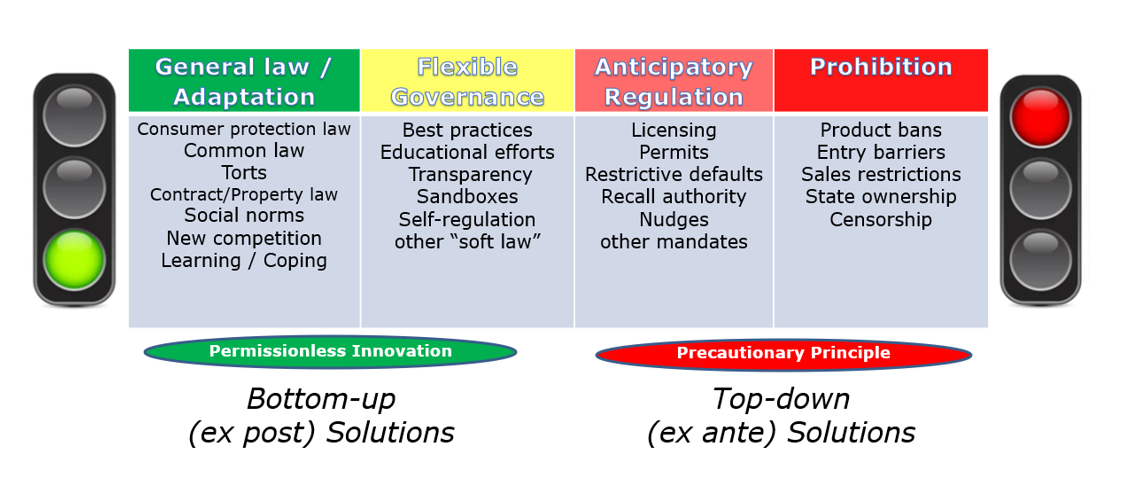
Debates about how to embed ethics and best practices into AI product design is where the question of public policy defaults becomes important. To the extent AI design becomes the subject of legal or regulatory decision-making, a choice must be made between two general approaches: the precautionary principle or the proactionary principle.[1] While there are many hybrid governance approaches in between these two poles, the crucial issue is whether the initial legal default for AI technologies will be set closer to the red light of the precautionary principle (i.e., permissioned innovation) or to the green light of the proactionary principle (i.e., (permissionless innovation). Each governance default will be discussed.
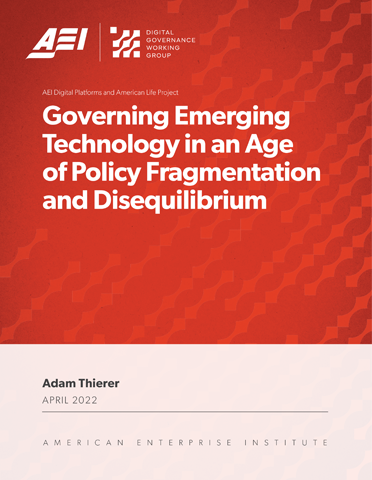
The American Enterprise Institute (AEI) has kicked off a new project called “Digital Platforms and American Life,” which will bring together a variety of scholars to answer the question: How should policymakers think about the digital platforms that have become embedded in our social and civic life? The series, which is being edited by AEI Senior Fellow Adam J. White, highlights how the democratization of knowledge and influence in the Internet age comes with incredible opportunities but also immense challenges. The contributors to this series will approach these issues from various perspectives and also address different aspects of policy as it pertains to the future of technological governance.
It is my honor to have the lead paper in this new series. My 19-page essay is entitled, Governing Emerging Technology in an Age of Policy Fragmentation and Disequilibrium, and it represents my effort to concisely tie together all my writing over the past 30 years on governance trends for the Internet and related technologies. The key takeaways from my essay are:
Traditional governance mechanisms are being strained by modern technological and political realities. Newer technologies, especially digital ones, are developing at an ever-faster rate and building on top of each other, blurring lines between sectors.
Congress has failed to keep up with the quickening pace of technological change. It also continues to delegate most of its constitutional authority to agencies to deal with most policy concerns. But agencies are overwhelmed too. This situation is unlikely to change, creating a governance gap.
Decentralized governance techniques are filling the gap. Soft law—informal, iterative, experimental, and collaborative solutions—represents the new normal for technological governance. This is particularly true for information sectors, including social media platforms, for which the First Amendment acts as a major constraint on formal regulation anyway.
No one-size-fits-all tool can address the many governance issues related to fast-paced science and technology developments; therefore, decentralized governance mechanisms may be better suited to address newer policy concerns.
My arguments will frustrate many people of varying political dispositions because I adopt a highly pragmatic approach to technological governance. Continue reading →
As I note in my latest regular column for The Hill, it seems like everyone these days is talking about the importance of America “building again.” For example, take a look at this compendium of essays I put together where scholars and pundits have been making the case for “building again” in various ways and contexts. It would seem that the phrase is on everyone’s lips. “These calls include many priorities,” I note, “but what unifies them is the belief that the nation needs to develop new innovations and industries to improve worker opportunities, economic growth and U.S. global competitive standing.”
What I fear, however, is that “building again” has become more of a convenient catch line than anything else. It seems like few people are willing to spell out exactly what it will take to get that started. My new column suggests that the most important place to start is “to cut back the thicket of red tape and stifling bureaucratic procedures that limit the productiveness of the American workforce.” I cite recent reports and data documenting the enormous burden that regulatory accumulation imposes on American innovators and workers. I then discuss how to get reforms started at all levels of government to get the problem under control and help us start building again in earnest. Jump over to
The Hill to read the entire essay.
Almost every argument against technological innovation and progress that we hear today was identified and debunked by Samuel C. Florman a half century ago. Few others since him have mounted a more powerful case for the importance of innovation to human flourishing than Florman did throughout his lifetime.
Chances are you’ve never heard of him, however. As prolific as he was, Florman did not command as much attention as the endless parade of tech critics whose apocalyptic predictions grabbed all the headlines. An engineer by training, Florman became concerned about the growing criticism of his profession throughout the 1960s and 70s. He pushed back against that impulse in a series of books over the next two decades, including most notably:
The Existential Pleasures of Engineering (1976), Blaming Technology: The Irrational Search for Scapegoats (1981), and The Civilized Engineer (1987). He was also a prolific essayist, penning hundreds of articles for a wide variety of journals, magazines, and newspapers beginning in 1959. He was also a regular columnist for MIT Technology Review for sixteen years.
Florman’s primary mission in his books and many of those essays was to defend the engineering profession against attacks emanating from various corners. More broadly, as he noted in a short autobiography on his personal website, Florman was interested in discussing, “the relationship of technology to the general culture.”
Florman could be considered a “rational optimist,” to borrow Matt Ridley’s notable term[1] for those of us who believe, as I have summarized elsewhere, that there is a symbiotic relationship between innovation, economic growth, pluralism, and human betterment.[2] Rational optimists are highly pragmatic and base their optimism on facts and historical analysis, not on dogmatism or blind faith in any particular viewpoint, ideology, or gut feeling. But they are unified in the belief that technological change is a crucial component of moving the needle on progress and prosperity.
Florman’s unique contribution to advancing rational optimism came in the way he itemized the various claims made by tech critics and then powerfully debunked each one of them. Continue reading →
Gabrielle Bauer, a Toronto-based medical writer, has just published one of the most concise explanations of what’s wrong with the precautionary principle that I have ever read. The precautionary principle, you will recall, generally refers to public policies that limit or even prohibit trial-and-error experimentation and risk-taking. Innovations are restricted until their creators can prove that they will not cause any harms or disruptions. In an essay for The New Atlantis entitled, “Danger: Caution Ahead,” Bauer uses the world’s recent experiences with COVID lockdowns as the backdrop for how society can sometimes take extreme caution too far, and create more serious dangers in the process. “The phrase ‘abundance of caution’ captures the precautionary principle in a more literary way,” Bauer notes. Indeed, another way to look at it is through the prism of the old saying, “better to be safe than sorry.” The problem, she correctly observes, is that, “extreme caution comes at a cost.” This is exactly right and it points to the profound trade-offs associated with precautionary principle thinking in practice.
In my own writing about the problems associated with the precautionary principle (see list of essays at bottom), I often like to paraphrase an ancient nugget of wisdom from St. Thomas Aquinas, who once noted in his
Summa Theologica that, if the highest aim of a captain were merely to preserve their ship, then they would simply keep it in port forever. Of course, that is not the only goal of a captain has. The safety of the vessel and the crew is essential, of course, but captains brave the high seas because there are good reasons to take such risks. Most obviously, it might be how they make their living. But historically, captains have also taken to the seas as pioneering explorers, researchers, or even just thrill-seekers.
This was equally true when humans first decided to take to the air in balloons, blimps, airplanes, and rockets. A strict application of the precautionary principle would have instead told us we should keep our feet on the ground. Better to be safe than sorry! Thankfully, many brave souls ignored that advice and took the heavens in the spirit of exploration and adventure. As Wilbur Wright once famously said, “If you are looking for perfect safety, you would do well to sit on a fence and watch the birds.” Needless to say, humans would have never mastered the skies if the Wright brothers (and many others) had not gotten off the fence and taken the risks they did. Continue reading →
This is a compendium of readings on “progress studies,” or essays and books which generally make the case for technological innovation, dynamism, economic growth, and abundance. I will update this list as additional material of relevance is brought to my attention.
Discourse magazine has just published my review of Where Is My Flying Car?, by J. Storrs Hall, which I argue is the most important book on technology policy written in the past quarter century. Hall perfectly defines what is at stake if we fail to embrace a pro-progress policy vision going forward. Hall documents how a “Jetsons” future was within our grasp, but it was stolen away from us. What held back progress in key sectors like transportation, nanotech & energy was anti-technological thinking and the overregulation that accompanies it. “[T]he Great Stagnation was really the Great Strangulation,” he argues. The culprits: negative cultural attitudes toward innovation, incumbent companies or academics looking to protect their turf, litigation-happy trial lawyers, and a raft of risk-averse laws and regulations.
Hall coins the term “the Machiavelli Effect” to identify why many people simultaneously fear the new and different, and they also want to protect whatever status quo they benefit from (or at least feel comfortable with). He builds on this passage from Niccolò Machiavelli’s classic 1532 study of political power, “The Prince”: Continue reading →
I was speaking at a conference recently and discussing my life’s work, which for 30 years has been focused on the importance of innovation and intellectual battles over what we mean progress. I put together up a short list of some things I have written over the last few years on this topic and thought I would just re-post them here. I will try to keep this regularly updated, at least for a few years.
The Technology Liberation Front is the tech policy blog dedicated to keeping politicians' hands off the 'net and everything else related to technology. Learn more about TLF →



 Discourse magazine has just published
  The Technology Liberation Front is the tech policy blog dedicated to keeping politicians' hands off the 'net and everything else related to technology.