This week, the Trump Administration proposed a new policy framework for artificial intelligence (AI) technologies that attempts to balance the need for continued innovation with a set of principles to address concerns about new AI services and applications. This represents an important moment in the history of emerging technology governance as it creates a policy vision for AI that is generally consistent with earlier innovation governance frameworks established by previous administrations.
Generally speaking, the Trump governance vision for AI encourages regulatory humility and patience in the face of an uncertain technological future. However, the framework also endorses a combination of “hard” and “soft” law mechanisms to address policy concerns that have already been raised about developing or predicted AI innovations.
AI promises to revolutionize almost every sector of the economy and can potentially benefit our lives in numerous ways. But AI applications also raise a number of policy concerns, specifically regarding safety or fairness. On the safety front, for example, some are concerned about the AI systems that control drones, driverless cars, robots, and other autonomous systems. When it comes to fairness considerations, critics worry about “bias” in algorithmic systems that could deny people jobs, loans, or health care, among other things.
These concerns deserve serious consideration and some level of policy guidance or else the public may never come to trust AI systems, especially if the worst of those fears materialize as AI technologies spread. But
how policy is formulated and imposed matters profoundly. A heavy-handed, top-down regulatory regime could undermine AI’s potential to improve lives and strengthen the economy. Accordingly, a flexible governance framework is needed and the administration’s new guidelines for AI regulation do a reasonably good job striking that balance. Continue reading →
What are we to make of this peculiar new term “permissionless innovation,” which has gained increasing currency in modern technology policy discussions? And how much relevance has this notion had—or
should it have—on those conversations about the governance of emerging technologies? That’s what I’d like to discuss here today.
Uncertain Origins, Unclear Definitions
I should begin by noting that while I have written a book with the term in the title, I take no credit for coining the phrase “permissionless innovation,” nor have I been able to determine who the first person was to use the term. The phrase is sometimes attributed to Grace M. Hopper, a computer scientist who was a rear admiral in the United States Navy. She once famously noted that, “It’s easier to ask forgiveness than it is to get permission.”
“Hopper’s Law,” as it has come to be known in engineering circles, is probably the most concise articulation of the general notion of “permissionless innovation” that I’ve ever heard, but Hopper does not appear to have ever used the actual phrase anywhere. Moreover, Hopper was not
necessarily applying this notion to the realm of technological governance, but was seemingly speaking more generically about the benefit of trying new things without asking for the blessing of any number of unnamed authorities or overseers—which could include businesses, bosses, teachers, or perhaps even government officials. Continue reading →
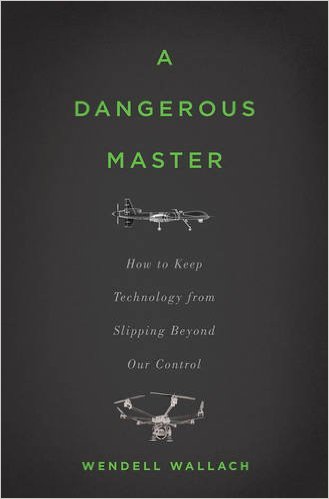
On May 3rd, I’m excited to be participating in a discussion with Yale University bioethicist Wendell Wallach at the Microsoft Innovation & Policy Center in Washington, DC. (RSVP here.) Wallach and I will be discussing issues we write about in our new books, both of which focus on possible governance models for emerging technologies and the question of how much preemptive control society should exercise over new innovations.
Of all the books of technological criticism or skepticism that I’ve read in recent years—and I have read stacks of them!—
A Dangerous Master is by far the most thoughtful and interesting. I have grown accustomed to major works of technological criticism being caustic, angry affairs. Most of them are just dripping with dystopian dread and a sense of utter exasperation and outright disgust at the pace of modern technological change.
Although he is certainly concerned about a wide variety of modern technologies—drones, robotics, nanotech, and more—Wallach isn’t a purveyor of the politics of panic. There are some moments in the book when he resorts to some hyperbolic rhetoric, such as when he frets about an impending “techstorm” and the potential, as the book’s title suggests, for technology to become a “dangerous master” of humanity. For the most part, however, his approach is deeper and more dispassionate than what is found in the leading tracts of other modern techno-critics.
I recently finishedLearning by Doing: The Real Connection between Innovation, Wages, and Wealth, by James Bessen of the Boston University Law School. It’s a good book to check out if you are worried about whether workers will be able to weather this latest wave of technological innovation. One of the key insights of Bessen’s book is that, as with previous periods of turbulent technological change, today’s workers and businesses will obviously need find ways to adapt to rapidly-changing marketplace realities brought on by the Information Revolution, robotics, and automated systems.
That sort of adaptation takes time, but for technological revolutions to take hold and have meaningful impact on economic growth and worker conditions, it requires that large numbers of ordinary workers acquire new knowledge and skills, Bessen notes. But, “that is a slow and difficult process, and history suggests that it often requires social changes supported by accommodating institutions and culture.” (p 223) That is not a reason to resist disruptive forms of technological change, however. To the contrary, Bessen says, it is crucial to allow ongoing trial-and-error experimentation and innovation to continue precisely because it represents a learning process which helps people (and workers in particular) adapt to changing circumstances and acquire new skills to deal with them. That, in a nutshell, is “learning by doing.” As he elaborates elsewhere in the book:
Major new technologies become ‘revolutionary’ only after a long process of learning by doing and incremental improvement. Having the breakthrough idea is not enough. But learning through experience and experimentation is expensive and slow. Experimentation involves a search for productive techniques: testing and eliminating bad techniques in order to find good ones. This means that workers and equipment typically operate for extended periods at low levels of productivity using poor techniques and are able to eliminate those poor practices only when they find something better. (p. 50)
Luckily, however, history also suggests that, time and time again, that process has happened and the standard of living for workers and average citizens alike improved at the same time. Continue reading →
I spend a lot of time reading books and essays about technology; more specifically, books and essays about technology history and criticism. Yet, I am often struck by how few of the authors of these works even bother defining what they mean by “technology.” I find that frustrating because, if you are going to make an attempt to either study or critique a particular technology or technological practice or development, then you probably should take the time to tell us how broadly or narrowly you are defining the term “technology” or “technological process.”
Of course, it’s not easy. “In fact, technology is a word we use all of the time, and ordinarily it seems to work well enough as a shorthand, catch-all sort of word,” notes the always-insightful Michael Sacasas in his essay “Traditions of Technological Criticism.” “That same sometimes useful quality, however, makes it inadequate and counter-productive in situations that call for more precise terminology,” he says.
Quite right, and for a more detailed and critical discussion of how earlier scholars, historians, and intellectuals have defined or thought about the term “technology,” you’ll want to check out Michael’s other recent essay, “What Are We Talking About When We Talk About Technology?” which preceded the one cited above. We don’t always agree on things — in fact, I am quite certain that most of my comparatively amateurish work must make his blood boil at times! — but you won’t find a more thoughtful technology scholar alive today than Michael Sacasas. If you’re serious about studying technology history and criticism, you should follow his blog and check out his book, The Tourist and The Pilgrim: Essays on Life and Technology in the Digital Age, which is a collection of some of his finest essays.
Anyway, for what it’s worth, I figured I would create this post to list some of the more interesting definitions of “technology” that I have uncovered in my own research. I suspect I will add to it in coming months and years, so please feel free to suggest other additions since I would like this to be a useful resource to others. Continue reading →
What follows is a response to Michael Sacasas, who recently posted an interesting short essay on his blog The Frailest Thing, entitled, “10 Points of Unsolicited Advice for Tech Writers.” As with everything Michael writes, it is very much worth reading and offers a great deal of useful advice about how to be a more thoughtful tech writer. Even though I occasionally find myself disagreeing with Michael’s perspectives, I always learn a great deal from his writing and appreciate the tone and approach he uses in all his work. Anyway, you’ll need to bounce over to his site and read his essay first before my response will make sense.
Michael:
Lots of good advice here. I think tech scholars and pundits of all dispositions would be wise to follow your recommendations. But let me offer some friendly pushback on points #2 & #10, because I spend much of my time thinking and writing about those very things.
In those two recommendations you say that those who write about technology “[should] not cite apparent historical parallels to contemporary concerns about technology as if they invalidated those concerns. That people before us experienced similar problems does not mean that they magically cease being problems today.” And you also warn “That people eventually acclimate to changes precipitated by the advent of a new technology does not prove that the changes were inconsequential or benign.”
I think these two recommendations are born of a certain frustration with the tenor of much modern technology writing; the sort of Pollyanna-ish writing that too casually dismisses legitimate concerns about the technological disruptions and usually ends with the insulting phrase, “just get over it.” Such writing and punditry is rarely helpful, and you and others have rightly pointed out the deficiencies in that approach.
That being said, I believe it would be highly unfortunate to dismiss any inquiry into the nature of individual and societal acclimation to technological change. Because adaptation obviously does happen! Certainly there must be much we can learn from it. In particular, what I hope to better understand is the process by which we humans have again and again figured out how to assimilate new technologies into their lives despite how much those technologies “unsettled” well-established personal, social, cultural, and legal norms. Continue reading →
[UPDATE 4/30/13: This article was subsequently published in Volume 65, Issues 2 of the Federal Communications Law Journal in April 2013. The links below now point to the final FCLJ version.]
The Mercatus Center at George Mason University has just released a new paper by Brent Skorup and me entitled, “Uncreative Destruction: The War on Vertical Integration in the Information Economy.” Brent, who is the research director for the Information Economy Project at the George Mason University School of Law, and I have been working on this paper since the Spring and we are looking forward to getting it published in a law review shortly. The paper focuses on Tim Wu’s “separations principle” for the digital economy, something I’ve spent some time critiquing here in the past. Here’s the introduction from the 44-page paper that Brent and I just released:
Are information sectors sufficiently different from other sectors of the economy such that more stringent antitrust standards should be applied to them preemptively? Columbia Law School professor Tim Wu responds in the affirmative in his book The Master Switch: The Rise and Fall of Information Empires. Having successfully pushed net-neutrality regulation into the policy spotlight, Wu has turned his attention to what he regards as excessive market concentration and threats to free speech throughout the entire information economy.To support his call for increased antitrust intervention, Wu explains his view of competition in the information economy—a view that deviates substantially from current mainstream antitrust theory.
Continue reading →
In this new Money Morning article, “The Antitrust Curse: What Apple Can Learn From Microsoft, IBM,” David Zeiler wonders whether the antitrust lawsuit filed against Apple and several book publishers by the U.S. Department of Justice last week could open the door to a broader case against Apple or, at a minimum, simply become a major distraction to the firm and it’s ability to innovate going forward. He uses IBM and Microsoft as case studies in this regard and notes that, “the problem with being in the DOJ’s gunsight is that it distracts management, makes the company hesitant to innovate, and blemishes the company’s public image. While antitrust woes may not have been entirely responsible for Microsoft and IBM ceding their dominant positions in tech, they were clearly a major factor,” he says. “And worse for Apple, the e-book case could be just the beginning.”
Even if Apple beats back [the eBooks] investigation, broader questions are being raised about the company’s power that could invite a much broader investigation. The danger for Apple is that antitrust becomes an omnipresent threat that must be factored into all ongoing business decisions. Antitrust is a particular danger to Apple because the firm is highly vertically integrated and that integration is the source of many of their innovations. As earlier tech titans like IBM and Microsoft learned, when antitrust hangs like the Sword of Damocles, every decision about how to evolve and innovate becomes a calculated gamble.
Regarding the earlier impact that antitrust Sword of Damocles had on Microsoft, Zeiler unearthed this terrific 2005 quote from Mark Kroese, a general manager of information services at the Microsoft Network, who described the impact of the MS antitrust case on innovation at the firm as follows: “Working at Microsoft today vs. five years ago is different,” Kroese said. “If anyone thinks the antitrust case hasn’t slowed us down, you’re wrong. If I want to meet with a products manager for Windows, there needs to be three lawyers in the room. We have to be so careful, we err on the side of caution. We are on such a fine line of conduct.” Regarding how antitrust chilled IBM, Zeiler cites veteran tech journalist Steve Wildstrom of Tech.pinionswho noted, “Twelve years of litigation were an enormous distraction in a time of rapid technological and business change. IBM management became cautious and over-lawyered, constantly looking over its shoulder-a condition that persisted for years after the case ended. The antitrust case was almost certainly a major cause of the serious decline of IBM in the late 1980s and early 90s,” Wildstrom said.
Of course, it is impossible to scientifically determine to what degree antitrust harassment contributed to either IBM or Microsoft’s inability to innovate and adapt to the rapidly changing market conditions. And let’s be clear: both IBM and MS have found ways to rebound and innovate in other ways. But one wonders what was lost in the process as the threat of antitrust constantly loomed and potentially chilled innovative efforts that could have kept both firms on the cutting-edge. Continue reading →
Over at Twitter, our TLF blogging colleague Jerry Brito asks a smart question about the Federal Communications Commission’s recently-openedinvestigation of the Apple-Google spatover Apple’s recent decision to reject the Google Voice app from the iPhone App Store. Jerry asks: “Maybe I should know this, but what authority does the FCC have to demand that Apple explain anything?” Good question, Jerry! But no, I don’t think there’s anything you’re missing. We might consider this merely the latest chapter of the agency’s rogue operator history: If you can’t find the authority to do something, just assert it anyway and go for broke! The idea of living within the confines of the law and paying attention to statutory authority seems like an alien concept to the FCC. As my PFF colleagues Barbara Esbin and Adam Marcus have pointed out in their amazing recent law review article, “The Law Is Whatever the Nobles Do: Undue Process at the FCC,” when all else fails, the agency just asserts “ancillary jurisdiction” and claims that the whole world is their oyster. They argue:
The FCC’s means of asserting regulatory authority over broadband Internet service providers’ (“ISP”) network management practices is unprecedented, sweeping in its breadth, and seemingly unbounded by conventional rules of interpretation and procedure. We should all be concerned, for apparently what we have on our hands is a runaway agency, unconstrained in its vision of its powers.
Of course, even if we ignore the agency’s cavalier attitude about the law and statutory authority, there are other reasons to be concerned about FCC interference in this matter.Continue reading →
The Technology Liberation Front is the tech policy blog dedicated to keeping politicians' hands off the 'net and everything else related to technology. Learn more about TLF →


 The Technology Liberation Front is the tech policy blog dedicated to keeping politicians' hands off the 'net and everything else related to technology.