The endless apocalyptic rhetoric surrounding Net Neutrality and many other tech policy debates proves there’s no downside to gloom-and-doomism as a rhetorical strategy. Being a techno-Jeremiah nets one enormous media exposure and even when such a person has been shown to be laughably wrong, the press comes back for more. Not only is there is no penalty for hyper-pessimistic punditry, but the press actually furthers the cause of such “fear entrepreneurs” by repeatedly showering them with attention and letting them double-down on their doomsday-ism. Bad news sells, for both the pundit and the press.
But what is most remarkable is that the press continues to label these preachers of the techno-apocalypse as “experts” despite a track record of failed predictions. I suppose it’s because, despite all the failed predictions, they are viewed as thoughtful & well-intentioned. It is another reminder that John Stuart Mill’s 1828 observation still holds true today: “I have observed that not the man who hopes when others despair, but the man who despairs when others hope, is admired by a large class of persons as a sage.”
Additional Reading:
—–
by Adam Thierer & Andrea O’Sullivan
Anytime someone proposes a top-down, government-directed “plan for journalism,” we should be a little wary. Journalism should not be treated like it’s a New Deal-era public works program or a struggling business sector requiring bailouts or an industrial policy plan.
Such ideas are both dangerous and unnecessary. Journalism is still thriving in America, and people have more access to more news content than ever before. The news business faces serious challenges and upheaval, but that does not mean central planning for journalism makes sense.
Unfortunately, some politicians and academics are once again insisting we need government action to “save journalism.” Senator and presidential candidate Bernie Sanders (D-VT) recently penned an op-ed for the
Columbia Journalism Review that adds media consolidation and lack of union representation to the parade of horrors that is apparently
destroying journalism. And a recent University of Chicago
report warns that “digital platforms” like Facebook and Google “present formidable new threats to the news media that market forces, left to their own devices, will not be sufficient” to continue providing high-quality journalism.
Critics of the current media landscape are quick to offer policy interventions. “The Sanders scheme would add layers of regulatory supervision to the news business,”
notes media critic Jack Shafer. Sanders promises to prevent or rollback media mergers, increase regulations on who can own what kinds of platforms, flex antitrust muscles against online distributors, and
extend privileges to those employed by media outlets. The academics who penned the University of Chicago report recommend public funding for journalism, regulations that “ensure necessary transparency regarding information flows and algorithms,” and rolling back liability protections for platforms afforded through
Section 230 of the Communications Decency Act.
Both plans feature government subsidies, too. Sen. Sanders proposes “taxing targeted ads and using the revenue to fund nonprofit civic-minded media” as part of a broader effort “to substantially increase funding for programs that support public media’s news-gathering operations at the local level.” The Chicago plan proposed a taxpayer-funded $50 media voucher that each citizen will then be able to spend on an eligible media operation of their choice. Such ideas have been
floated before and the problems are still numerous. Apparently, “saving journalism” requires that media be placed on the public dole and become a ward of the state.
Socializing media in order to save it seems like a bad plan in a country that cherishes the First Amendment.
Continue reading →
Thirteen years ago I penned an essay entitled, “Your Soapbox is My Soapbox!” It was condensed from a 2005 book I had released at the same time called Media Myths. My research and writing during that period and for fifteen years prior to that was focused on the dangers associated with calls by radical Left-leaning media scholars and policy activists for a veritable regulatory revolution in the way information and communication technology (ICT) platforms were operated. They pushed this revolution using noble-sounding rhetoric like “fairness in coverage,” “right of reply,” “integrity of public debate,” “preserving the public square,” and so on. Their advocacy efforts were also accompanied by calls for a host of new regulatory controls including a “Bill of Media Rights” to grant the public a litany of new affirmative rights over media and communications providers and platforms.
But no matter how much the so-called “media access” movement sought to sugarcoat their prescriptions, in the end, what those Left-leaning scholars and advocates were calling for was sweeping state control of media and communications technologies and platforms. In essence, they wanted to socialize private soapboxes and turn them into handmaidens of the state.
Here’s the way I began my old “soapbox” essay:
Imagine you built a platform in your backyard for the purpose of informing or entertaining your friends of neighbors. Now further imagine that you are actually fairly good at what you do and manage to attract and retain a large audience. Then one day, a few hecklers come to hear you speak on your platform. They shout about how it’s unfair that you have attracted so many people to hear you speak on your soapbox and they demand access to your platform for a certain amount of time each day. They rationalize this by arguing that it is THEIR rights as listeners that are really important, not YOUR rights as a speaker or the owner of the soapbox.
That sort of scenario could never happen in America, right? Sadly, it’s been the way media law has operated for several decades in this country. This twisted “media access” philosophy has been employed by federal lawmakers and numerous special interest groups to justify extensive and massively unjust regime of media regulation and speech redistributionism. And it’s still at work today.
That was 2005. What’s amazing today is that this same twisted attitude is still on display, but it is
conservatives who are now the ring-leaders of the push to socialize soapboxes! Continue reading →
 The use of unmanned aircraft systems, or “drones,” for private and commercial uses remains the subject of much debate. The issue has been heating up lately after Congress ordered the Federal Aviation Administration (FAA) to integrate UASs into the nation’s airspace system by 2015 as part of the FAA Modernization and Reform Act of 2012.
The debate has thus far centered mostly around the safety and privacy-related concerns associated with private use of drones. The FAA continues to move slowly on this front based on a fear that private drones could jeopardize air safety or the safety of others on the ground. Meanwhile, some privacy advocates are worried that private drones might be used in ways that invade private spaces or even public areas where citizens have a reasonable expectation of privacy. For these and other reasons, the FAA’s current ban on private operation of drones in the nation’s airspace remains in place.
But what about the
speech-related implications of this debate? After all, private and commercial UASs can have many peaceful, speech-related uses. Indeed, to borrow Ithiel de Sola Pool’s term, private drones can be thought of as “technologies or freedom” that expand and enhance the ability of humans to gather and share information, thus in turn expanding the range of human knowledge and freedom.
A new Mercatus Center at George Mason University working paper, “News from Above: First Amendment Implications of the Federal Aviation Administration Ban on Commercial Drones,” deals with these questions. This 59-page working paper was authored by Cynthia Love, Sean T. Lawson, and Avery Holton. (Love is currently a Law Clerk for Judge Carolyn B. McHugh in 10th Circuit U.S. Court of Appeals. Lawson and Holton are affliated with the Department of Communication at the University of Utah.)
“To date, little attention has been paid to the First Amendment implications of the [FAA] ban,” note Love, Lawson, and Holton. Their article argues that “aerial photography with UASs, whether commercial or not, is protected First Amendment activity, particularly for news-gathering purposes. The FAA must take First Amendment-protected uses of this technology into account as it proceeds with meeting its congressional mandate to promulgate rules for domestic UASs.” They conclude by noting that “The dangers of [the FAA’s] regulatory approach are no mere matter of esoteric administrative law. Rather, as we have demonstrated, use of threats to enforce illegally promulgated rules, in particular a ban on journalistic use of UASs, infringes upon perhaps our most cherished constitutional right, that of free speech and a free press.” Continue reading →
I’ve spent a lot of time here through the years trying to identify the factors that fuel moral panics and “technopanics.” (Here’s a compendium of the dozens of essays I’ve written here on this topic.) I brought all this thinking together in a big law review article (“Technopanics, Threat Inflation, and the Danger of an Information Technology Precautionary Principle”) and then also in my new booklet, “Permissionless Innovation: The Continuing Case for Comprehensive Technological Freedom.”
One factor I identify as contributing to panics is the fact that “bad news sells.” As I noted in the book, “Many media outlets and sensationalist authors sometimes use fear-based tactics to gain influence or sell books. Fear mongering and prophecies of doom are always effective media tactics; alarmism helps break through all the noise and get heard.”
In line with that, I want to highly recommend you check out this excellent new oped by John Stossel of Fox Business Network on “Good News vs. ‘Pessimism Porn‘.” Stossel correctly notes that “the media win by selling pessimism porn.” He says:
Are you worried about the future? It’s hard not to be. If you watch the news, you mostly see violence, disasters, danger. Some in my business call it “fear porn” or “pessimism porn.” People like the stuff; it makes them feel alive and informed.
Of course, it’s our job to tell you about problems. If a plane crashes — or disappears — that’s news. The fact that millions of planes arrive safely is a miracle, but it’s not news. So we soak in disasters — and warnings about the next one: bird flu, global warming, potential terrorism. I won Emmys hyping risks but stopped winning them when I wised up and started reporting on the overhyping of risks. My colleagues didn’t like that as much.
He continues on to note how, even though all the data clearly proves that humanity’s lot is improving, the press relentlessly push the “pessimism porn.” Continue reading →
Yesterday on TechCrunch, Josh Constine posted an interesting essay about how some in the press were “Selling Digital Fear” on the privacy front. His specific target was The Wall Street Journal, which has been running an ongoing investigation of online privacy issues with a particular focus on online apps. Much of the reporting in their “What They Know” series has been valuable in that it has helped shine light on some data collection practices and privacy concerns that deserve more scrutiny. But as Constine notes, sometimes the articles in the WSJ series lack sufficient context, fail to discuss trade-offs, or do not identify any concrete harm or risk to users. In other words, some of it is just simple fear-mongering. Constine argues:
Reality has yet to stop media outlets from yelling about privacy, and because the WSJ writers were on assignment, they wrote the “Selling You On Facebook” hit piece despite thin findings. These kind of articles can make mainstream users so worried about the worst-case scenario of what could happen to their data, they don’t see the value they get in exchange for it. “Selling You On Facebook” does bring up the important topic of how apps can utilize personal data granted to them by their users, but it overstates the risks. Yes, the business models of Facebook and the apps on its platform depend on your personal information, but so do the services they provide. That means each user needs to decide what information to grant to who, and Facebook has spent years making the terms of this value exchange as clear as possible.
“While sensationalizing the dangers of online privacy sure drives page views and ad revenue,” Constine also noted, “it also impedes innovation and harms the business of honest software developers.” These trade-offs are important because, to the extent policymakers get more interested in pursing privacy regulations based on these fears, they could force higher prices or less innovation upon us with very little benefit in exchange.
Of course, the press generating hypothetical fears or greatly inflating dangers is nothing new. We have seen it happen many times in the past and it can be seen at work in many other fields today (online child safety is a good example). In my recent 80-page paper on “Technopanics, Threat Inflation, and the Danger of an Information Technology Precautionary Principle,” I discussed how and why the press and other players inflate threats and sell fear. Here’s a passage from my paper: Continue reading →
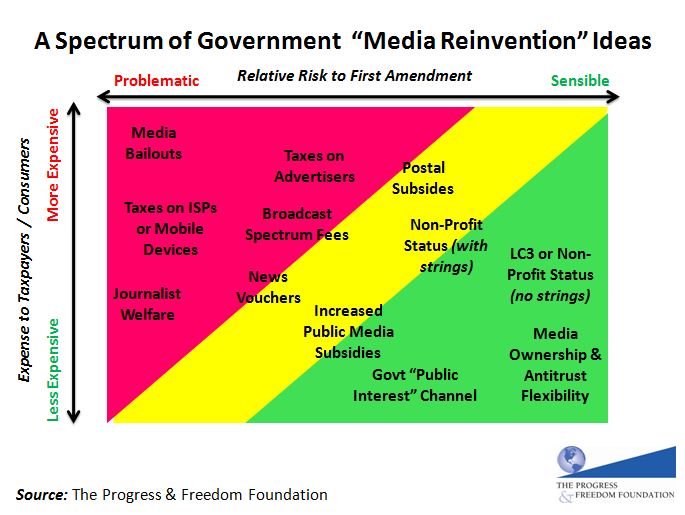
As I’ve noted here before, the Federal Trade Commission (FTC) has an ongoing proceeding asking “How Will Journalism Survive the Internet Age?” The agency has hosted two workshops on the issue and a third is scheduled for June 15th at the National Press Club. Recently, the FTC released a 47-page staff discussion draft entitled “Potential Policy Recommendations to Support the Reinvention of Journalism,” which outlines dozens of proposals that have been set forth in recent years to “save journalism,” “reinvent media,” or support various forms of so-called “public interest programming.” [I’ve embedded the document down below.] Although the FTC makes it very clear on the first page of the discussion draft that it “does not represent final conclusions or recommendations by the Commission or FTC staff [and] it is solely for purposes of discussion,” the document is drawing scrutiny and raising concern since it might foreshadow where the FTC (and Obama Administration) could be heading on this front.
Some of those raising a stink about the FTC draft include: Jeff Jarvis (“FTC Protects Journalism’s Past“); Rob Port (“Federal Government Considering “iPad Tax” To Subsidize Journalism“); Mark Tapscott: “(Will Journalists Wake up in Time to Save Journalism from Obama’s FTC?”); and Andrew Malcolm of the Los Angeles Times (“Obama’s FTC Plan to Reinvent America’s News Media“), who says, “this FTC study is rated R for anyone who thinks the federal government, the object of copious news coverage itself, has no business deciding which sectors of the private media business survive and thrive through its support, subsidies and encouragement with things like tax incentives. Yet that’s what this Obama administration paper is suggesting as another of the ex-community organizer’s galactic reform plans.” Ouch!
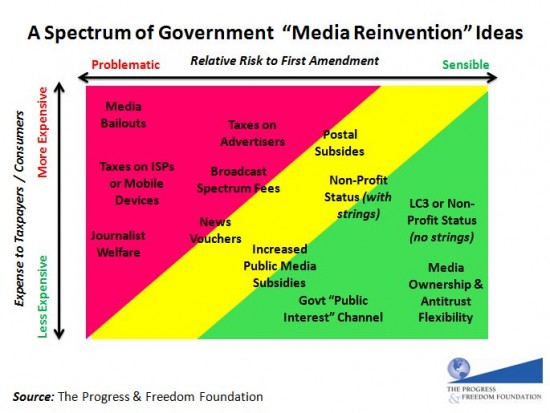
Continue reading →
I’m keeping tabs on who filed “major” comments (more than a 10-15 pages) in the Federal Communications Commission’s “Future of Media” proceeding (GN Docket No. 10-25). As I noted last week, The Progress & Freedom Foundation submitted almost 80 pages of comments (single-spaced!) in the matter, so it’s something I care deeply about and will be tracking closely going forward.
Incidentally, the general consensus of those who filed (especially if you count “minor” comments) is fairly overwhelming:
Bring on Big Government! Seriously, I only found a handful of comments that object strenuously to government meddling in media markets or that raised concerns about the potential for the State’s increasing involvement in the journalism profession. Even many of the affected industries appear to be suffering from a bit of Stockholm syndrome here. Most of them just play up the good things they are doing but barely utter a peep about the dangers of federal encroachment into the affairs of the Press.
Anyway, for those of you who care to track the gradual federalization of media and journalism, I think what you see below is a fairly comprehensive listing of the major filings submitted thus far in the FCC’s “Future of Media” proceeding. I’ll try to add more as I find them. You might also want to track what was filed in the Federal Trade Commission’s workshops on “How Will Journalism Survive the Internet Age.” Finally, if you care to learn more of this issue, I’m hosting an event on the morning of May 20th to discuss these issues in more detail.
Continue reading →
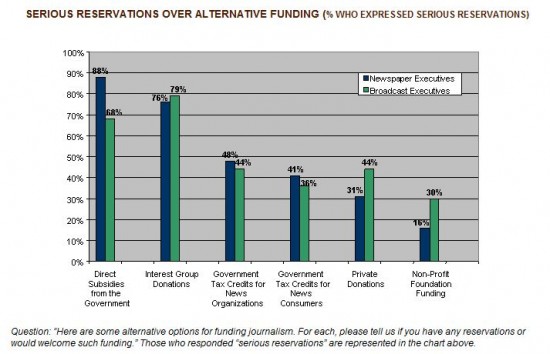
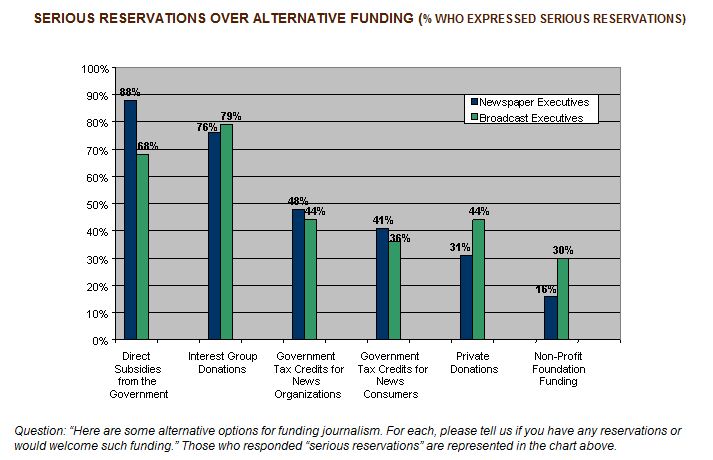
Good to see so many media industry executives expressing skepticism about the idea of government subsidies for the press. Danny Glover brought to my attention this new survey by the Pew Research Center’s Project for Excellence in Journalism in association with the American Society of News Editors (ASNE) and the Radio Television Digital News Association (RTDNA). It revealed that, “Fully 75% of all news executives surveyed—and 88% of newspaper executives—said they had ‘serious reservations,’ or the highest level of concern, about direct subsidies from the government.” A smaller percentage (only 46%) had serious reservations about tax credits for news organizations, then again, only 13% said they “would welcome such funding” and just 6% said they were “enthusiastic” about it.
This is encouraging news as many government officials at the FCC, FTC, and in Congress are currently considering whether government should steps to prop up failing media entities or promote certainly types of content. Berin Szoka and I have been working on a series of essays about the wrong ways to go about reinventing media [see Part 1, Part 2] and plan several more installments leading up to a big filing in the FCC’s “Future of Media” proceeding (the deadline is May 7th).
Here’s a chart from the Pew survey illustrating funding alternatives and the percentage who had “serious reservations” about each option:

 The Technology Liberation Front is the tech policy blog dedicated to keeping politicians' hands off the 'net and everything else related to technology.
List of Major Comments in FCC “Future of Media” Proceeding
by Adam Thierer on May 10, 2010 · 8 comments
I’m keeping tabs on who filed “major” comments (more than a 10-15 pages) in the Federal Communications Commission’s “Future of Media” proceeding (GN Docket No. 10-25). As I noted last week, The Progress & Freedom Foundation submitted almost 80 pages of comments (single-spaced!) in the matter, so it’s something I care deeply about and will be tracking closely going forward.
Incidentally, the general consensus of those who filed (especially if you count “minor” comments) is fairly overwhelming: Bring on Big Government! Seriously, I only found a handful of comments that object strenuously to government meddling in media markets or that raised concerns about the potential for the State’s increasing involvement in the journalism profession. Even many of the affected industries appear to be suffering from a bit of Stockholm syndrome here. Most of them just play up the good things they are doing but barely utter a peep about the dangers of federal encroachment into the affairs of the Press.
Anyway, for those of you who care to track the gradual federalization of media and journalism, I think what you see below is a fairly comprehensive listing of the major filings submitted thus far in the FCC’s “Future of Media” proceeding. I’ll try to add more as I find them. You might also want to track what was filed in the Federal Trade Commission’s workshops on “How Will Journalism Survive the Internet Age.” Finally, if you care to learn more of this issue, I’m hosting an event on the morning of May 20th to discuss these issues in more detail.
Continue reading →