Posts tagged as:

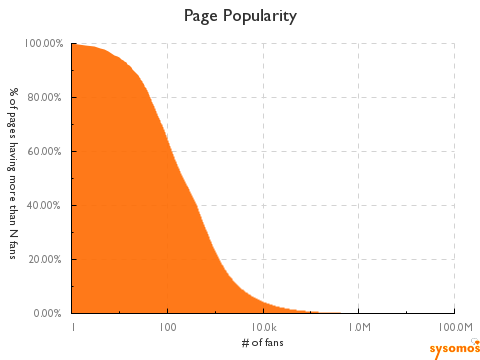
Facebook power lawPerfect media equality is impossible.  There has never been anything close to “equal outcomes” when it comes to the distribution or relative success of old media: books, magazines, music, movies, book, theater tickets, etc.  A small handful of titles have always dominated, usually according to a classic “power law” or “80-20? distribution, with roughly 20% of the titles getting 80% of the traffic / revenue.

But here’s the really interesting thing: This trend is increasing, not decreasing, for newer and more “democratic” online media.  As I pointed out in two previous essays [“YouTube, Power Laws & the Persistence of Media Inequality” & “Cuban on Fragmentation & Attention in the Blogosphere (or Why Power Laws Really Do Govern All Media)”], there is solid evidence that blogs, YouTube, Twitter, and other digital media outlets and platforms not only follow a classic power law distribution but that the distribution is even more heavily skewed toward the “fat head” of the distribution curve, not “the long tail” of it.

The latest evidence of the persistence of power laws across media comes from Facebook. Erick Schonfeld has a new essay up at TechCrunch (“It’s Not Easy Being Popular. 77 Percent Of Facebook Fan Pages Have Under 1,000 Fans“) highlighting some new findings from an upcoming report by Sysomos, a social media monitoring and analytics firm. Here’s the summary from Schonfeld: Continue reading →

Twitter Power Laws

by on August 17, 2009 · 12 comments

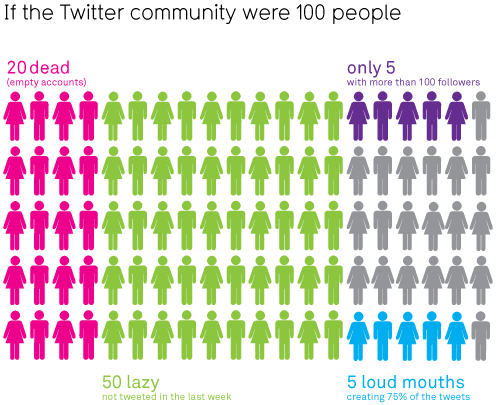
Thanks to Mashable, we clearly see power laws at work on Twitter. While many protest this as evidence of “media inequality,” the “non-tweeting will always be with us” (to paraphrase Jesus’s comment about the persistence of “the poor”)—and this is nothing to get bent out of shape about, as Adam has explained.

Courtesy of Mashable

Courtesy of Mashable, David McCandless

“Liberty upsets patterns.” That was one of the many lessons that the late Harvard philosopher Robert Nozick taught us in his 1974 masterpiece “Anarchy, State, and Utopia.” What Nozick meant was that there is a fundamental tension between liberty and egalitarianism such that when people are left to their own devices, some forms of inequality would be inevitable and persistent throughout society. (Correspondingly, any attempt to force patterns, or outcomes, upon society requires a surrender of liberty.)

No duh, right? Most people understand this today–even if some of them are all too happy to hand their rights over to the government in exchange for momentary security or some other promise.  In the world of media policy, however, many people still labor under the illusion that liberty and patterned equality are somehow reconcilable. That is, some media policy utopians and Internet pollyannas would like us to believe that if you give every man, woman, and child a platform on which to speak, everyone will be equally heard.  Moreover, in pursuit of that goal, some of them argue government should act to “upset patterns” and push to achieve more “balanced” media outcomes. That is the philosophy that has guided the “media access” movement for decades and it what fuels the “media reformista” movement that is led by groups like the (inappropriately named) Free Press, which was founded by neo-Marxist media theorist Robert McChesney.

Alas, perfect media equality remains an illusive pipe dream. As I have pointed out here before, there has never been anything close to “equal outcomes” when it comes to the distribution or relative success of books, magazines, music, movies, book sales, theater tickets, etc.  A small handful of titles have always dominated, usually according to a classic “power law” or “80-20” distribution, with roughly 20% of the titles getting 80% of the traffic / revenue.  And this trend is increasing, not decreasing, for newer and more “democratic” online media.

For example, recent research has revealed that “the top 10% of prolific Twitter users accounted for over 90% of tweets” and  “the top 15% of the most prolific [Wkipedia] editors account for 90% of Wikipedia’s edits.” As Clay Shirky taught us back in 2003 in this classic essay, the same has long held true for blogging, where outcomes are radically inegalitarian, with a tiny number of blogs getting the overwhelming volume of blogosphere attention.  The reason, Shirky pointed out, is that:

Continue reading →

Mark Cuban penned a sharp piece over the weekend entitled “Who Cares What People Write?” in which he explains why people shouldn’t get too worked up about what they might read about themselves (or their organizations) online since, chances are, very few people are ever going to see it anyway.  To explain why, Cuban identifies two kinds of “Outties” (which is shorthand for someone who publishes on the web): (1) “professional outties” (or “Those that attempt to publish in a limited number of locations to a maximum number of readers or listeners, with a reasonable expectation of building a following.”) and (2) “amateur outties” (“Those that attempt to publish in as many places as possible hoping they are “discovered.”)  But those “amateur outties… really [have] no impact on 99.99pct of the population,” Cuban argues, “[and the] vast majority of what is written on the web goes unread and even that which is read, is quickly forgotten.”  Moreover, “even when something is heavily commented on, it  is usually just an onslaught by the ‘amateur outties.’”

Thus, Cuban concludes:

Fragmentation applies to 100pct of media. We have gotten to the point where it is so easy to publish to the web, that most of it is ignored. When it is not ignored and it garners attention, the attention is usually from those people, the amateur outties, whose only goal is to create volume on the web in hopes of being noticed. That’s not to say there are no sites that people consume and pay attention to. There obviously are.  That’s where the “professional outties” come in. They are branded. They have an identity that usually extends beyond the net.  They are able to make a living publishing, even if its not much of one.  They are the sites that people consume and may possibly remember. The moral of the story is that on the internet, volume is not engagement.  Traffic is not reach.  When you see things written about a person, place or thing you care about,  whether its positive or negative, take a very deep breath before thinking that the story means anything to anyone but you.

Continue reading →