This a running list of all the essays and reports I’ve already rolled out on the governance of artificial intelligence (AI), machine learning (ML), and robotics. Why have I decided to spend so much time on this issue? Because this will become the most important technological revolution of our lifetimes. Every segment of the economy will be touched in some fashion by AI, ML, robotics, and the power of computational science. It should be equally clear that public policy will be radically transformed along the way.
Eventually, all policy will involve AI policy and computational considerations. As AI “eats the world,” it eats the world of public policy along with it. The stakes here are profound for individuals, economies, and nations. As a result, AI policy will be the most important technology policy fight of the next decade, and perhaps next quarter century. Those who are passionate about the freedom to innovate need to prepare to meet the challenge as proposals to regulate AI proliferate.
There are many socio-technical concerns surrounding algorithmic systems that deserve serious consideration and appropriate governance steps to ensure that these systems are beneficial to society. However,
there is an equally compelling public interest in ensuring that AI innovations are developed and made widely available to help improve human well-being across many dimensions. And that’s the case that I’ll be dedicating my life to making in coming years.
Here’s the list of what I’ve done so far. I will continue to update this as new material is released: Continue reading →
I’m finishing up my next book, which is tentatively titled, “A Flexible Governance Framework for Artificial Intelligence.” I thought I’d offer a brief preview here in the hope of connecting with others who care about innovation in this space and are also interested in helping to address these policy issues going forward.
The goal of my book is to highlight the ways in which artificial intelligence (AI) machine learning (ML), robotics, and the power of computational science are set to transform the world—and the world of public policy—in profound ways. As with all my previous books and research products, my goal in this book includes both empirical and normative components. The first objective is to highlight the tensions between emerging technologies and the public policies that govern them. The second is to offer a defense of a specific governance stance toward emerging technologies intended to ensure we can enjoy the fruits of algorithmic innovation.
AI is a transformational technology that is general-purpose and dual-use. AI and ML also build on top of other important technologies—computing, microprocessors, the internet, high-speed broadband networks, and data storage/processing systems—and they will become the building blocks for a great many other innovations going forward. This means that, eventually,
all policy will involve AI policy and computational considerations at some level. It will become the most important technology policy issue here and abroad going forward.
The global race for AI supremacy has important implications for competitive advantage and other geopolitical issues. This is why nations are focusing increasing attention on what they need to do to ensure they are prepared for this next major technological revolution. Public policy attitudes and defaults toward innovative activities will have an important influence on these outcomes.
In my book, I argue that, if the United States hopes to maintain a global leadership position in AI, ML, and robotics, public policy should be guided by two objectives:
Maximize the potential for innovation, entrepreneurialism, investment, and worker opportunities by seeking to ensure that firms and other organizations are prepared to compete at a global scale for talent and capital and that the domestic workforce is properly prepared to meet the same global challenges.
Develop a flexible governance framework to address various ethical concerns about AI development or use to ensure these technologies benefit humanity, but work to accomplish this goal without undermining the goals set forth in the first objective.
The book primarily addresses the second of these priorities because getting the governance framework for AI right significantly improves the chances of successfully accomplishing the first goal of ensuring that the United States remains a leading global AI innovator. Continue reading →
On July 12, I participated in a Bipartisan Policy Center event on “Civil Society Perspectives on Artificial Intelligence Impact Assessments.” It was an hour-long discussion moderated by Michele Nellenbach, Vice President of Strategic Initiatives at the Bipartisan Policy Center, and which also featured Miriam Vogel, President and CEO of EqualAI. We discussed the ins and outs of algorithmic auditing and impact assessments for artificial intelligence. This is one of the hottest topics in the field of AI governance today, with proposals multiplying rapidly in academic and public policy circles. Several governments are already considering mandating AI auditing and impact assessments.
You can watch the entire discussion here, and down below I have included some of my key talking points from the session. I am currently finishing up my next book, which is on how to craft a flexible governance framework for AI and algorithmic technologies. It includes a lengthy chapter on this issue and I also plan on eventually publishing a stand-alone study on this topic.
On Thursday, June 9, it was my great pleasure to return to my first work office at the Adam Smith Institute in London and give a talk on the future of innovation policy and the governance of artificial intelligence. James Lawson, who is affiliated with the ASI and wrote a wonderful 2020 study on AI policy, introduced me and also offered some remarks. Among the issues discussed:
What sort of governance vision should govern the future of innovation generally and AI in particular: the “precautionary principle” or “permissionless innovation”?
Which AI sectors are witnessing the most exciting forms of innovation currently?
What are the fundamental policy fault lines in the AI policy debates today?
Will fears about disruption and automation lead to a new Luddite movement?
How can “soft law” and decentralized governance mechanism help us solve pressing policy concerns surrounding AI?
How did automation affect traditional jobs and sectors?
Will the European Union’s AI Act become a global model for regulation and will it have a “Brussels Effect” in terms of forcing innovators across the world to come into compliance with EU regulatory mandates?
How will global innovation arbitrage affect the efforts by governments in Europe and elsewhere to regulate AI innovation?
Can the common law help address AI risk? How is the UK common law system superior to the US legal system?
What do we mean by “existential risk” as it pertains to artificial intelligence?
I have a massive study in the works addressing all these issues. In the meantime, you can watch the video of my London talk here. And thanks again to my friends at the Adam Smith Institute for hosting!
The American Enterprise Institute (AEI) has kicked off a new project called “Digital Platforms and American Life,” which will bring together a variety of scholars to answer the question: How should policymakers think about the digital platforms that have become embedded in our social and civic life? The series, which is being edited by AEI Senior Fellow Adam J. White, highlights how the democratization of knowledge and influence in the Internet age comes with incredible opportunities but also immense challenges. The contributors to this series will approach these issues from various perspectives and also address different aspects of policy as it pertains to the future of technological governance.
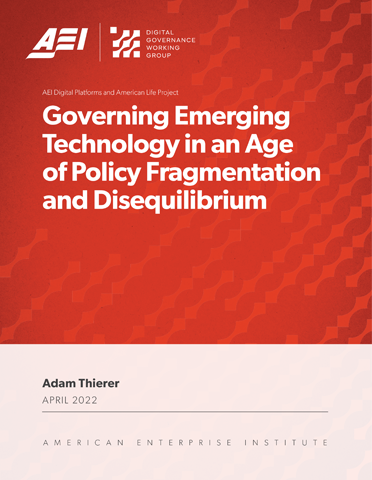
It is my honor to have the lead paper in this new series. My 19-page essay is entitled, Governing Emerging Technology in an Age of Policy Fragmentation and Disequilibrium, and it represents my effort to concisely tie together all my writing over the past 30 years on governance trends for the Internet and related technologies. The key takeaways from my essay are:
Traditional governance mechanisms are being strained by modern technological and political realities. Newer technologies, especially digital ones, are developing at an ever-faster rate and building on top of each other, blurring lines between sectors.
Congress has failed to keep up with the quickening pace of technological change. It also continues to delegate most of its constitutional authority to agencies to deal with most policy concerns. But agencies are overwhelmed too. This situation is unlikely to change, creating a governance gap.
Decentralized governance techniques are filling the gap. Soft law—informal, iterative, experimental, and collaborative solutions—represents the new normal for technological governance. This is particularly true for information sectors, including social media platforms, for which the First Amendment acts as a major constraint on formal regulation anyway.
No one-size-fits-all tool can address the many governance issues related to fast-paced science and technology developments; therefore, decentralized governance mechanisms may be better suited to address newer policy concerns.
My arguments will frustrate many people of varying political dispositions because I adopt a highly pragmatic approach to technological governance. Continue reading →
As I note in my latest regular column for The Hill, it seems like everyone these days is talking about the importance of America “building again.” For example, take a look at this compendium of essays I put together where scholars and pundits have been making the case for “building again” in various ways and contexts. It would seem that the phrase is on everyone’s lips. “These calls include many priorities,” I note, “but what unifies them is the belief that the nation needs to develop new innovations and industries to improve worker opportunities, economic growth and U.S. global competitive standing.”
What I fear, however, is that “building again” has become more of a convenient catch line than anything else. It seems like few people are willing to spell out exactly what it will take to get that started. My new column suggests that the most important place to start is “to cut back the thicket of red tape and stifling bureaucratic procedures that limit the productiveness of the American workforce.” I cite recent reports and data documenting the enormous burden that regulatory accumulation imposes on American innovators and workers. I then discuss how to get reforms started at all levels of government to get the problem under control and help us start building again in earnest. Jump over to
The Hill to read the entire essay.
This is a compendium of readings on “progress studies,” or essays and books which generally make the case for technological innovation, dynamism, economic growth, and abundance. I will update this list as additional material of relevance is brought to my attention.
Discourse magazine has just published my review of Where Is My Flying Car?, by J. Storrs Hall, which I argue is the most important book on technology policy written in the past quarter century. Hall perfectly defines what is at stake if we fail to embrace a pro-progress policy vision going forward. Hall documents how a “Jetsons” future was within our grasp, but it was stolen away from us. What held back progress in key sectors like transportation, nanotech & energy was anti-technological thinking and the overregulation that accompanies it. “[T]he Great Stagnation was really the Great Strangulation,” he argues. The culprits: negative cultural attitudes toward innovation, incumbent companies or academics looking to protect their turf, litigation-happy trial lawyers, and a raft of risk-averse laws and regulations.
Hall coins the term “the Machiavelli Effect” to identify why many people simultaneously fear the new and different, and they also want to protect whatever status quo they benefit from (or at least feel comfortable with). He builds on this passage from Niccolò Machiavelli’s classic 1532 study of political power, “The Prince”: Continue reading →
A short presentation I do for Mercatus Center graduate students every couple of years offering advice to aspiring policy scholars looking to develop their personal brand & be more effective public policy analysts.
The Technology Liberation Front is the tech policy blog dedicated to keeping politicians' hands off the 'net and everything else related to technology. Learn more about TLF →

 Discourse magazine has just published
  The Technology Liberation Front is the tech policy blog dedicated to keeping politicians' hands off the 'net and everything else related to technology.
Running List of My Research on AI, ML & Robotics Policy
by Adam Thierer on July 29, 2022 · 0 comments
[last updated 4/3/2025 – Check my Medium page for latest posts]
This a running list of all the essays and reports I’ve already rolled out on the governance of artificial intelligence (AI), machine learning (ML), and robotics. Why have I decided to spend so much time on this issue? Because this will become the most important technological revolution of our lifetimes. Every segment of the economy will be touched in some fashion by AI, ML, robotics, and the power of computational science. It should be equally clear that public policy will be radically transformed along the way.
Eventually, all policy will involve AI policy and computational considerations. As AI “eats the world,” it eats the world of public policy along with it. The stakes here are profound for individuals, economies, and nations. As a result, AI policy will be the most important technology policy fight of the next decade, and perhaps next quarter century. Those who are passionate about the freedom to innovate need to prepare to meet the challenge as proposals to regulate AI proliferate.
There are many socio-technical concerns surrounding algorithmic systems that deserve serious consideration and appropriate governance steps to ensure that these systems are beneficial to society. However, there is an equally compelling public interest in ensuring that AI innovations are developed and made widely available to help improve human well-being across many dimensions. And that’s the case that I’ll be dedicating my life to making in coming years.
Here’s the list of what I’ve done so far. I will continue to update this as new material is released: Continue reading →