Posts tagged as:

Here’s a new DC EKG podcast I recently appeared on to discuss the current state of policy development surrounding artificial intelligence. In our wide-ranging chat, we discussed:

  • why a sectoral approach to AI policy is superior to general purpose licensing
  • why comprehensive AI legislation will not pass in Congress
  • the best way to deal with algorithmic deception
  • why Europe lost its tech sector
  • how a global AI regulator threatens our safety
  • the problem with Biden’s AI executive order
  • will AI policy follow same path as nuclear policy?
  • global innovation arbitrage & the innovation cage
  • AI, health care & FDA regulation
  • AI regulation vs trade secrets
  • is AI transparency / auditing the solution?

Listen to the full show here or here. To read more about current AI policy developments, check out my “Running List of My Research on AI, ML & Robotics Policy.”


My latest dispatch from the frontlines of the artificial intelligence policy wars in Washington looks at the major proposals to regulate AI. In my new essay, “Artificial Intelligence Legislative Outlook: Fall 2023 Update,” I argue that there are 3 major impediments to getting major AI legislation over the finish line in Congress: (1) Breadth and complexity of the issue; (2) Multiplicity of concerns & special interests; & (3) Extreme rhetoric / proposals are dominating the discussion.

If Congress wants to get something done in this session, they’ll need to do two things: (1) set aside the most radical regulatory proposals (like big new AI agencies or licensing schemes); and (2) break AI policy down into its smaller subcomponents and then prioritize among them where policy gaps might exist.

Prediction: Congress will not pass any AI-related legislation this session due to the factors identified in my essay. The temptation to “go big” with everything-and-the-kitchen-sink approaches to AI regulation will (especially with extreme ideas like new agencies & licenses) will doom AI legislation. It’s also worth noting that Washington’s swelling interest in AI policy is having a crowding-out effect on other important legislative proposals that might have advanced otherwise, such as the baseline privacy bill (ADPPA) and other things like driverless car legislation. Many want to advance those efforts first, but the AI focus makes that hard.

Read the entire essay here.

It was my pleasure to recently join Matthew Lesh, Director of Public Policy and Communications for the London-based Institute of Economic Affairs (IEA), for the IEA podcast discussion, “Should We Regulate AI?” In our wide-ranging 30-minute conversation, we discuss how artificial intelligence policy is playing out across nations and I explained why I feel the UK has positioned itself smartly relative to the US & EU on AI policy. I argued that the UK approach encourages a better ‘innovation culture’ than the new US model being formulated by the Biden Administration.

We also went through some of the many concerns driving calls to regulate AI today, including: fears about job dislocations, privacy and security issues, national security and existential risks, and much more.

Continue reading →

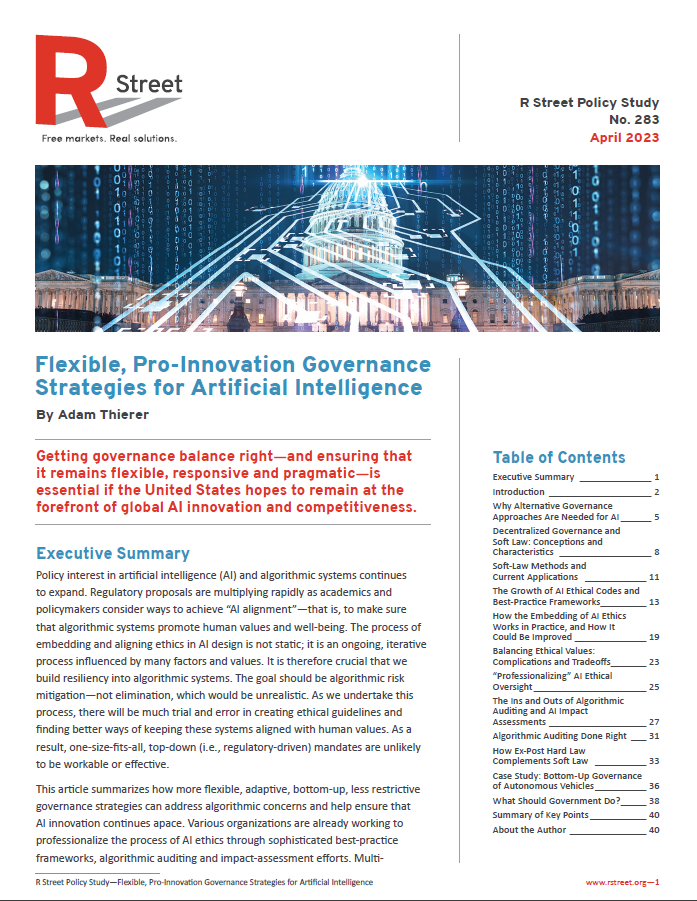
The R Street Institute has just released my latest study on AI governance and how to address “alignment” concerns in a bottom-up fashion. The 40-page report is entitled, “Flexible, Pro-Innovation Governance Strategies for Artificial Intelligence.”

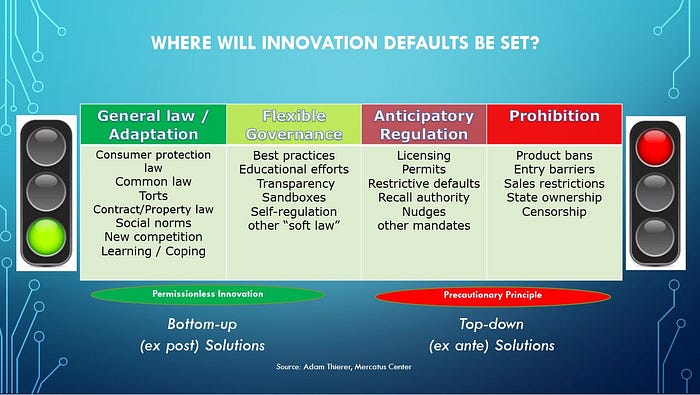
My report asks, is it possible to address AI alignment without starting with the Precautionary Principle as the governance baseline default? I explain how that is indeed possible. While some critics claim that no one is seriously trying to deal with AI alignment today, my report explains how no technology in history has been more heavily scrutinized this early in its life-cycle as AI, machine learning and robotics. The number of ethical frameworks out there already is astonishing. We don’t have too few alignment frameworks; we probably have too many!

We need to get serious about bringing some consistency to these efforts and figure out more concrete ways to a culture of safety by embedding ethics-by-design. But there is an equally compelling interest in ensuring that algorithmic innovations are developed and made widely available to society.

Continue reading →

In my latest R Street Institute report, I discuss the importance of “Getting AI Innovation Culture Right.” This is the first of a trilogy of major reports on what sort of policy vision and set of governance principles should guide the development of  artificial intelligence (AI), algorithmic systems, machine learning (ML), robotics, and computational science and engineering more generally. More specifically, these reports seek to answer the question, Can we achieve AI safety without innovation-crushing top-down mandates and massive new regulatory bureaucracies? 

These questions are particular pertinent as we just made it through a week in which we’ve seen a major open letter issued that calls for a 6-month freeze on the deployment of AI technologies, while a prominent AI ethicist argued that governments should go further and consider airstrikes data processing centers even if the exchange of nuclear weapons needed to be considered! On top of that, Italy became the first major nation to ban ChatGPT, the popular AI-enabled chatbot created by U.S.-based OpenAI.

My report begins from a different presumption: AI, ML and algorithmic technologies present society with enormously benefits and, while real risks are there, we can find better ways of addressing them. Continue reading →

In my latest R Street Institute blog post, “Mapping the AI Policy Landscape Circa 2023: Seven Major Fault Lines,” I discuss the big issues confronting artificial intelligence and machine learning in the coming year and beyond. I note that the AI regulatory proposals are multiplying fast and coming in two general varieties: broad-based and targeted. Broad-based algorithmic regulation would address the use of these technologies in a holistic fashion across many sectors and concerns. By contrast, targeted algorithmic regulation looks to address specific AI applications or concerns. In the short-term, it is more likely that targeted or “sectoral” regulatory proposals have a chance of being implemented.

I go on to identify seven major issues of concern that will drive these policy proposals. They include:

1) Privacy and Data Collection

2) Bias and Discrimination

3) Free Speech and Disinformation

4) Kids’ Safety

5) Physical Safety and Cybersecurity

6) Industrial Policy and Workforce Issues

7) National Security and Law Enforcement Issues

Continue reading →

We are entering a new era for technology policy in which many pundits and policymakers will use “algorithmic fairness” as a universal Get Out of Jail Free card when they push for new regulations on digital speech and innovation. Proposals to regulate things like “online safety,” “hate speech,” “disinformation,” and “bias” among other things often raise thorny definitional questions because of their highly subjective nature. In the United States, efforts by government to control these things will often trigger judicial scrutiny, too, because restraints on speech violate the First Amendment. Proponents of prior restraint or even ex post punishments understand this reality and want to get around it. Thus, in an effort to avoid constitutional scrutiny and lengthy court battles, they are engaged in a rebranding effort and seeking to push their regulatory agendas through a techno-panicky prism of “algorithmic fairness” or “algorithmic justice.”

Hey, who could possibly be against FAIRNESS and JUSTICE? Of course, the devil is always in the details as Neil Chilson and I discuss in our new paper for the The Federalist Society and Regulatory Transparency Project on, “The Coming Onslaught of ‘Algorithmic Fairness’ Regulations.” We document how federal and state policymakers from both parties are currently considering a variety of new mandates for artificial intelligence (AI), machine learning, and automated systems that, if imposed, “would thunder through our economy with one of the most significant expansions of economic and social regulation – and the power of the administrative state – in recent history.” Continue reading →

[Cross-posted from Medium.]

[Cross-posted from Medium]

There are two general types of technological governance that can be used to address challenges associated with artificial intelligence (AI) and computational sciences more generally. We can think of these as “on the ground” (bottom-up, informal “soft law”) governance mechanisms versus “on the books” (top-down, formal “hard law”) governance mechanisms.

Unfortunately, heated debates about the latter type of governance often divert attention from the many ways in which the former can (or already does) help us address many of the challenges associated with emerging technologies like AI, machine learning, and robotics. It is important that we think harder about how to optimize these decentralized soft law governance mechanisms today, especially as traditional hard law methods are increasingly strained by the relentless pace of technological change and ongoing dysfunctionalism in the legislative and regulatory arenas.

Continue reading →

For my latest column in The Hill, I explored the European Union’s (EU) endlessly expanding push to regulate all facets of the modern data economy. That now includes a new effort to regulate artificial intelligence (AI) using the same sort of top-down, heavy-handed, bureaucratic compliance regime that has stifled digital innovation on the continent over the past quarter century.

The European Commission (EC) is advancing a new Artificial Intelligence Act, which proposes banning some AI technologies while classifying many others under a heavily controlled “high-risk” category. A new bureaucracy, the European Artificial Intelligence Board, will be tasked with enforcing a wide variety of new rules, including “prior conformity assessments,” which are like permission slips for algorithmic innovators. Steep fines are also part of the plan. There’s a lengthy list of covered sectors and technologies, with many others that could be added in coming years. It’s no wonder, then, that the measure has been labelled the measure “the mother of all AI laws” and analysts have argued it will further burden innovation and investment in Europe.

As I noted in my new column, the consensus about Europe’s future on the emerging technology front is dismal to put it mildly. The International Economy journal recently asked 11 experts from Europe and the U.S. where the EU currently stood in global tech competition. Responses were nearly unanimous and bluntly summarized by the symposium’s title: “The Biggest Loser.” Respondents said Europe is “lagging behind in the global tech race,” and “unlikely to become a global hub of innovation.” “The future will not be invented in Europe,” another analyst bluntly concluded. Continue reading →