Here’s a new DC EKG podcast I recently appeared on to discuss the current state of policy development surrounding artificial intelligence. In our wide-ranging chat, we discussed:
why a sectoral approach to AI policy is superior to general purpose licensing
why comprehensive AI legislation will not pass in Congress
the best way to deal with algorithmic deception
why Europe lost its tech sector
how a global AI regulator threatens our safety
the problem with Biden’s AI executive order
will AI policy follow same path as nuclear policy?
I recently joined Rep. Dan Crenshaw on his Hold These Truths podcast to discuss, “What’s Wrong with Industrial Policy.” We chatted for 25 minutes about a wide range of issues related to the the growing push for grandiose industrial policy schemes in the US, including the massive new 3,000-page, $350 billion “COMPETES Act” legislation that recently passed in the House and which will soon be conferenced with a Senate bill that already passed.
On the same day this podcast was released this week, I also had a new op-ed appear in
The Hill on “The Coming Industrial Policy Hangover.” In both that essay and the podcast with Rep. Crenshaw, I stress that, beyond all the other problems with these new industrial policy measures, no one is talking about the fiscal cost of it all. As I note:
In the rush to pass legislation, we’ve barely heard a peep about the $250-$350 billion price tag. This follows a massive splurge of recent government borrowing, which led to the U.S. national debt hitting another lamentable new record: $30 trillion. China already owns over $1 trillion of that debt, making one wonder if we’re really countering China by adopting a massive, new and unfunded industrial policy that they will end up financing indirectly.
I was my pleasure to appear on the latest episode of the Dissed podcast to discuss economic liberty and the right to earn a living. The show was hosted by Anastasia Boden and Elizabeth Slattery of the Pacific Legal Foundation and it included legal scholars Hadley Arkes, Timothy Sandefur, and Clark Neily. I appear in the second half of the program.
Industrial Policy is a red-hot topic once again with many policymakers and pundits of different ideological leanings lining up to support ambitious new state planning for various sectors — especially 5G, artificial intelligence, and semiconductors. A remarkably bipartisan array of people and organizations are advocating for government to flex its muscle and begin directing more spending and decision-making in various technological areas. They all suggest some sort of big plan is needed, and it is not uncommon for these industrial policy advocates to suggest that hundreds of billions will need to be spent in pursuit of those plans.
Others disagree, however, and I’ll be using this post to catalog some of their concerns on an ongoing basis. Some of the criticisms listed here are portions of longer essays, many of which highlight other types of steps that governments can take to spur innovative activities. Industrial policy is an amorphous term with many definitions of a broad spectrum of possible proposals. Almost everyone believes in
some form of industrial policy if you define the term broadly enough. But, as I argued in a September 2020 essay “On Defining ‘Industrial Policy‘,” I believe it is important to narrow the focus of the term such that we can continue to use the term in a rational way. Toward that end, I believe a proper understanding of industrial policy refers to targeted and directed efforts to plan for specific future industrial outputs and outcomes.
The collection of essays below is merely an attempt to highlight some of the general concerns about the most ambitious calls for expansive industrial policy, many of which harken back to debates I was covering in the late 1980s and early 1990s, when I first started a career in policy analysis. During that time, Japan and South Korea were the primary countries of concern cited by industrial policy advocates. Today, it is China’s growing economic standing that is fueling calls for ambitious state-led targeted investments in “strategic” sectors and technologies. To a lesser extent, grandiose European industrial policy proposals are also prompting new US counter-proposals.
All this activity is what has given rise to many of the critiques listed below. If you have suggestions for other essays I might add to this list, please feel free to pass them along. FYI: There’s no particular order here.
I wanted to bring to your attention this Federalist Society podcast discussion I hosted a few weeks ago on, “Tech Policy Under the Biden Administration and 117th Congress.” I was joined by Jennifer Huddleston, Director of Technology & Innovation Policy at the American Action Forum, and Blake Reid, Clinical Professor at the University of Colorado Law School.
We discussed key policy debates – such as antitrust and “Big Tech,” online speech and Section 230, and the race to 5G – and considered how the new presidential administration and Congress might approach innovation and the tech industry in 2021 and beyond. Note: You might also want to check out this earlier essay by Jennifer on, “5 Tech Policy Topics to Follow in the Biden Administration and 117th Congress.”
Here’s a new episode of the James Madison Institute “Policy Gone Viral” podcast in which my former Mercatus Center colleague Andrea O’Sullivan and I discuss the future of technological innovation and the public policies governing it. The video is embedded below or you can listen to just the audio here.
This week, it was my pleasure to be interviewed by Eric Peterson of the Pelican Institute on their “PeliCast” live video podcast. We discussed potential futures for permissionless innovation and, more importantly, what my favorite beer in Louisiana is. Tune in to find the answer!
It was my great pleasure to recently join Paul Matzko and Will Duffield on the Building Tomorrow podcast to discuss some of the themes in my last book and my forthcoming one. During our 50-minute conversation, which you can listen to here, we discussed:
the “pacing problem” and how it complicates technological governance efforts;
the steady rise of “innovation arbitrage” and medical tourism across the globe;
the continued growth of “evasive entrepreneurialism” (i.e., efforts to evade traditional laws & regs while innovating);
new forms of “technological civil disobedience;”
the rapid expansion of “soft law” governance mechanism as a response to these challenges; and,
craft beer bootlegging tips! (Seriously, I move a lot of beer in the underground barter markets).
Bounce over to the Building Tomorrow site and give the show a listen. Fun chat.
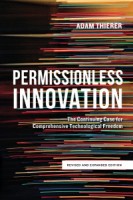
I am pleased to announce the release of the second edition of my book, Permissionless Innovation: The Continuing Case for Comprehensive Technological Freedom. As with the first edition, the book represents a short manifesto that condenses — and attempts to make more accessible — arguments that I have developed in various law review articles, working papers, and blog posts over the past few years. The book attempts to accomplish two major goals.
First, I attempt to show how the central fault line in almost all modern technology policy debates revolves around “the permission question,” which asks:
Must the creators of new technologies seek the blessing of public officials before they develop and deploy their innovations? How that question is answered depends on the disposition one adopts toward new inventions. Two conflicting attitudes are evident.
One disposition is known as the “precautionary principle.” Generally speaking, it refers to the belief that new innovations should be curtailed or disallowed until their developers can prove that they will not cause any harms to individuals, groups, specific entities, cultural norms, or various existing laws, norms, or traditions.
The other vision can be labeled “permissionless innovation.” It refers to the notion that experimentation with new technologies and business models should generally be permitted by default. Unless a compelling case can be made that a new invention will bring serious harm to society, innovation should be allowed to continue unabated and problems, if they develop at all, can be addressed later.
I argue that we are witnessing a grand clash of visions between these two mindsets today in almost all major technology policy discussions today. Continue reading →
The Technology Liberation Front is the tech policy blog dedicated to keeping politicians' hands off the 'net and everything else related to technology. Learn more about TLF →


 The Technology Liberation Front is the tech policy blog dedicated to keeping politicians' hands off the 'net and everything else related to technology.