Posts tagged as:

My thanks to both Maria H. Andersen and Michael Sacasas for their thoughtful responses to my recent Forbes essay on “10 Things Our Kids Will Never Worry About Thanks to the Information Revolution.” They both go point by point through my Top 10 list and offer an alternative way of looking at each of the trends I identify. What their responses share in common is a general unease with the hyper-optimism of my Forbes piece. That’s understandable. Typically in my work on technological “optimism” and “pessimism” — and yes, I admit those labels are overly simplistic — I always try to strike a sensible balance between pollyannism and hyper-pessimism as it pertains to the impact of technological change on our culture and economy. I have called this middle ground position “pragmatic optimism.” In my Forbes essay, however, I was in full-blown pollyanna mode. That doesn’t mean I don’t generally feel very positive about the changes I itemized in that essay, rather, I just didn’t have the space in a 1,000-word column to identify the tradeoffs inherent in each trend. Thus, Andersen and Sacasas are rightfully pushing back against my lack of balance.

But there is a problem with their slightly pessimistic pushback, too. To better explain my own position and respond to Andersen and Sacasas, let me return to the story we hear again and again in discussion about technological change: the well-known allegorical tale from Plato’s Phaedrus about the dangers of the written word. In the tale, the god Theuth comes to King Thamus and boasts of how Theuth’s invention of writing would improve the wisdom and memory of the masses relative to the oral tradition of learning.  King Thamus shot back, “the discoverer of an art is not the best judge of the good or harm which will accrue to those who practice it.”  King Thamus then passed judgment himself about the impact of writing on society, saying he feared that the people “will receive a quantity of information without proper instruction, and in consequence be thought very knowledgeable when they are for the most part quite ignorant.”

After recounting Plato’s allegory in my essay, “Are You An Internet Optimist or Pessimist? The Great Debate over Technology’s Impact on Society,” I noted how this same tension has played out in every subsequent debate about the impact of a new technology on culture, values, morals, language, learning, and so on. It is a never-ending cycle. Continue reading →

NPR science correspondent Shankar Vedantam had a great spot on NPR’s Morning Edition today about the disputes among social scientists over the impact of violent video games on kids. [“It’s A Duel: How Do Violent Video Games Affect Kids?”] You won’t be surprised to hear I wholeheartedly agree with Texas A&M psychologist Chris Ferguson, who noted in the spot:

Ferguson says it’s easy to think senseless video game violence can lead to senseless violence in the real world. But he says that’s mixing up two separate things.  “Many of the games do have morally objectionable material and I think that is where a lot of the debate on this issue went off the rails,” he said. “We kind of mistook our moral concerns about some of these video games, which are very valid — I find many of the games to be morally objectionable — and then assumed that what is morally objectionable is harmful.”

I’ve written about Ferguson’s work and these issues more generally many times over through the years here at the TLF. Here are some of the most relevant essays:

In these essays, I’ve tried to make a couple of key points about the social science literature on “media effects” theory: Continue reading →

I enjoyed this Wall Street Journal essay by Daniel H. Wilson on “The Terrifying Truth About New Technology.”  It touches on many of the themes I’ve discussed here in my essays on techno-panics, fears about information overload, and the broader battle throughout history between technology optimists and pessimists regarding the impact of new technologies on culture, life, and learning. Wilson correctly notes that:

The fear of the never-ending onslaught of gizmos and gadgets is nothing new. The radio, the telephone, Facebook — each of these inventions changed the world. Each of them scared the heck out of an older generation. And each of them was invented by people who were in their 20s.

He continues:

Young people adapt quickly to the most absurd things. Consider the social network Foursquare, in which people not only willingly broadcast their location to the world but earn goofy virtual badges for doing so. My first impulse was to ignore Foursquare—for the rest of my life, if I have to. And that’s the problem. As we get older, the process of adaptation slows way down. Unfortunately, we depend on alternating waves of assimilation and accommodation to adapt to a constantly changing world. For [developmental psychologist Jean] Piaget, this balance between what’s in the mind and what’s in the environment is called equilibrium. It’s pretty obvious when equilibrium breaks down. For example, my grandmother has phone numbers taped to her cellphone. Having grown up with the Rolodex (a collection of numbers stored next to the phone), she doesn’t quite grasp the concept of putting the numbers in the phone. Why are we so nostalgic about the technology we grew up with? Old people say things like: “This new technology is stupid. I liked (new, digital) technology X better when it was called (old, analog) technology Y. Why, back in my day….” Which leads inexorably to, “I just don’t get it.”

There’s a simple explanation for this phenomenon: “adventure window.” At a certain age, that which is familiar and feels safe becomes more important to you than that which is new, different, and exciting. Think of it as “set-in-your-ways syndrome.”

Continue reading →

Here’s the first of two essays I’ve recently penned making “The Case for Internet Optimism.” This essay was included in the book, The Next Digital Decade: Essays on the Future of the Internet (2011), which was edited by Berin Szoka and Adam Marcus of TechFreedom.  In these essays, I identify two schools of Internet pessimism: (1) “Net Skeptics,” who are pessimistic about the Internet improving the lot of mankind; and (2) “Net Lovers,” who appreciate the benefits the Net brings society but who fear those benefits are disappearing, or that the Net or openness are dying.  (Regular readers of this blog will be familiar with these themes since I sketched them out in previous essays here such as, “Are You an Internet Optimist or Pessimist?” and “Two Schools of Internet Pessimism.”) The second essay is here.

This essay focuses on the first variant of Internet pessimism, which is rooted in general skepticism about the supposed benefits of cyberspace, digital technologies, and information abundance. The proponents of this pessimistic view often wax nostalgic about some supposed “good ‘ol days” when life was much better (although they can’t seem to agree when those were). At a minimum, they want us to slow down and think twice about life in the Information Age and how it’s personally affecting each of us.  Occasionally, however, this pessimism borders on neo-Ludditism, with some proponents recommending steps to curtail what they feel is the destructive impact of the Net or digital technologies on culture or the economy.  I identify the leading exponents of this view of Internet pessimism and their major works. I trace their technological pessimism back to Plato but argue that their pessimism is largely unwarranted. Humans are more resilient than pessimists care to admit and we learn how to adapt to technological change and assimilate new tools into our lives over time. Moreover, were we really better off in the scarcity era when we were collectively suffering from information poverty?  Generally speaking, despite the challenges it presents society, information abundance is a better dilemma to be facing than information poverty.  Nonetheless, I argue, we should not underestimate or belittle the disruptive impacts associated with the Information Revolution.  But we need to find ways to better cope with turbulent change in a dynamist fashion instead of attempting to roll back the clock on progress or recapture “the good ‘ol days,” which actually weren’t all that good.

Down below, I have embedded the entire chapter in a Scribd reader, but the essay can also be found on the TechFreedom website for the book as well as on SSRN.  I have also includes two updated tables that appeared in my old “optimists vs. pessimists” essay.  The first lists some of the leading Internet optimists and pessimists and their books. The second table outlines some of the major lines of disagreement between these two camps and I divided those disagreements into (1) Cultural / Social beliefs vs. (2) Economic / Business beliefs.

Continue reading →

Information overload is a hot topic these days. I’ve really enjoyed recent essays by Aaron Saenz (“Are We Too Plugged In? Distracted vs. Enhanced Minds”), Michael Sacasas (“Technology Sabbaths and Other Strategies for the Digitized World“), and Peggy Noonan (“Information Overload is Nothing New“) discussing this concern in a thoughtful way.   Thoughtful discussion about this issue is sometimes hard to find because, as I’ve noted here before, information overload is a subject that bitterly divides Internet optimists and pessimists. The pessimists tend to overplay the issue and discuss it in apocalyptic terms. The optimists, by contrast, often dismiss the concern out of hand. Certainly there must be some reasonable middle ground on this issue, no?

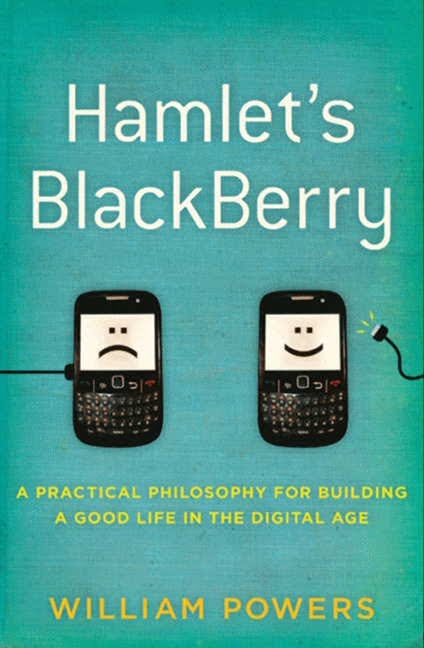
There is, and some of it can be found in a fine new book, Hamlet’s BlackBerry: A Practical Philosophy for Building a Good Life in the Digital Age, by William Powers.  Powers, a former staff writer for the Washington Post , is a gifted storyteller and his walk though the history of philosophy and technology makes this slender volume an enjoyable, quick read.  He begins by reminding us that:

whenever new devices have emerged, they’ve presented the kinds of challenges we face today — busyness, information overload, that sense of life being out of control.  These challenges were as real two millennia ago as they are today, and throughout history, people have been grappling with them and looking for creative ways to manage life in the crowd. (p. 5)

His key insight is that humans can adapt to new technology, but it takes time, patience, humility, and a little effort. “The key is to strike a balance,” he says, between “the call of the crowd” and the “need for time and space apart” from it. (p. 4) The problem we face today is that all the pressure is on us to be what he calls “Digital Maximalists.”  That is, many of us are increasingly out to maximize the time spent in front of various digital “screens” whether we have made the determination that is really in our best interest or not. It has just gradually happened, Powers argues, because “The goal is no longer to be ‘in touch’ but to erase the possibility of ever being out of touch.” (p. 15)

Continue reading →

Over at MediaFreedom.org, a new site devoted to fighting the fanaticism of radical anti-media freedom groups like Free Press and other “media reformistas,” I’ve started rolling out a 5-part series of essays about “The Battle for Media Freedom.” In Part 1 of the series, I defined what real media freedom is all about, and in Part 2 I discussed the rising “cyber-collectivist” threat to media freedom.  In my latest installment, I offer an analytical framework that better explains the major differences between the antagonists in the battle over media freedom.

Understanding the Origins of Political Struggles

In his many enlightening books, Thomas Sowell, a great economist and an even better political scientist, often warns of the triumph of good intentions over good economics. It’s a theme that F.A. Hayek and Milton Friedman both developed extensively before him. But Sowell has taken this analysis to an entirely differently level in books like A Conflict of Visions: Ideological Origins of Political Struggles, and The Vision of the Anointed: Self-Congratulation as a Basis for Social Policy . Sowell teaches us that no matter how noble one’s intentions might be, it does not mean that those ideas will translate into sound public policy. Nonetheless, since “the anointed” believe their own intentions are pure and their methods are sound, they see nothing wrong with substituting their will for the will of millions of individuals interacting spontaneously and voluntarily in the marketplace. The result is an expansion of the scope of public decision-making and a contraction of the scope of private, voluntary action. As a result, mandates replace markets, and freedom gives way central planning.

Sowell developed two useful paradigms to help us better understand “the origins of political struggles.” He refers to the “constrained” versus “unconstrained” vision and separates these two camps according to how they view the nature of man, society, economy, and politics:

“Constrained Vision” “Unconstrained Vision”
Man is inherently constrained; highly fallible and imperfect Man is inherently unconstrained; just a matter of trying hard enough; man & society are perfectible
Social and economic order develops in bottom-up, spontaneous fashion. Top down planning is hard because planners aren’t omnipotent. Order derives from smart planning, often from top-down. Elites can be trusted to make smart social & economic interventions.
Trade-offs & incentives matter most; wary of unintended consequences Solutions & intentions matter most; less concern about costs or consequences of action
Opportunities count more than end results; procedural fairness is key; Liberty trumps Outcomes matter most; distributive or “patterned” justice is key; Equality trumps liberty
Prudence and patience are virtues. There are limits to human reason. Passion for, and pursuit of, high ideals trumps all. Human reason has boundless potential.
Law evolves and is based on the experience of ages. Law is made by trusted elites.
Markets offer benefit of experience & experimentation and help develop knowledge over time. Markets cannot ensure desired results; must be superseded by planning & patterned justice
Exponents: Aristotle, Adam Smith, Edmund Burke, James Madison, Lord Acton, F.A. Hayek, Ludwig von Mises, Milton Friedman, James Buchanan, Robert Nozick Exponents: Plato, Rousseau, William Godwin, Voltaire, Robert Owen, John Kenneth Galbraith, John Dewey, Earl Warren, Bertrand Russell, John Rawls

Continue reading →

David Leonhardt of The New York Times penned an interesting essay a few days ago entitled, “Do Video Games Equal Less Crime?” reflecting upon the same FBI crime data I wrote about earlier this week, which showed rapid drops in violent crime last year (on top of years of steady declines).  Crimes of all sorts plummeted last year despite the serious economic recession we find ourselves in.  Downturns in the economy are typically followed by upticks in crime. Not so this time.  Which leads Leonhardt to wonder if perhaps exposure to violent media (especially violent video games) could have played a positive role in tempering criminal activity in some fashion:

Video games can not only provide hours of entertainment. They can also give people — especially young men, who play more than their fair share of video games and commit more than their fair share of crimes — an outlet for frustration that doesn’t involve actual violence. Video games obviously have many unfortunate side effects. They can promote obsessive, antisocial behavior and can make violent situations seem ordinary. But might video games also have an upside? I’m willing to consider the idea.

Go Back to the Greeks

What Leonhardt is suggesting here goes by the name “cathartic effect hypothesis” and debates have raged over it for centuries.  Seriously, the fight goes all the way back to the great Greek philosophers Plato and Aristotle. And, as with everything else, Aristotle had it right! Well, at least in my opinion he did, but I am a rabid Aristotealian.  While Plato thought the media of his day (poetry, plays & music) had a deleterious impact on culture and humanity, Aristotle took a very different view. Indeed, most historians believe it was Aristotle who first used the term katharsis when discussing the importance of Greek tragedies, which often contained violent overtones and action. He suggested that these tragedies helped the audience, “through pity and fear effecting the proper purgation of these emotions.” (See Part IV of Aristotle’s Poetics,) Aristotle spoke highly of tragedies that used provocative or titillating storytelling to its fullest effect:

Continue reading →

[I’ve been working on an outline for a book I hope to write surveying technological skepticism throughout history. I first started thinking about this topic two years when I noticed that a great number of recent books about Internet policy could generally be grouped into one of two camps: Internet optimists vs. Internet pessimists. I subsequently penned an essay on the subject that generated a fair bit of attention. So, I figured I must be on to something, and the more Net policy books I read, the more I realized that the divisions between these two camps were growing wider and increasingly heated. Thus, I thought I would share this very rough draft (much of it still in outline form) of the opening chapter of that book I want to write about this great intellectual war over the impact of technology on society. I invite reader input. Update Jan. 2011: I finally published a full-length essay on this topic. You can find it here. ]

__________

The impact of technological change on culture, learning, and morality has long been the subject of intense debate, and every technological revolution brings out a fresh crop of both pessimists and pollyannas. Indeed, a familiar cycle has repeat itself throughout history whenever new modes of production (from mechanized agriculture to assembly-line production), means of transportation (water, rail, road, or air), energy production processes (steam, electric, nuclear), medical breakthroughs (vaccination, surgery, cloning), or communications techniques (telegraph, telephone, radio, television) have appeared on the scene.

The cycle goes something like this. A new technology appears. Those who fear the sweeping changes brought about by this technology see a sky that is about to fall. These “techno-pessimists” predict the death of the old order (which, ironically, is often a previous generation’s hotly-debated technology that others wanted slowed or stopped).  Embracing this new technology, they fear, will result in the overthrow of traditions, beliefs, values, institutions, business models, and much else they hold sacred.

The pollyannas, by contrast, look out at the unfolding landscape and see mostly rainbows in the air. Theirs is a rose-colored world in which the technological revolution du jour is seen as improving the general lot of mankind and bringing about a better order.  If something has to give, then the old ways be damned! For such “techno-optimists,” progress means some norms and institutions must adapt—perhaps even disappear—for society to continue its march forward.

Our current Information Revolution is no different. It too has its share of techno-pessimists and techno-optimists. Indeed, before most of us had even heard of the Internet, people were already fighting about it—or at least debating what the rise of the Information Age meant for our culture, society, and economy. Continue reading →

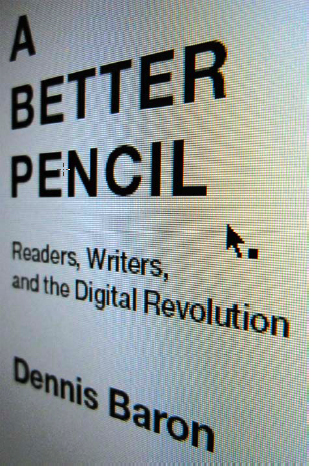
A Better Pencil book coverI very much enjoyed Dennis Baron’s new book, A Better Pencil: Readers, Writers, and the Digital Revolution, and highly recommend you pick it up. Baron does a wonderful job exploring the history of techno-pessimism and the endless battles about the impact of new technologies on life and learning, something I have written about here before in my essays on “Internet optimists vs. pessimists” (See: 1, 2, 3).

I have a complete review of Baron’s A Better Pencil now up on the City Journal‘s website here.  I’ve also pasted it down below.


Plato Wrote it Down by Adam Thierer

a review of A Better Pencil: Readers, Writers, and the Digital Revolution, by Dennis Baron (Oxford University Press, 280 pp., $24.95)

In the beginning, Dennis Baron reminds us in his new book, A Better Pencil, there was the word—the spoken word, that is. Oral tradition, the passing of knowledge through stories and lectures, was the primary method of instruction and learning throughout early human civilization. But then a few innovative souls decided to start writing everything down on stones and clay. Almost as soon as they did, a great debate began on the impact of new communications technology on culture and education. And it rages on today, with a new generation of optimists and skeptics battling over the impact that computing, the Internet, and digital technologies have on our lives and on how we learn about the world.

Continue reading →

libertyby Adam Thierer & Berin Szoka — (Ver. 1.0 — Summer 2009)

We are attempting to articulate the core principles of cyber-libertarianism to provide the public and policymakers with a better understanding of this alternative vision for ordering the affairs of cyberspace. We invite comments and suggestions regarding how we should refine and build-out this outline. We hope this outline serves as the foundation of a book we eventually want to pen defending what we regard as “Real Internet Freedom.” [Note:  Here’s a printer-friendly version, which we also have embedded down below as a Scribd document.]

I. What is Cyber-Libertarianism?

Cyber-libertarianism refers to the belief that individuals—acting in whatever capacity they choose (as citizens, consumers, companies, or collectives)—should be at liberty to pursue their own tastes and interests online.

Generally speaking, the cyber-libertarian’s motto is “Live & Let Live” and “Hands Off the Internet!”  The cyber-libertarian aims to minimize the scope of state coercion in solving social and economic problems and looks instead to voluntary solutions and mutual consent-based arrangements.

Cyber-libertarians believe true “Internet freedom” is freedom from state action; not freedom for the State to reorder our affairs to supposedly make certain people or groups better off or to improve some amorphous “public interest”—an all-to convenient facade behind which unaccountable elites can impose their will on the rest of us.

Continue reading →