On December 13th, I will be participating in an Atlas Network panel on, “Big Tech, Free Speech, and Censorship: The Classical Liberal Approach.” In anticipation of that event, I have also just published a new op-ed for The Hill entitled, “Left and right take aim at Big Tech — and the First Amendment.” In this essay, I expand upon that op-ed and discuss the growing calls from both the Left and the Right for a variety of new content regulations. I then outline the classical liberal approach to concerns about free speech platforms more generally, which ultimately comes down to the proposition that innovation and competition are always superior to government regulation when it comes to content policy.
In the current debates, I am particularly concerned with calls by many conservatives for more comprehensive governmental controls on speech policies enforced by various private platforms, so I will zero in on those efforts in this essay. First, here’s what both the Left and the Right share in common in these debates: Many on both sides of the aisle desire more government control over the editorial decisions made by private platforms. They both advocate more political meddling with the way private firms make decisions about what types of content and communications are allowed on their platforms. In today’s hyper-partisan world,” I argue in my
Hill column, “tech platforms have become just another plaything to be dominated by politics and regulation. When the ends justify the means, principles that transcend the battles of the day — like property rights, free speech and editorial independence — become disposable. These are things we take for granted until they’ve been chipped away at and lost.”
Despite a shared objective for greater politicization of media markets, the Left and the Right part ways quickly when it comes to the underlying objectives of expanded government control. As I noted in my
Hill op-ed:
there is considerable confusion in the complaints both parties make about “Big Tech.” Democrats want tech companies doing more to limit content they claim is hate speech, misinformation, or that incites violence. Republicans want online operators to do less, because many conservatives believe tech platforms already take down too much of their content.
This makes life very lonely for free speech defenders and classical liberals. Usually in the past, we could count on the Left to be with us in some free speech battles (such as putting an end to “indecency” regulations for broadcast radio and television), while the Right would be with us on others (such as opposition to the “Fairness Doctrine,” or similar mandates). Today, however, it is more common for classical liberals to be fighting with both sides about free speech issues.
My focus is primarily on the Right because, with the rise of Donald Trump and “national conservatism,” there seems to be a lot of soul-searching going on among conservatives about their stance toward private media platforms, and the editorial rights of digital platforms in particular. Continue reading →
President Trump and his allies have gone to war with social media sites and digital communications platforms like Twitter, Facebook, and Google. Decrying supposed anti-conservative “bias,” Trump has even floated an Executive Order aimed at “Preventing Online Censorship,” that entails many new forms of government meddling with these private speech platforms. Section 230 is their crosshairs and First Amendment restraints are being thrown to the wind.
Various others have already documented the many legal things wrong with Trump’s call for greater government oversight of private speech platforms. I want to focus on something slightly different here: The surprising ideological origins of what Trump and his allies are proposing. Because for those of us who are old-timers and have followed communications and media policy for many decades, this moment feels like deja vu all over again, but with the strange twist that supposed “conservatives” are calling for a form of communications collectivism that used to be the exclusive province of hard-core Leftists.
To begin, the truly crazy thing about President Trump and some conservatives saying that social media should be regulated as public forums is not just that they’re abandoning free speech rights, it’s that they’re betraying
property rights, too. Treating private media like a “public square” entails a taking of private property. Amazingly, Trump and his followers have taken over the old “media access movement” and given it their own spin. Continue reading →
In my last post, I discussed an outstanding new paper from Ronald Cass on “Antitrust for High-Tech and Low: Regulation, Innovation, and Risk
.” As I noted, it’s one of the best things I’ve ever read about the relationship between antitrust regulation and the modern information economy. That got me thinking about what other papers on this topic that I might recommend to others. So, for what it’s worth, here are the 12 papers that have most influenced my own thinking on the issue. (If you have other suggestions for what belongs on the list, let me know. No reason to keep it limited to just 12.)
- J. Gregory Sidak & David J. Teece, “Dynamic Competition in Antitrust Law,” 5 Journal of Competition Law & Economics (2009).
- Geoffrey A. Manne & Joshua D. Wright, “Innovation and the Limits of Antitrust,” 6 Journal of Competition Law & Economics, (2010): 153
- Joshua D. Wright, “Antitrust, Multi-Dimensional Competition, and Innovation: Do We Have an Antitrust-Relevant Theory of Competition Now?” (August 2009).
- Daniel F. Spulber, “Unlocking Technology: Antitrust and Innovation,” 4(4) Journal of Competition Law & Economics, (2008): 915.
- Ronald Cass, “Antitrust for High-Tech and Low: Regulation, Innovation, and Risk
,” 9(2) Journal of Law, Economics and Policy, Forthcoming (Spring 2012)
- Richard Posner, “Antitrust in the New Economy,” 68 Antitrust Law Journal, (2001).
- Stan J. Liebowitz & Stephen E. Margolis,”Path Dependence, Lock-in, and History,” 11(1) Journal of Law, Economics and Organization, (April 1995): 205-26.
- Robert Crandall and Charles Jackson, “Antitrust in High-Tech Industries,” Technology Policy Institute (December 2010).
- Bruce Owen, “Antitrust and Vertical Integration in ‘New Economy’ Industries,” Technology Policy Institute (November 2010).
- Douglas H. Ginsburg & Joshua D. Wright, “Dynamic Analysis and the Limits of Antitrust Institutions,” 78 (1) Antitrust Law Journal (2012): 1-21.
- Thomas Hazlett, David Teece, Leonard Waverman, “Walled Garden Rivalry: The Creation of Mobile Network Ecosystems,” George Mason University Law and Economics Research Paper Series, (November 21, 2011), No. 11-50.
- David S. Evans, “The Antitrust Economics of Two Sided Markets.”
 In my work critiquing the Lessig-Zittrain-Wu school of thinking–which fears the decline and fall of online “openness” and digital “generativity”–I have argued that, while there is no such thing as perfect “openness,” things are actually getting more open and generative all the time. All that really counts from my perspective is that we are witnessing healthy innovation across the generativity continuum.
Will some devices and platforms continue to be “closed”? Sure. Think Apple and cable set-top boxes. But (a) there’s a ton of innovation taking place on top of those supposedly “closed” platforms and (b) there are other options consumers can exercise if they don’t like those content /information delivery methods. [See this chapter from the Next Digital Decade book for my fuller critique.]
And, even if one adopts a rigid Zittrainian view of openness and generativity, each day seems to bring more good news. From that perspective it’s hard to find a better headline than this one: ”
Smartphone Makers Bow to Demands for More Openness.” That’s from ArsTechnica today and it refers to the fact that smartphone giant HTC just announced it would no longer attempt to lock the bootloader on its smartphones, meaning geeks like me can root and hack their devices to their heart’s content. As the Ars story notes:
Continue reading →
Venture capitalist Bill Gurley asked a good question in a Tweet late last night when he was “wondering if Apple’s 30% rake isn’t a foolish act of hubris. Why drive Amazon, Facebook, and others to different platforms?” As most of you know, Gurley is referring to Apple’s announcement in February that it would require a 30% cut of app developers’ revenues if they wanted a place in the Apple App Store.
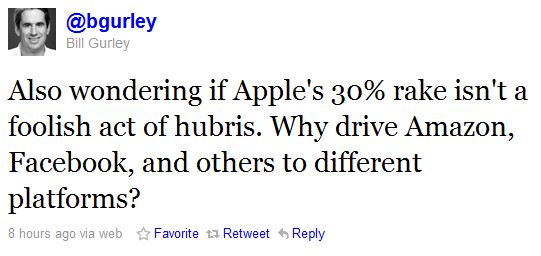 Indeed, why would Apple be so foolish? Of course, some critics will cry “monopoly!” and claim that Apple’s “act of hubris” was simply a logical move by a platform monopolist to exploit its supposedly dominant position in the mobile OS / app store marketplace. But what then are we to make of Amazon’s big announcement yesterday that it was jumping in the ring with its new app store for Android? And what are we to make of the fact that Google immediately responded to Apple’s 30% announcement by offering publishers a more reasonable 10%-of-the-cut deal? And, as Gurley notes, you can’t forget about Facebook. Who knows what they have up their sleeve next. They’ve denied any interest in marketing their own phone and, at least so far, have not announced any intention to offer a competing app store, but why would they need to? Their platform can integrate apps directly into it! Oh, and don’t forget that there’s a little company called Microsoft out there still trying to stake its claim to a patch of land in the mobile OS landscape. Oh, and have you visited the HP-Palm development center lately? Some very interesting things going on there that we shouldn’t ignore.
What these developments illustrate is a point that I have constantly reiterated here: Continue reading →
I’ve just released a new PFF white paper looking at the hysteria that has often accompanied major media mergers and then taking a look at the marketplace reality years after the fact. Here‘s the PDF, but I have also pasted the entire thing down below.
_____________________________
A Brief History of Media Merger Hysteria:
From AOL-Time Warner to Comcast-NBC
by Adam Thierer
Although the pending union of Comcast and NBC Universal has not yet made it to the altar, Chicken Little-esque wails about the marriage have already begun in earnest. For example, the pro-regulatory media organization Free Press has already set up a website to complain about the deal.[1] And Jeff Chester, executive director of the Center for Digital Democracy, has called it “an unholy marriage.”[2] The fever only promises to spread once the deal is formally announced, and a lengthy fight over the deal is expected at the Federal Communications Commission (FCC) and whichever antitrust agency reviews the deal.[3]
But reality tends to play out somewhat less dramatically than the script penned by the media worrywarts. It’s worth looking back at some of the more prominent examples of media merger hysteria in recent years to understand why such panic is unwarranted, and why a deal between Comcast and NBC Universal is unlikely to lead to the sort of problems that the pessimists suggest.[4] Continue reading →
 Seems like everywhere I turn someone is gushing about their new Droid phone, including my TLF colleagues Berin Szoka, Braden Cox, and Ryan Radia, who all had great fun rubbing their new toys in my nose over the past couple of days. And why not, it’s a very cool little device. It makes my HTC Touch seems positively archaic in some ways, and it’s only a year old. Apparently, 100,000 people already picked up a Droid in just its first weekend on the market.
But here’s the first thing that pops in my mind every time I see someone showing off their new Droid: How can a device like this even exist when America’s leading cyberlaw experts have been telling us that the whole digital world is increasingly going to hell because of “closed” devices, proprietary code, and managed networks? I’m speaking, of course, about the lamentations of Harvard professors Lawrence Lessig, Jonathan Zittrain, and their many disciples. As faithful readers will recall, I have relentlessly hammered this crew for their unwarranted cyber-Chicken Little-ism and hyper techno-pessimism. (See my many battles with Zittrain [1, 2, 3, 4, 5, 6 + video] and my 2-part debate with Lessig earlier this year).
“Left to itself,” Lessig warned in Code, “cyberspace will become a perfect tool of control.” He went on to forecast a dystopian future in which nefarious corporate schemers would quash our digital liberties unless benevolent public philosopher kings stepped in to save our poor souls. Code was the Old Testament of cyber-collectivism. The New Testament arrived last year with Zittrain’s
The Future of the Internet and How to Stop It. In it, we hear the grim prediction that “sterile and tethered” digital technologies and networks will triumph over the more “open and generative” devices and systems of the past. The iPhone and TiVo are cast as villains in Zittrain’s drama since they apparently represent the latest manifestations of Lessig’s “perfect control” paranoia.
Apple’s “Angel of Death”
How completely out-of-control has this thinking gotten? Well, here’s David Weinberger — another Harvard Berkman Center worrywart — talking about that supposed satanic font of all evil, the Apple AppStore: Continue reading →
by Berin Szoka & Adam Thierer, Progress Snapshot 5.11 (PDF)
Ten years ago, Nobel Prize-winning economist Milton Friedman lamented the “Business Community’s Suicidal Impulse:” the persistent propensity to persecute one’s competitors through regulation or the threat thereof. Friedman asked: “Is it really in the self-interest of Silicon Valley to set the government on Microsoft?” After yesterday’s FCC vote’s to open a formal “Net Neutrality” rule-making, we must ask whether the high-tech industry—or consumers—will benefit from inviting government regulation of the Internet under the mantra of “neutrality.”
The hatred directed at Microsoft in the 1990s has more recently been focused on the industry that has brought broadband to Americans’ homes (Internet Service Providers) and the company that has done more than any other to make the web useful (Google). Both have been attacked for exercising supposed “gatekeeper” control over the Internet in one fashion or another. They are now turning their guns on each other—the first strikes in what threatens to become an all-out, thermonuclear war in the tech industry over increasingly broad neutrality mandates. Unless we find a way to achieve “Digital Détente,” the consequences of this increasing regulatory brinkmanship will be “mutually assured destruction” (MAD) for industry and consumers.
New Fronts in the Neutrality Wars
The FCC’s proposed rules would apply to all broadband providers, including wireless, but not to Google or many other players operating in other layers of the Net who favor such broadband-specific rules. With this rulemaking looming, AT&T came after Google with letters to the FCC in late September and then another last week accusing the company of violating neutrality principles in their business practices and arguing that any neutrality rules that apply to ISPs should apply equally to Google’s panoply of popular services. In particular, AT&T accused Google of “search engine bias,” suggesting that only government-enforced neutrality mandates could protect consumers from Google’s supposed “monopolist” control.
The promise made yesterday by the FCC—to only apply neutrality principles to the infrastructure layer of the Net—is hollow and will ultimately prove unenforceable. Continue reading →
Whatever you think about this messy dispute between AT&T and Google about how to classify web-based telephony apps for regulatory purposes — in this case, Google Voice — the key issue not to lose site of here is that we are inching ever closer to FCC regulation of web-based apps! Again, this is the point we have stressed here again and again and again and again when opposing Net neutrality mandates: If you open the door to regulation of one layer of the Net, you open up the door to the eventual regulation of all layers of the Net.
You might not buy that story initially but if you doubt it then I invite you to read just about any history of American broadcast media regulation over the course of the past seven decades. (You might want to start with Krattenmaker & Powe’s Regulating Broadcast Programming or Jonathan Emord’s
Freedom, Technology, and the First Amendment). In such histories you will find a common theme: Once regulation of media and communications platforms gets underway, the natural progression of things is uni-directional — Up! That is, when new questions arise about how to “deal with” a new service, network, platform, or technology, the general tendency is the “regulate up” instead of “deregulating down.” When regulators are given a greater say about the contours of markets as technologies evolve and/or converge, we shouldn’t be surprised that their first instinct is to “bring them into the fold.”
And, sadly, that is exactly what is likely to occur eventually with Google Voice. The only really interesting question is what else regulators start mucking with in the search and applications layer once they get their hands on it. And if you still insist that I am being overly paranoid about “regulatory creep” and the prospect of the FCC gradually transforming into the Federal Information Commission, then consider what the agency had to say about cloud computing in paragraph 60 (pg. 21) of the FCC’s recent Wireless Innovation and Investment Notice of Inquiry, which was launched on August 27th: Continue reading →


 The Technology Liberation Front is the tech policy blog dedicated to keeping politicians' hands off the 'net and everything else related to technology.