We hear a lot today about the importance of “disruptive innovation,” “deep technologies,”
“moonshots,” and even “technological miracles.” What do these terms mean and how are they related? Are they just silly clichés used to hype techno-exuberant books, articles, and speeches? Or do these terms have real meaning and importance?
This article explores those questions and argues that, while these terms are confronted with definitional challenges and occasional overuse, they retain real importance to human flourishing, economic growth, and societal progress.
Basic Concepts
Don Boudreaux
defines
moonshots as, “radical but feasible solutions to important problems” and Mike Cushing
has referred to them
as “innovation that achieves the previously unthinkable.” “Deep technology” is another buzzword being used to describe such revolutionary and important innovations. Swati Chaturvedi of investment firm Propel[x]
says
deep technologies are innovations that are “built on tangible scientific discoveries or engineering innovations” and “are trying to solve big issues that really affect the world around them.”
“Disruptive technology” or “game-changing innovations” are other terms that are often used in reference to technologies and inventions with major societal impacts. “Transformative technologies” is another increasingly popular term, albeit one focused mostly on health and wellness-related innovations. Continue reading →
Claire Cain Miller of The New York Times posted an interesting story yesterday noting how, “Technology Has Made Life Different, but Not Necessarily More Stressful.” Her essay builds on a new study by researchers at the Pew Research Center and Rutgers University on “Social Media and the Cost of Caring.” Miller’s essay and this new Pew/Rutgers study indirectly make a point that I am always discussing in my own work, but that is often ignored or downplayed by many technological critics, namely: We humans have repeatedly proven quite good at adapting to technological change, even when it entails some heartburn along the way.
The major takeaway of the Pew/Rutgers study was that, “social media users are not any more likely to feel stress than others, but there is a subgroup of social media users who are more aware of stressful events in their friends’ lives and this subgroup of social media users does feel more stress.” Commenting on the study, Miller of the
Times notes:
Fear of technology is nothing new. Telephones, watches and televisions were similarly believed to interrupt people’s lives and pressure them to be more productive. In some ways they did, but the benefits offset the stressors. New technology is making our lives different, but not necessarily more stressful than they would have been otherwise. “It’s yet another example of how we overestimate the effect these technologies are having in our lives,” said Keith Hampton, a sociologist at Rutgers and an author of the study. . . . Just as the telephone made it easier to maintain in-person relationships but neither replaced nor ruined them, this recent research suggests that digital technology can become a tool to augment the relationships humans already have.
I found this of great interest because I have written about how humans assimilate new technologies into their lives and become more resilient in the process as they learn various coping techniques. Continue reading →
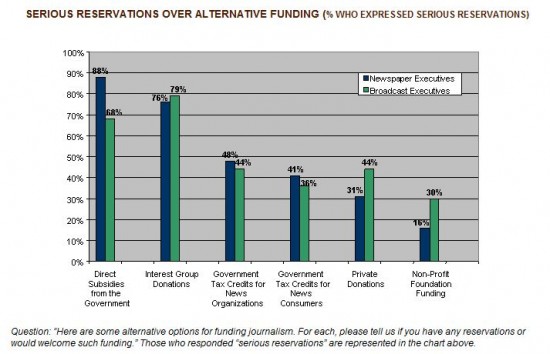
Good to see so many media industry executives expressing skepticism about the idea of government subsidies for the press. Danny Glover brought to my attention this new survey by the Pew Research Center’s Project for Excellence in Journalism in association with the American Society of News Editors (ASNE) and the Radio Television Digital News Association (RTDNA). It revealed that, “Fully 75% of all news executives surveyed—and 88% of newspaper executives—said they had ‘serious reservations,’ or the highest level of concern, about direct subsidies from the government.” A smaller percentage (only 46%) had serious reservations about tax credits for news organizations, then again, only 13% said they “would welcome such funding” and just 6% said they were “enthusiastic” about it.
This is encouraging news as many government officials at the FCC, FTC, and in Congress are currently considering whether government should steps to prop up failing media entities or promote certainly types of content. Berin Szoka and I have been working on a series of essays about the wrong ways to go about reinventing media [see Part 1, Part 2] and plan several more installments leading up to a big filing in the FCC’s “Future of Media” proceeding (the deadline is May 7th).
Here’s a chart from the Pew survey illustrating funding alternatives and the percentage who had “serious reservations” about each option:
by Adam Thierer & Berin Szoka, Progress Snaphot 6.1
Stephanie Clifford of the
New York Times posted a very interesting article this week summarizing a recent “on-the-record chat” the Times staff had with Federal Trade Commission (FTC) chairman Jon Leibowitz and FTC Bureau of Consumer Protection chief David Vladeck. The interview [discussed by Braden here] is profoundly important in that it reveals an alarming disconnect regarding the relationship between “privacy” regulation and the future of media, which were the subjects of their discussion with Times staff. Namely, Leibowitz and Vladeck apparently fail to appreciate how the delicate balance between commercial advertising and journalism is at risk precisely because of the sort of regulations they apparently are ready to adopt. Because the value of online advertising depends on data about its effectiveness and consumers’ likely interests, and because advertising is indispensable to funding media, what’s ultimately at stake here is nothing short of the future of press freedom.
The “Day of Reckoning” Is Upon Us
Leibowitz and Vladeck spend the first half of
The Times interview wringing their hands about “privacy policies,” the declarations made by websites and advertising networks about their data collection and use practices (for which the FTC can and must hold them accountable). But the two feel that privacy policies don’t adequately inform consumers. Chairman Leibowitz claims that online companies “haven’t given consumers effective notice, so they can make effective choices.” And Mr. Vladeck states that advise-and-consent models “depended on the fiction that people were meaningfully giving consent.” But he and the FTC seem ready to abandon the notice and choice model because the “literature is clear” that few people read privacy policies, Vladeck told the Times. He and Leibowitz continue:
“Philosophically, we wonder if we’re moving to a post-disclosure era and what that would look like,” Mr. Vladeck said. “What’s the substitute for it?” He said the commission was still looking into the issue, but it hoped to have an answer by June or July, when it plans to publish a report on the subject. Mr. Leibowitz gave a hint as to what might be included: “I have a sense, and it’s still amorphous, that we might head toward opt-in,” Mr. Leibowitz said.
This clearly foreshadows the regulatory endgame we have long suspected was coming. When the FTC released its “Self-Regulatory Principles for Online Behavioral Advertising” eleven months ago, we asked: “What’s the Harm & Where Are We Heading?” Their answers to both questions have become clearer with each new calculated comment—all apparently intended to slowly “turn up the heat” on the advertising industry so that the proverbial frog will stay in the pot until the water finally boils. Leibowitz’s FTC has simply dodged the “harm” question with a four-part strategy: Continue reading →
I’ve spent a lot of time in recent years trying to debunk various myths about online child safety or at least put those risks into perspective. Too often, press reports and public policy initiatives are being driven by myths, irrational fears, or unjustified “moral panics.” Luckily, the New York Times reports that there’s another study out this week that helps us see things in a more level-headed light. This new MacArthur Foundation report is entitled Living and Learning with New Media: Summary of Findings from the Digital Youth Project. This white paper is a summary of three years of research on kids’ informal learning with digital media. The survey incorporates the insights from 800 youth and young adults and over 5000 hours of online observations. The information will eventually be contained in a book from MIT Press (“Hanging Out, Messing Around, Geeking Out: Living and Learning with New Media.”)
From the summary of the study on the MacArthur website:
“It might surprise parents to learn that it is not a waste of time for their teens to hang out online,” said Mizuko Ito, University of California, Irvine researcher and the report’s lead author. “There are myths about kids spending time online – that it is dangerous or making them lazy. But we found that spending time online is essential for young people to pick up the social and technical skills they need to be competent citizens in the digital age.”
Importantly, regarding the concerns many parents and policymakers have about online predation, Ms. Ito told the
New York Times that, “Those concerns about predators and stranger danger have been overblown.” “There’s been some confusion about what kids are actually doing online. Mostly, they’re socializing with their friends, people they’ve met at school or camp or sports.”
In the report, according to the summary, the researchers “identified two distinctive categories of teen engagement with digital media: friendship-driven and interest-driven. While friendship-driven participation centered on “hanging out” with existing friends, interest-driven participation involved accessing online information and communities that may not be present in the local peer group.” The specific findings of the study are as follows:
Continue reading →

 The Technology Liberation Front is the tech policy blog dedicated to keeping politicians' hands off the 'net and everything else related to technology.