 I’ve noted here before that Gordon Crovitz is my favorite technology policy columnist and that everything he pens for his “Information Age” column for The Wall Street Journal is well worth reading. His latest might be his best ever. It touches upon the great debate between Internet optimists and pessimists regarding the impact of digital technology on our culture and economy. His title is just perfect: “Is Technology Good or Bad? Yes.” His point is that you can find evidence that technological change has both beneficial and detrimental impacts, and plenty of people on both sides of the debate to cite it for you.
He specifically references the leading pessimist, Nicholas Carr, and optimist, Clay Shirky, of our time. In The Shallows: What the Internet is Doing to Our Brains and The Big Switch: Rewiring the World, From Edison to Google, Carr paints a dismal portrait of what the Internet is doing us and the world around us. Clay Shirky responds in books like Here Comes Everybody and Cognitive Surplus: Creativity and Generosity in the a Connected Age, arguing that we are much better off because of the rise of the Net and digital technology.
This is a subject I’ve spent a lot of time noodling over here through the years and, most recently, I compiled all my random thoughts into a mega-post asking, “
Are You an Internet Optimist or Pessimist?” That post tracks all the leading texts on both sides of this debate. I was tickled, therefore, when Gordon contacted me and asked for comment for his story after seeing my piece. [See, people really do still read blogs!] Continue reading →
Michiko Kakutani has a very interesting essay in the New York Times entitled, “Texts Without Contexts,” which does a nice job running through the differences between Internet optimists and pessimists, a topic I’ve spent a great deal of time writing about here. (See: “Are You An Internet Optimist or Pessimist? The Great Debate over Technology’s Impact on Society.”) She surveys many of the books I’ve reviewed and discussed here before by authors such as Neil Postman, Nick Carr, Cass Sunstein, Andrew Keen, Mark Helprin, Jaron Lanier, and others. She notes:
These new books share a concern with how digital media are reshaping our political and social landscape, molding art and entertainment, even affecting the methodology of scholarship and research. They examine the consequences of the fragmentation of data that the Web produces, as news articles, novels and record albums are broken down into bits and bytes; the growing emphasis on immediacy and real-time responses; the rising tide of data and information that permeates our lives; and the emphasis that blogging and partisan political Web sites place on subjectivity.
At the same time it’s clear that technology and the mechanisms of the Web have been accelerating certain trends already percolating through our culture — including the blurring of news and entertainment, a growing polarization in national politics, a deconstructionist view of literature (which emphasizes a critic’s or reader’s interpretation of a text, rather than the text’s actual content), the prominence of postmodernism in the form of mash-ups and bricolage, and a growing cultural relativism that has been advanced on the left by multiculturalists and radical feminists, who argue that history is an adjunct of identity politics, and on the right by creationists and climate-change denialists, who suggest that science is an instrument of leftist ideologues.
It’s a great debate, but a very controversial one, of course. Anyway, go read her entire essay.
Ryan Radia brought to my attention this excellent Slate piece by Vaughan Bell entitled, “Don’t Touch That Dial! A History of Media Technology Scares, from the Printing Press to Facebook.” It touches on many of the themes I’ve discussed here in my essays on techno-panics, fears about information overload, and the broader optimists v. pessimist battle throughout history regarding the impact of new technologies on culture, life and learning. “These concerns stretch back to the birth of literacy itself,” Bell rightly notes:
Worries about information overload are as old as information itself, with each generation reimagining the dangerous impacts of technology on mind and brain. From a historical perspective, what strikes home is not the evolution of these social concerns, but their similarity from one century to the next, to the point where they arrive anew with little having changed except the label.
Quite right. And Bell’s essay reminds us of this gem from the great Douglas Adams about how bad we humans are at putting technological change in perspective:
Anything that is in the world when you’re born is normal and ordinary and is just a natural part of the way the world works. Anything that’s invented between when you’re fifteen and thirty-five is new and exciting and revolutionary and you can probably get a career in it. Anything invented after you’re thirty-five is against the natural order of things.
So true, and I wish I would have remembered it before I wrapped up my discussion about “adventure windows” in the review of Jaron Lanier’s new book, You Are Not a Gadget, which I published last night. As I noted in that essay:
Our willingness to try new things and experiment with new forms of culture—our “adventure window”—fades rapidly after certain key points in life, as we gradually get set in our ways. Many cultural critics and average folk alike always seem to think the best days are behind us and the current good-for-nothing generation and their new-fangled gadgets and culture are garbage.
Continue reading →
2009 was not as big of a year for Internet and information technology (“info-tech”) policy books as 2008 was, but there were still some notable titles released that offered interesting perspectives about the future of the Net and the impact the Digital Revolution is having on our lives, culture, and economy. So, like last year, I figured I would throw together my list of the 10 most important info-tech policy books of the year.
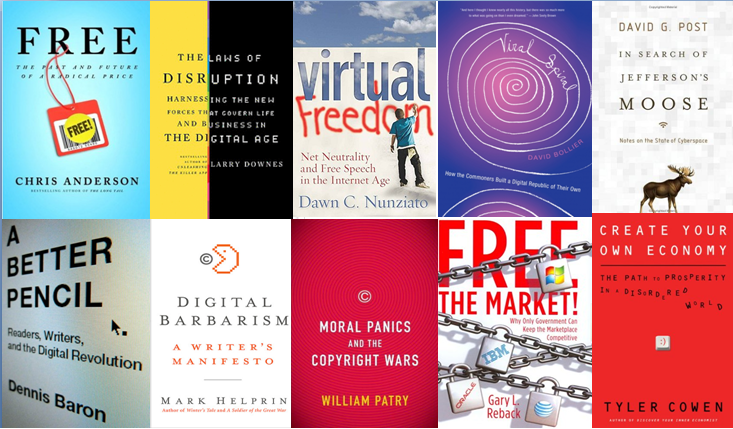 First, let me repeat a few of the same caveats and disclaimers that I set forth last year. What qualifies as an “important” info-tech policy book? Simply put, it’s a title that many people are currently discussing and that we will likely be referencing for many years to come. However, I want to be clear that merely because a book appears on my list it does not necessarily mean I agree with everything said in it. In fact, as was the case in previous years, I found much with which to disagree in my picks for the most important books of 2009 and I find that the cyber-libertarianism I subscribe to has very few fans out there.
Another caveat: Narrowly-focused titles lose a few points on my list. For example, if a book deals mostly with privacy issues, copyright law, or antitrust policy, it does not exactly qualify as the same sort of “tech policy book” as other titles found on this list since it is a narrow exploration of just one set of issues with a bearing on technology policy.
With those caveats in mind, here are my choices for the Most Important Info-Tech Policy Books of 2009. Continue reading →
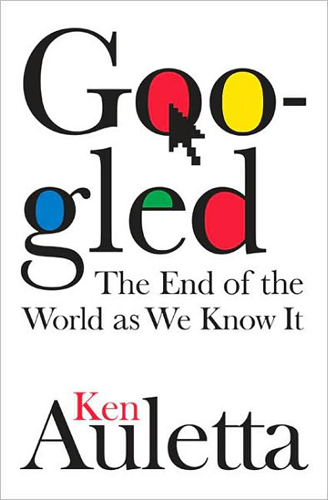 I just finished Ken Auletta’s latest book,
Googled: The End of the World As We Know It, and I highly recommend it. Auletta is an amazingly gifted journalist and knows how put together a hell of good story. It helps in this case that he was granted unprecedented access to the Google team and their day-to-day workings at the Googleplex. I’m really shocked by the level of access he was granted to important meetings and officials–over 150 interviews with Googlers, including 11 with CEO Eric Schmidt and several with founders Sergey Brin and Larry Page. That’s impressive.
I just finished Ken Auletta’s latest book,
Googled: The End of the World As We Know It, and I highly recommend it. Auletta is an amazingly gifted journalist and knows how put together a hell of good story. It helps in this case that he was granted unprecedented access to the Google team and their day-to-day workings at the Googleplex. I’m really shocked by the level of access he was granted to important meetings and officials–over 150 interviews with Googlers, including 11 with CEO Eric Schmidt and several with founders Sergey Brin and Larry Page. That’s impressive.
The book shares much in common with Randall Stross’s excellent Planet Google: One Company’s Audacious Plan to Organize Everything We Know, which I reviewed here earlier this year. Both books recount the history of Google from its early origins to present. And both survey a great deal of ground in terms of the challenges that Google faces as it matures and the policy issues that are relevant to the company (privacy, free speech, copyright law, etc).
What makes Auletta’s book unique is the way we taps his extensive “old media” world contacts and integrates such a diverse cast of characters into the narrative — Mel Karmazin (former Viacom, now Sirius XM), Bob Iger (Disney), Howard Stringer (Sony), Martin Sorrrell (WPP), Irwin Gotlieb (Group M), and even the Internet’s “inventor”–Al Gore! Auletta interviews them or recounts stories about their interactions with Google to show the growing tensions being created by this disruptive company and its highly disruptive technologies. There are some terrifically entertaining anecdotes in the book, but the bottom line is clear: Google has made a lot of enemies in a very short time.
Indeed, the book is as much about the decline of old media as it is about Google’s ascendancy. What Auletta has done so brilliantly here is to tell their stories together and ask how much old media’s recent woes can be blamed on Google and digital disintermediation in general. “If Google is destroying or weakening old business models,” Auletta argues, “it is because the Internet inevitably destroys old ways of doing things, spurs ‘creative destruction.’ This does not mean that Google is not ambitious to grow, and will not grow at the expense of others. But the rewards, and the pain, are unavoidable,” he concludes. Continue reading →
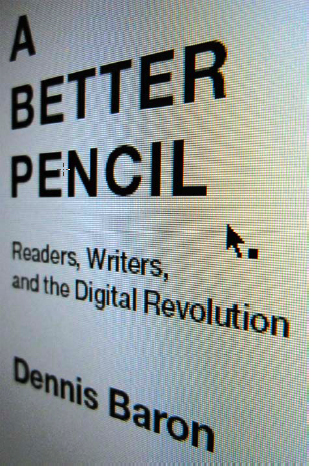 I very much enjoyed Dennis Baron’s new book, A Better Pencil: Readers, Writers, and the Digital Revolution, and highly recommend you pick it up. Baron does a wonderful job exploring the history of techno-pessimism and the endless battles about the impact of new technologies on life and learning, something I have written about here before in my essays on “Internet optimists vs. pessimists” (See: 1, 2, 3).
I have a complete review of Baron’s
A Better Pencil now up on the City Journal‘s website here. I’ve also pasted it down below.
Plato Wrote it Down
by Adam Thierer
a review of A Better Pencil: Readers, Writers, and the Digital Revolution, by Dennis Baron (Oxford University Press, 280 pp., $24.95)
In the beginning, Dennis Baron reminds us in his new book,
A Better Pencil, there was the word—the spoken word, that is. Oral tradition, the passing of knowledge through stories and lectures, was the primary method of instruction and learning throughout early human civilization. But then a few innovative souls decided to start writing everything down on stones and clay. Almost as soon as they did, a great debate began on the impact of new communications technology on culture and education. And it rages on today, with a new generation of optimists and skeptics battling over the impact that computing, the Internet, and digital technologies have on our lives and on how we learn about the world.
Continue reading →
Interesting piece from Jeff Jarvis about “Google Bigotry,” or his belief that “media people are going after Google’s success for no good reason other than their own jealousy.” Jarvis argues that reporters penning hard-nosed stories about Google are, in reality, just a bunch of envious cry-babies:
newspaper people will use their last drops of ink to complain about Google’s success and try to blame it for their own failures rather than changing their own businesses. .. It’s not just that they dislike the competition – and they do, for it is a new experience for too many of them. If they were smart, they’d use Google to get more audience and make more money but they don’t know how to (or rather, they’d prefer not to change). No, the problem is that Google represents change and a new world they’ve refused to understand.
Well, yes and no. I don’t believe that
every story penned about Google by a mainstream media reporter is rooted in envy, and certainly not the one that Jarvis alludes to as prompting him to pen this piece. Jarvis apparently received an inquiry from a French journalist at Le Monde asking for comment about “an article about Google facing a rising tide of discontent concerning privacy and monopoly.” That doesn’t necessarily sound like an unreasonable journalistic inquiry to me. So, I’m not sure it’s fair to accuse every journalist who calls with a hard-nosed question about privacy and antitrust as being guilty of “Google bigotry.”
That being said,
some journalists are likely feeling a bit miffed about Google’s recent success, thinking it comes at their expense, and, therefore, their envy might be prompting some of them to pen attack stories on the company. I think Jarvis in on stronger ground, however, in asserting that most privacy and antitrust complaints about Google are unfounded, and also based on envy. Indeed, Berin Szoka and I have have been cataloging the complaints that we believe are driven by an irrational form of corporate envy we call “Googlephobia.” And in prior years we saw a similar form of Microsoft-bashing at work that we still have with us today. That’s why I think Jarvis is on to something when he notes that Google-bashing represents a broader sociological phenomenon: Continue reading →
It’s been a big year for tech policy books. Several important titles were released in 2008 that offer interesting perspectives about the future of the Internet and the impact digital technologies are having on our lives, culture, and economy. Back in September, I compared some of the most popular technology policy books of the past five years and tried to group them into two camps: “Internet optimists” vs. “Internet pessimists.” That post generated a great deal of discussion and I plan on expanding it into a longer article soon. In this post, however, I will merely list what I regard as the most important technology policy books of the past year.
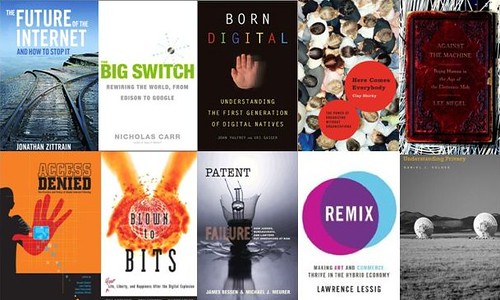
What qualifies as an “important” tech policy book? Basically, it’s a title that many people in this field are currently discussing and that we will likely be talking about for many years to come. I want to make it clear, however, that merely because a book appears on this list it does not necessarily mean I agree with everything said in it. In fact, I found much with which to disagree in my picks for the two most important books of 2008, as well as many of the other books on the list. [Moreover, after reading all these books, I am more convinced than ever that libertarians are badly losing the intellectual battle of ideas over Internet issues and digital technology policy. There’s just very few people defending a “Hands-Off-the-Net” approach anymore. But that’s a subject for another day!]
Another caveat: Narrowly focused titles lose a few points on my list. For example, as was the case in past years, a number of important IP-related books have come out this year. If a book deals exclusively with copyright or patent issues, it does not exactly qualify as the same sort of “tech policy book” as other titles found on this list since it is a narrow exploration of just one set of issues that have a bearing on digital technology policy. The same could be said of a book that deals exclusively with privacy policy, like Solove’s
Understanding Privacy. It’s an important book with implications for the future of tech policy, but I demoted it a bit because of its narrow focus.
With those caveats in mind, here are my Top 10 Most Important Tech Policy Books of 2008 (and please let me know about your picks for book of the year):
Continue reading →
Somewhere between Nick Carr’s “Typology of Network Strategies” and Chris Anderson’s “Four Kinds of Free” is the secret to understanding our new economy:
Carr’s “Typology of Network Strategies”:
- Network effect
- Data mining
- Digital sharecropping, or “user-generated content”
- Complements
- Two-sided markets
- Economies of scale, economies of scope, and experience
Anderson’s “Four Kinds of Free”:
- Direct cross-subsidy (get one thing free, pay for another)
- Ad-supported (third-party subsidizes second party)
- “Freemium” (a few people subsidize everyone else)
- “Gift economy” (people give away things for non-monetary rewards)
Of course, both Carr and Anderson are building on theories and business models previously articulated by many others. A few that come to mind:
 I just finished reading through The Economist’s new 14-page special report on cloud computing, “Let It Rise” in which Ludwig Siegele provides an outstanding overview of cloud computing and why it is so important:
The rise of the cloud is more than just another platform shift that gets geeks excited. It will undoubtedly transform the information technology (IT) industry, but it will also profoundly change the way people work and companies operate. It will allow digital technology to penetrate every nook and cranny of the economy and of society, creating some tricky political problems along the way.
Even if you are very familiar with cloud computing, I recommend you take a look at the article. Anyway, while I was reading it, I was unsurprised to come across some comments from Nicholas Carr, whose new book
The Big Switch: Rewiring the World, from Edison to Google, is essentially an early history of cloud computing and an investigation into its effects on our economy, culture, and society. And that also reminded me that, even though I have mentioned Carr’s book here several times since it was released earlier this year, I have failed to give it a dedicated review. And it certain deserves one because “The Big Switch” is easily one of the most important technology policy books of 2008.
Continue reading →

 The Technology Liberation Front is the tech policy blog dedicated to keeping politicians' hands off the 'net and everything else related to technology.