Those who advocate regulating Internet service providers as common carriers subject to “open access” mandates (a/k/a “Net Neutrality”) want us to believe that their cause is the “Civil Rights” issue of the digital age, with huge popular support and opposed only by self-interested cable companies and their henchmen. In fact, such regulations would actually harm consumers, increase broadband prices, retard the heretofore-explosive growth of bandwidth, and dramatically increase government control over the Internet. Of course, the degree of public interest in a cause doesn’t actually tell us anything about its justice and, fortunately, we live in a democratic oligarchic republic, not a pure democracy. But it’s worth asking whether Americans are really up in arms about the need for “Net Neutrality” regulations. Google Trends suggests not:
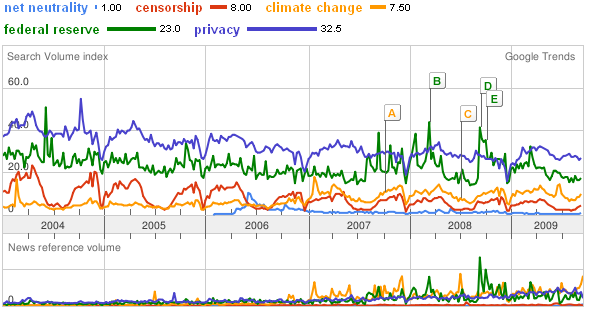 This kind of comparison should dispel once and for all the myth of a popular groundswell for net neutrality regulation—especially since online search volumes heavily over-represent the interests of the digerati, thus over-stating general interest in web-related topics.
In fact, “Net Neutrality” regulation is a
niche cause trumpeted incessantly by the blogosphere with about the same level of broad popular interest online as “housing rights”—a topic about which most of us probably don’t often fall into conversation (unless we happen to live in Bakuninist Berkeley or the Bolivarian Caliphate of Cambridge, MA, ground-zero of American Chavismo). Continue reading →
In a past life — that is, from roughly 1994-2004 — I spent an enormous amount of time countering the proponents of “open access” regulation for communications and high-tech networks. My work in that field culminated in the publication of a 2003 book with my old Cato colleague Wayne Crews entitled, What’s Yours is Mine: Open Access & the Rise of Infrastructure Socialism. We aimed to counter the efforts of bureaucrats and central planners to command technology companies and industry sectors to share networks, facilities, or specific technologies with rivals in the name of “competition.” Simply stated, sharing is not competing, and
competition in the creation of networks is just as important as competition in the goods, services, and information that move across those networks. Moreover, there are property right considerations that come into play when governments seek to commandeer networks or take over network management decisions.
But let’s just stick to the economic issue here regarding the incentives created by the network-sharing mentality of the “forced access” movement and the fiction associated with the belief that network sharing can create competition. My old PFF colleague Randy May, who currently serves as President of the Free State Foundation, continues to cover developments in this field far closer than I do, and has always done much better work on the subject than me. Recently, Randy addressed some new fictions put forth by the radical Leftist activity group, the (Un-)Free Press who are, once again, spinning a revisionist history of telecom and media policy. Specifically, Free Press has recently suggested that in the late 1990s we lived in a veritable communications nirvana, with thousands of Internet Service Providers and/or “competitive exchange carriers” hotly “competing” for our business. Here’s how Randy May addresses this:
Continue reading →
Cory Doctorow has called for a Wikipedia-style effort to build an open source, non-profit search engine. From his column in The Guardian:
What’s more, the way that search engines determine the ranking and relevance of any given website has become more critical than the editorial berth at the New York Times combined with the chief spots at the major TV networks. Good search engine placement is make-or-break advertising. It’s ideological mindshare. It’s relevance…
It’s a terrible idea to vest this much power with one company, even one as fun, user-centered and technologically excellent as Google. It’s too much power for a handful of companies to wield.
The question of what we can and can’t see when we go hunting for answers demands a transparent, participatory solution. There’s no dictator benevolent enough to entrust with the power to determine our political, commercial, social and ideological agenda. This is one for The People.
Put that way, it’s obvious: if search engines set the public agenda, they should be public.
He goes on to claim that “Google’s algorithms are editorial decisions.” For Doctorow, this is an outrage: “so much editorial power is better vested in big, transparent, public entities than a few giant private concerns.”
I wish Doctorow well in his effort to crowdsource a Google-killer, but I’m more than a little skeptical that anyone would actually want to use his search engine of The People. My guess is that, like most things produced in the name of “The People” (Soviet toilet paper comes to mind), it will probably won’t be much fun to use, and will likely chafe noticeably. (For the record, I love and regularly use Wikipedia; I just don’t think that model is unlikely to produce a particularly useful search engine. As Doctorow himself has noted of Google, “they make incredibly awesome search tools.”)
But I’m glad to see that Doctorow has conceded an important point of constitutional law:
The First Amendment protects the editorial discretion of search engines, like all private companies, to decide what to content to communicate. For a newspaper, that means deciding which articles or editorials to run. For a library or bookstore, it means which books to carry. For search engines, it means how to write their search algorithims. Continue reading →

 The Technology Liberation Front is the tech policy blog dedicated to keeping politicians' hands off the 'net and everything else related to technology.