 The Mercatus Center at George Mason University has just released a new paper by Brent Skorup and me entitled, “A History of Cronyism and Capture in the Information Technology Sector.” In this 73-page working paper, which we hope to place in a law review or political science journal shortly, we document the evolution of government-granted privileges, or “cronyism,” in the information and communications technology marketplace and in the media-producing sectors. Specifically, we offer detailed histories of rent-seeking and regulatory capture in: the early history of the telephony and spectrum licensing in the United States; local cable TV franchising; the universal service system; the digital TV transition in the 1990s; and modern video marketplace regulation (i.e., must-carry and retransmission consent rules, among others.
Our paper also shows how cronyism is slowly creeping into new high-technology sectors.We document how Internet companies and other high-tech giants are among the fastest-growing lobbying shops in Washington these days. According to the Center for Responsive Politics, lobbying spending by information technology sectors has almost doubled since the turn of the century, from roughly $200 million in 2000 to $390 million in 2012. The computing and Internet sector has been responsible for most of that growth in recent years. Worse yet, we document how many of these high-tech firms are increasingly seeking and receiving government favors, mostly in the form of targeted tax breaks or incentives. Continue reading →
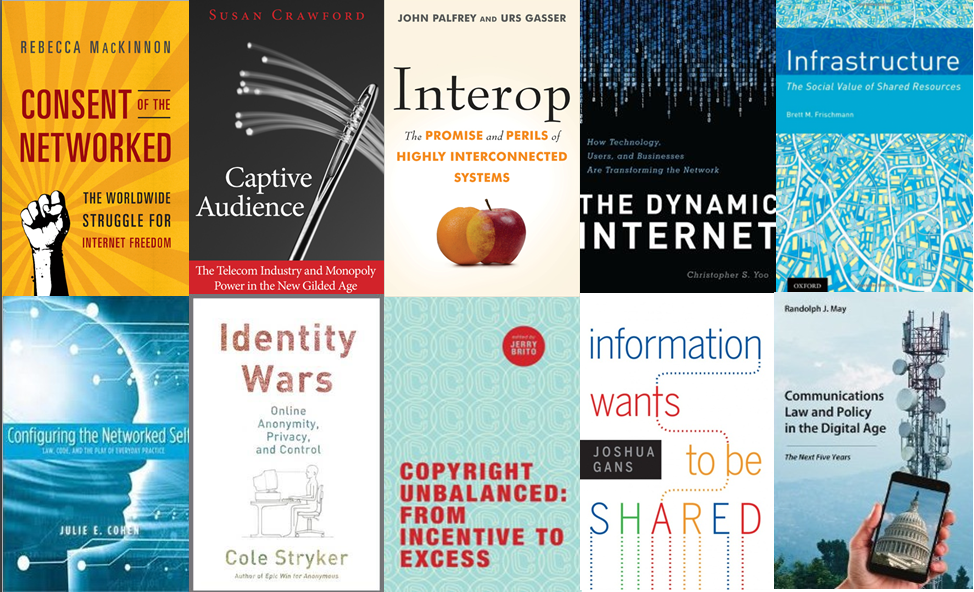
The number of major cyberlaw and information tech policy books being published annually continues to grow at an astonishing pace, so much so that I have lost the ability to read and review all of them. In past years, I put together end-of-year lists of important info-tech policy books (here are the lists for 2008, 2009, 2010, and 2011) and I was fairly confident I had read just about everything of importance that was out there (at least that was available in the U.S.). But last year that became a real struggle for me and this year it became an impossibility. A decade ago, there was merely a trickle of Internet policy books coming out each year. Then the trickle turned into a steady stream. Now it has turned into a flood. Thus, I’ve had to become far more selective about what is on my reading list. (This is also because the volume of journal articles about info-tech policy matters has increased exponentially at the same time.)
So, here’s what I’m going to do. I’m going to discuss what I regard to be the five most important titles of 2012, briefly summarize a half dozen others that I’ve read, and then I’m just going to list the rest of the books out there. I’ve read most of them but I have placed an asterisk next to the ones I haven’t. Please let me know what titles I have missed so that I can add them to the list. (Incidentally, here’s my compendium of all the major tech policy books from the 2000s and here’s the running list of all my book reviews.)
Continue reading →
Many folks are discussing Christopher Ferguson’s latest paper on “The School Shooting / Violent Video Game Link: Causal Relationship or Moral Panic?” And with good reason. It’s an important look at how “moral panics” develop in modern society, in this case around video games. [Moral panics is a subject I have written on at length here many times
before. Alice Marwick’s brilliant article on “technopanics” is also worth reading in this regard].
As I’ve noted here before, Ferguson has penned many important articles raising questions about the claims made by some other psychologists (and politicians) that there is causal relationship between exposure to violent video games and youth aggression. Ferguson has shown there are reasons to be skeptical of such claims — both methodologically and practically-speaking. More on that down below.
In his latest piece, however, Ferguson, a professor at Texas A&M’s Department of Behavioral, Applied Sciences and Criminal Justice, is more fully developing moral panic theory, which he describes as follows: “A moral panic occurs when a segment of society believes that the behavior or moral choices of others within that society poses a significant risk to the society as a whole.” To illustrate the various forces at work that drive moral panics, Ferguson uses this “Moral Panic Wheel”:
![Moral Panic Wheel [Ferguson]](http://farm4.static.flickr.com/3080/3219688961_6d255b309f.jpg) Continue reading →
Continue reading →
A new study (which is actually based on an old study) by Dr. Craig Anderson of Iowa State University and two other researchers is making news today because it suggests a link between violent video games and real-world aggression. I have written extensively about such studies here in the past, and have included a list of relevant links down below. But let me just use the opportunity to restate the fundamental problem with the way the press reports these things.
- First, the press typically accepts the assertion made by authors of studies like these that the social “science” is unanimous in support of such a link between exposure to violent video games and real-world aggression. there is another side the story, but the press usually doesn’t report on it.
- Second, reporters almost always fail to ask about how the researchers define “violent” games and the resulting “aggression” found in these studies.
- Third, reporters almost never ask about how strong the correlation is or, more importantly, what other variables might have had an influence on the the subjects who were studied. (For example, did they factor in real violence in the home or at school?)
- Finally, the reporters almost never query the researchers about the biases they bring to the task of studying this issue (namely, do these researchers have strong feelings about the content in the games they review such that they think they should be regulated in some fashion?).
Luckily, other social researchers are willing to point out these deficiencies. (See, for example, my reviews of the recent books by Drs. Kutner & Olson as well as Dr. Kourosh Dini.) With reference to the new study reported in the press today, Texas A&M researcher Dr. Christopher Ferguson has challenged the study on many of the grounds I listed above. Specifically, in a letter to the journal (Pediatrics) in which the Anderson study appeared, Dr. Ferguson argues:
Continue reading →
 The Mercatus Center at George Mason University has just released a new paper by Brent Skorup and me entitled, “A History of Cronyism and Capture in the Information Technology Sector.” In this 73-page working paper, which we hope to place in a law review or political science journal shortly, we document the evolution of government-granted privileges, or “cronyism,” in the information and communications technology marketplace and in the media-producing sectors. Specifically, we offer detailed histories of rent-seeking and regulatory capture in: the early history of the telephony and spectrum licensing in the United States; local cable TV franchising; the universal service system; the digital TV transition in the 1990s; and modern video marketplace regulation (i.e., must-carry and retransmission consent rules, among others.
 The Technology Liberation Front is the tech policy blog dedicated to keeping politicians' hands off the 'net and everything else related to technology.