by Adam Thierer & Berin Szoka
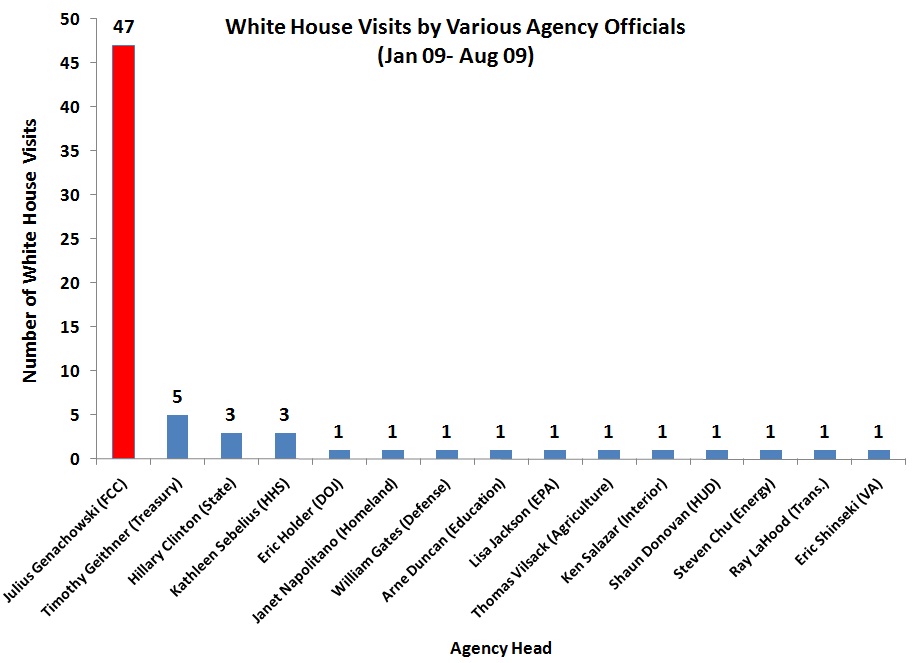
Move over, health care reform, climate change, and the economy. Judging by White House visits by various government agency heads, the Obama administration instead appears preoccupied with the re-regulation of communications, media, and the Internet. The Administration has just released logs of all visitors to the White House and Executive Office Buildings from Obama’s inauguration through August—including a staggering 47 visits by Federal Communications Commission (FCC) Chairman Julius Genachowski. By contrast, no other major agency head logged more than five visits. Chairman Genachowski obviously has an audience with those at the highest levels of power, including the President himself, but this raises questions about just how “independent” this particular regulator and his agency really are.
Unprecedented Transparency by White House
The Administration deserves credit for releasing these visitor logs, which offer unprecedented transparency into the White House’s workings. Unfortunately, the logs lack visitors’ affiliation and title, making it difficult to discern subtle patterns. Furthermore, each entry indicates only one “visitee” and the total number of people involved. Full disclosure requires identifying all meeting participants. Nonetheless, President Obama’s gesture is a great first step toward improved government accountability.
This openness allows us to ask questions we couldn’t pose for previous administrations—such as why the FCC head seems to have unparalleled access to the White House. Lacking data from previous administrations, it’s difficult to make direct comparisons with previous FCC Chairmen, but the sheer number of visits by Chairman Genachowski leaves no doubt about his uniquely close involvement with the White House. Continue reading →
As someone who follows the federal regulatory process, I was amazed to see this in a recent American Spectator post about White House technology advisor Susan Crawford’s return to the University of Michigan Law School:
But White House sources say that she ran afoul of senior White House economics adviser Larry Summers, who claimed he and other senior Obama officials were unaware of how radical the draft Net Neutrality regulations were when they were initially internally circulated to Obama administration officials several weeks ago … In the end, the proposed regulations were slightly moderated from the original language FCC chairman Julius Genachowski, a Crawford ally, circulated.
Unlike regulatory agencies that are considered part of the executive branch, the Federal Communications Commission is an “independent” regulatory agency — which means the president cannot fire its five commissioners. Before executive branch agencies can propose a regulation, it must be reviewed by the Office of Management and Budget’s Office of Information and Regulatory Affairs (OIRA). No administration has yet tried to bring independent agencies like the FCC under OIRA review.
Typically, congressional and private watchdogs scream bloody murder when they see the White House trying to influence independent agencies. But I haven’t heard any barking about this one.
Personally, I think independent agencies’ regulations should be subject to OIRA review. I don’t mind letting the president and his advisors have their say on regulations proposed by people he appointed. But I’d like to see it happen through the formal OIRA review process, where the public knows it’s happening and knows what the rules are.
For example: If you want to know which proposed regulations OIRA has reviewed, go here. If you want to know the standards OIRA uses to review regulations, go here. If you want to know what outside parties have met with OIRA to discuss regulations, go here.
 President-elect Barack Obama will soon be naming Cass Sunstein, an old friend of his from their University of Chicago Law School days together, the new head the White House Office of Information and Regulatory Affairs (OIRA). OIRA oversees regulation throughout the U.S. government. Basically, Sunstein’s position is the equivalent of the federal regulatory czar.
Sunstein certainly possess excellent qualifications for the job. During his time at the University of Chicago and Harvard Law School, Sunstein has established himself as a leading liberal thinker in the field of law and economics. And, as I have joked in writing about him before, he is so insanely prolific that it seems every time I finish reading one of his new books a new title by him lands on my desk. I am quite convinced that both he and Richard Posner are actually cyborgs. I just don’t understand how two humans can compose words so rapidly!
Anyway, Professor Sunstein’s new position as head of OIRA gives him the ability influence federal regulatory decisions in both a procedural and substantive way. In terms of substance, it gives him an important platform to subtly “nudge” the regulatory philosophy and direction of the Obama Administration on many matters, including Internet policy. So, what has Professor Sunstein had to say about Internet policy in his recent work? Sunstein has developed his thinking about these issues primarily in his two recent books: Republic.com (2000) and Infotopia: How Many Minds Produce Knowledge (2006). But he’s also had a few relevant things to say about Internet issues in his recent book with Richard Thaler, Nudge: Improving Decisions About Health, Wealth, and Happiness
(2008).
There are 3 Internet policy-related things from his work that I’d like to focus on here because I find them all quite troubling. Continue reading →

 The Technology Liberation Front is the tech policy blog dedicated to keeping politicians' hands off the 'net and everything else related to technology.