Today, the Obama administration announced 5 executive actions it is taking and 7 legislative proposals it is making to address the problem of patent trolls. While these are incremental steps in the right direction, they are still pretty weak sauce. The reforms could alleviate some of the litigation pressure on Silicon Valley firms, but there’s a long way to go if we want to have a patent system that maximized innovation.
The proposals aim to reduce anonymity in patent litigation, improve review at the USPTO, give more protection to downstream users, and improve standards at the International Trade Commission, a venue which has been gamed by patent plaintiffs. These are all steps worth taking. But they’re not enough. The White House’s press release quotes the president as saying that “our efforts at patent reform [i.e. the America Invents Act, passed in 2011] only went about halfway to where we need to go.” Presumably the White House believes these steps will take us the rest of the way there.
But the problem with computer-enabled patents isn’t merely that they result in a lot of opportunistic litigation, though they do. The problem is that almost every new idea is actually pretty obvious, in the sense that it is “invented” at the same time by lots of companies that are innovating in the same space. Granting patents in a field where everyone is innovating in the same way at the same time is a recipe for slowing down, not speeding up, innovation. Instead of just getting on with the process of building great new products, companies have to file for patents, assemble patent portfolios, license patents from competitors who “invented” certain software techniques a few months earlier, deal with litigation, and so on. A device like a smartphone requires thousands of patents to be filed, licensed, or litigated.
If we really want to speed up innovation, we need to take bolder steps. New Zealand recently abolished software patents by declaring that software is not an invention at all. It would be terrific if the White House would get behind that kind of bold thinking. In the meantime, we’ll have to watch closely as the Obama administration’s executive actions are implemented and its legislative recommendations move through Congress. I hope for the best, but for now I’m not too impressed.
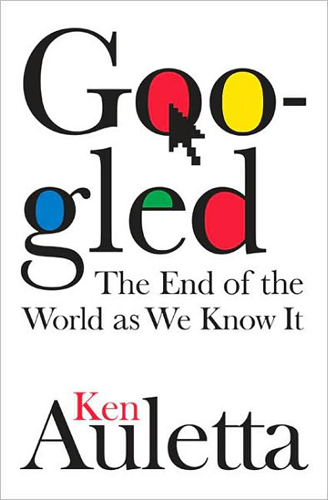 I just finished Ken Auletta’s latest book,
Googled: The End of the World As We Know It, and I highly recommend it. Auletta is an amazingly gifted journalist and knows how put together a hell of good story. It helps in this case that he was granted unprecedented access to the Google team and their day-to-day workings at the Googleplex. I’m really shocked by the level of access he was granted to important meetings and officials–over 150 interviews with Googlers, including 11 with CEO Eric Schmidt and several with founders Sergey Brin and Larry Page. That’s impressive.
I just finished Ken Auletta’s latest book,
Googled: The End of the World As We Know It, and I highly recommend it. Auletta is an amazingly gifted journalist and knows how put together a hell of good story. It helps in this case that he was granted unprecedented access to the Google team and their day-to-day workings at the Googleplex. I’m really shocked by the level of access he was granted to important meetings and officials–over 150 interviews with Googlers, including 11 with CEO Eric Schmidt and several with founders Sergey Brin and Larry Page. That’s impressive.
The book shares much in common with Randall Stross’s excellent Planet Google: One Company’s Audacious Plan to Organize Everything We Know, which I reviewed here earlier this year. Both books recount the history of Google from its early origins to present. And both survey a great deal of ground in terms of the challenges that Google faces as it matures and the policy issues that are relevant to the company (privacy, free speech, copyright law, etc).
What makes Auletta’s book unique is the way we taps his extensive “old media” world contacts and integrates such a diverse cast of characters into the narrative — Mel Karmazin (former Viacom, now Sirius XM), Bob Iger (Disney), Howard Stringer (Sony), Martin Sorrrell (WPP), Irwin Gotlieb (Group M), and even the Internet’s “inventor”–Al Gore! Auletta interviews them or recounts stories about their interactions with Google to show the growing tensions being created by this disruptive company and its highly disruptive technologies. There are some terrifically entertaining anecdotes in the book, but the bottom line is clear: Google has made a lot of enemies in a very short time.
Indeed, the book is as much about the decline of old media as it is about Google’s ascendancy. What Auletta has done so brilliantly here is to tell their stories together and ask how much old media’s recent woes can be blamed on Google and digital disintermediation in general. “If Google is destroying or weakening old business models,” Auletta argues, “it is because the Internet inevitably destroys old ways of doing things, spurs ‘creative destruction.’ This does not mean that Google is not ambitious to grow, and will not grow at the expense of others. But the rewards, and the pain, are unavoidable,” he concludes. Continue reading →
A number of conservative blogs have picked up on reports that the Obama administration is looking to data mine users on social networking sites. Reports CNS News:
Anyone who posts comments on the White House’s Facebook, MySpace, YouTube and Twitter pages will have their statements captured and permanently archived by the federal government, according to a plan that the White House is now seeking a contractor to carry out.
Whenever government is collecting information about private citizens, we should be concerned. But this controversy smells a lot like privacy fear-mongering, even though it involves government. If you post a comment to an “official” Obama administration page on a social networking site, it seems only natural that it’s fair game for data mining. The same goes if you post a video response on a publicly accessible site.
If you’re posting controversial statements online under your real name for the public to see, what do you expect will happen? Anybody in the world who has an Internet connection can log your postings, so why shouldn’t government officials be able to do the same? Until government starts pressuring Facebook or Myspace to hand over data that’s being collected on an
involuntary basis, I don’t see a whole lot here to worry about.
This controversy, and the flap over flag@whitehouse.gov from a few weeks back, raise another interesting question: should Congress reexamine the Presidential Records Act (PRA) of 1978? This is the law that governs Presidential record-keeping. According to some commentators, if the administration solicits data on its critics, it is obligated under the PRA to retain that data indefinitely. I haven’t read the law, but at first glance it appears that it may have some serious deficiencies. This is is hardly surprising, of course, given that the Internet — let alone social networks — didn’t even exist when the PRA was enacted in 1978.
I was very pleased to read in Federal Computer Week this morning that the Office of Management and Budget will begin tracking earmark requests next year for the fiscal 2011 budget cycle.
OMB makes available some years’ approved earmarks, but not the earmark requests put forward by members of Congress. Tracking and publishing requests will shed light on the whole ecosystem of congressional earmarks—the favor factory, if you will.
OMB’s move follows a project WashingtonWatch.com has conducted this summer: asking the public to plug earmark disclosures into a database. The site now maps over 20,000 earmarks. (Well, technically, that much data breaks the mapping tool, but you can see state-by-state earmark maps.)
Earlier this year, the House and Senate Appropriations Committees required their members to disclose earmark requests. These disclosures—published as Web pages and PDF documents—were not useful, but public interest in this area is strong, and the public made them useful by entering them into WashingtonWatch.com’s database.
The project isn’t over, by the way, and the current focus is collecting earmarks requested by Appropriations Committee members.
It’s great news that next year the Obama Administration will track and disclose earmarks, from request all the way through to enactment. Given his struggle in the area lately, this is a chance to score some transparency points. President Obama campaigned against earmarks, promising reform, and this is an important step toward delivering on that promise.
More restraint is in order when it comes to the Obama administrations intent to escalate “antitrust” enforcement against business and enterprise in America.
A skeptical interpretation of antitrust’s realities—up to and including recent campaigns targeting Intel, Google, XM-Sirius; and earlier campaigns against Microsoft and the AOL Time Warner merger, as well as rejected mergers like Echostar/DirecTV—is that antitrust often advances the well being of various species of political predators rather than consumers.
Antitrust is a form of economic regulation. And like all economic regulation, it transfers wealth from somebody to somebody else, often in response to special-interest urging. Partly in recognition of such shortcomings, many economic sectors like transportation and telecommunications were (partly) deregulated and liberalized during the last quarter of the 20th century. But antitrust regulation typically gets a pass. Even in the “new economy,” this century-old smokestack era concept is used to justify constraints and conditions imposed on vigorously competitive modern companies. Antitrust is wrongly seen as being in the public interest, as having a superior role to play in policing markets relative to the alternatives.
Continue reading →
. . . or does he?
Friday afternoon, the White House blog announced that the American Recovery and Reinvestment Act of 2009 was posted online for public comment. This is good evidence that the President intends to honor his campaign promise to post legislation online and take public comment for five days before signing it.
But it’s not great evidence of that.
The Whitehouse.gov post went up at 2:05 pm, but the House didn’t vote until 2:24 pm and the Senate voted at 05:29 pm. (Click on the “votes” to see how your representatives did.) As of Saturday afternoon, the Thomas legislative tracking system doesn’t indicate that the bill has been presented to the President yet. And news reports indicate that the President will sign the bill on Monday, three days after it was “pre-“posted.
Regular order, Mr. President. When a bill is presented to you, post it online (at a consistent place on your Web site, not just at ad hoc URLs as you’ve done up to now). Then wait five days, reviewing the comments of the public as you promised to do when you asked the public to elect you.
The steps the White House has taken toward implementing the President’s promise are good steps. (In this Cato daily podcast, I characterized the President’s record on transparency so far as “mixed.”) But the promise is not fulfilled until bills receive five days online airing after they have been presented.
Presentment is a distinct, constitutional step in the legislative process. Until every non-emergency bill is posted online for five days after presentment and before signing, President Obama will look like he’s being driven by events and maneuvered by his elders in Congress.
I’ve been following President Obama’s early moves on government transparency here on Tech Liberation and on the Cato@Liberty blog.
Last week, Obama’s first broken campaign promise was the pledge to post legislation online for five days before signing it.
Well, the White House is working to address that, but it appears to be doing so with a half-measure that comes up short. On Sunday, the White House blog announced that the SCHIP legislation pending in the Senate was up for public comment. And it is, of course, but it hasn’t passed the Senate yet.
It was implicit in the promise to post bills online for five days prior to signing that the bill posted would be the one passed by the House and Senate and presented to the President.
If the White House were to implement the promised practice of leaving bills sitting out there, unsigned, after they pass Congress, that would have significant effects. The practice would threaten to reveal excesses in parochial amendments and earmarks which could bring down otherwise good bills. President Obama’s promised five-day cooling off period would force the House and Senate to act with more circumspection.
Taking comments on a bill as it makes its way through the House and Senate does not have the same salutary effect. If the White House is trying to start the five-day clock on the SCHIP bill with the posting of a comment page on Sunday, that is not consistent with President Obama’s promise.
The Washington Post reports that the Obama administration is delaying the Bush Administration plan to require federal contractors to use the E-Verify worker background check system.
Criticizing the move, Lamar Smith (R-TX), ranking minority member on the House Judiciary Committee says, “It is ironic that at the same time President Obama was pushing for passage of the stimulus package to help the unemployed, his Administration delayed implementation of a rule designed to protect jobs for U.S. citizens and legal workers.”
E-Verify may well have been designed or intended to protect jobs for citizens and legal workers, but that’s not at all what it would do. I wrote about it in a Cato Policy Analysis titled “Electronic Employment Eligibility Verification: Franz Kafka’s Solution to Illegal Immigration” (a ten-year follow-on to Stephen Moore’s “A National Id System: Big Brother’s Solution to Illegal Immigration“):
A mandatory national EEV system would have substantial costs yet still fail to prevent illegal immigration. It would deny a sizable percentage of law-abiding American citizens the ability to work legally. Deemed ineligible by a database, millions each year would go pleading to the Department of Homeland Security and the Social Security Administration for the right to work.
Even if E-Verify were workable, mission creep would lead to its use for direct federal control of many aspects of American citizens’ lives. Though it should be scrapped, the longer E-Verify is delayed the better.
In at least two recent stories, the mainstream press are highlighting Obama administration slow-walking on transparency.
Bloomberg recently filed suit against the Fed under the Freedom of Information Act to force disclosure of securities the central bank is taking as collateral for $1.5 trillion of loans to banks.
“The American taxpayer is entitled to know the risks, costs and methodology associated with the unprecedented government bailout of the U.S. financial industry,” said Matthew Winkler, the editor-in-chief of Bloomberg News, a unit of New York-based Bloomberg LP . . . .
And here’s what President Obama said in his day-one memorandum on FOIA:
Continue reading →

 The Technology Liberation Front is the tech policy blog dedicated to keeping politicians' hands off the 'net and everything else related to technology.