Posts tagged as:

NPR science correspondent Shankar Vedantam had a great spot on NPR’s Morning Edition today about the disputes among social scientists over the impact of violent video games on kids. [“It’s A Duel: How Do Violent Video Games Affect Kids?”] You won’t be surprised to hear I wholeheartedly agree with Texas A&M psychologist Chris Ferguson, who noted in the spot:

Ferguson says it’s easy to think senseless video game violence can lead to senseless violence in the real world. But he says that’s mixing up two separate things.  “Many of the games do have morally objectionable material and I think that is where a lot of the debate on this issue went off the rails,” he said. “We kind of mistook our moral concerns about some of these video games, which are very valid — I find many of the games to be morally objectionable — and then assumed that what is morally objectionable is harmful.”

I’ve written about Ferguson’s work and these issues more generally many times over through the years here at the TLF. Here are some of the most relevant essays:

In these essays, I’ve tried to make a couple of key points about the social science literature on “media effects” theory: Continue reading →

My thanks to Linton Weeks of NPR who reached out to me for comment for a story he was doing on the impact of the Internet and digital technology on culture and our attention spans. His essay, “We Are Just Not Digging The Whole Anymore,” is an interesting exploration of the issue, although it is clear that Weeks, like Nick Carr (among others), is concerned about what the Net is doing to our brains. He says:

We just don’t do whole things anymore. We don’t read complete books — just excerpts. We don’t listen to whole CDs — just samplings. We don’t sit through whole baseball games — just a few innings. Don’t even write whole sentences. Or read whole stories like this one. We care more about the parts and less about the entire. We are into snippets and smidgens and clips and tweets. We are not only a fragmented society, but a fragment society. And the result: What we gain is the knowledge — or the illusion of knowledge — of many new, different and variegated aspects of life. What we lose is still being understood.

After reading the entire piece I realized that some of my comments to Weeks probably came off as a bit more pessimistic about things than I actually am. I told him, for example, that “Long-form reading, listening and viewing habits are giving way to browse-and-choose consumption,” and that “With the increase in the number of media options — or distractions, depending on how you look at them — something has to give, and that something is our attention span.”

Luckily, however, Weeks was kind enough to also give me the last word in the story in which I pointed out that it would be a serious mistake to conclude “that we’re all growing stupid, or losing our ability to think, or losing our appreciation of books, albums or other types of long-form content.” Instead, I argued: Continue reading →

It was my pleasure today to debate the future of public media funding on Warren Olney’s NPR program, “To The Point“.  I was 1 of 5 guests and I wasn’t brought into the show until about 29 minutes into the program, but I tried to reiterate some of the key points I made in my essay last week on “‘Non-Commercial Media’ = Fine; ‘Public Media’ = Not So Much.”  I won’t reiterate everything I said before since you can just go back and read it, but to briefly summarize what I said there as well as on today’s show: (1) taxpayers shouldn’t be forced to subsidize speech or media content they find potentially objectionable; and (2) public broadcasters are currently perfectly positioned to turn this federal funding “crisis” into a golden opportunity by asking its well-heeled and highly-diversified base of supporters to step up to the plate and fill the gap left by the end of taxpayer subsidies.

Just a word more on that last point. As I pointed out on the show today, it’s an uncomfortable fact of life for NPR that their average listener is old, rich, highly-educated, and mostly white.  Specifically, here are some numbers that NPR itself has compiled about its audience demographics:

  • The median age of the NPR listener is 50.
  • The median household income of an NPR News listener is about $86,000, compared to the national average of about $55,000.
  • NPR’s audience is extraordinarily well-educated.  Nearly 65% of all listeners have a bachelor’s degree, compared to only a quarter of the U.S. population.  Also, they are three times more likely than the average American to have completed graduate school.
  • The majority of the NPR audience (86%) identifies itself as white.

Why do these numbers matter? Simply stated: These people can certainly step up to the plate and pay more to cover the estimated $1.39 that taxpayers currently contribute to the public media in the U.S.  But wait, there’s more! Continue reading →

I’m not one of those libertarians who incessantly rants about the supposed evils of National Public Radio (NPR) and the Public Broadcast Service (PBS).  In fact, I find quite a bit to like in the programming I consume on both services, NPR in particular. A few years back I realized that I was listening to about 45 minutes to an hour of programming on my local NPR affiliate (WAMU) each morning and afternoon, and so I decided to donate $10 per month. Doesn’t sound like much, but at $120 bucks per year, that’s more than I spend on any other single news media product with the exception of The Wall Street Journal. So, when there’s value in a media product, I’ll pay for it, and I find great value in NPR’s “long-form” broadcast journalism, despite its occasional political slant on some issues.

In many ways, the Corporation for Public Broadcasting, which supports NPR and PBS, has the perfect business model for the age of information abundance. Philanthropic models — which rely on support for foundational benefactors, corporate underwriters, individual donors, and even government subsidy — can help diversify the funding base at a time when traditional media business models — advertising support, subscriptions, and direct sales — are being strained.  This is why many private media operations are struggling today; they’re experiencing the ravages of gut-wrenching marketplace / technological changes and searching for new business models to sustain their operations. By contrast, CPB, NPR, and PBS are better positioned to weather this storm since they do not rely on those same commercial models.

Nonetheless, NPR and PBS and the supporters of increased “pubic media” continue to claim that they are in peril and that increased support — especially public subsidy — is essential to their survival.  For example, consider an editorial in today’s Washington Post making “The Argument for Funding Public Media,” which was penned by Laura R. Walker, the president and chief executive of New York Public Radio, and Jaclyn Sallee, the president and chief executive of Officer Kohanic Broadcast Corp. in Anchorage. They argue: Continue reading →

I sincerely hope it was a Washington Post editor, and not New America Foundation president Steve Coll, who picked the title for his editorial today, “Why Fox News Should Help Fund NPR.”  After all, Coll certainly must be smart enough to know that there is no law or regulation on the books today that gives the Federal Communications Commission (FCC) or any other agency the ability to force private media providers to fund their public media competitors.  Moreover, it takes a lot of chutzpah to try to spin NPR’s recent Juan Williams fiasco into an excuse for private media providers like Fox News to fund NPR, but, shockingly, that’s exactly what Coll does. “The Williams imbroglio is teachable, but its lessons actually point in the opposite direction: America’s public media system, including NPR, requires more funding, not less.”  Hmm… that’s not exactly the lesson most of the rest of the world took away from this episode!

Coll first argues it makes sense for private media funds to be transferred to NPR becuase “In this time of niche publications and cable networks that thrive on ideological anger, we should be seeking to strengthen NPR’s role as a convener of the public square, a demagogue-free zone where all political and social groups — including conservatives and others opposed to federal funding of public media — should be welcome on equal terms.”  This is indicative of the all-too-common “progressive” impulse to force media upon us that we don’t want or even find offensive.  To be clear, I am not one of those people who finds NPR to be a hopelessly biased bastion of Leftist thinking.  While I think it’s clear to everyone that many of NPR’s stories and reporters do lean that direction, I also think there’s some outstanding reporting to be found there.  But if Steve Coll and his colleagues at the New America Foundation want to see NPR get more funding, they should do the same thing I do:  Open up their wallets and make the voluntary choice to fund it. To force everyone else to do so is despicable.

Continue reading →

Just FYI.. Tomorrow’s “Diane Rehm Show” on NPRs local affiliate station (WAMU 88.5FM) will feature a debate about the Federal Communications Commission’s (FCC) National Broadband Plan, which is due out tomorrow. [Here’s the executive summary.]  The show airs at 10:00 locally, but you can listen to the show here online, and I’ll repost a link or embedded audio file once it becomes available.

I’ve been invited to be on the show alongside Ben Scott, policy director at Free Press, Dennis Wharton, spokesperson for the National Association of Broadcasters (NAB), and a few other guests who haven’t been announced just yet. (Here are some of my early musings on the plan: 1, 2.)

Every Tuesday, Washington, DC’s local NPR station (88.5 WAMU) carries a “Tech Tuesdays” program as a regular part of The Kojo Nnamdi Show.  This week’s show, which was guest hosted by Marc Fisher of the Washington Post, was on “Regulating the World Wide Web: A View from Abroad.” It was a wide-ranging and very interesting discussion about the future of Internet governance and regulation, featuring:

  • Evgeny Morozov: Yahoo! Fellow at the Institute for the Study of Diplomacy at Georgetown University; Fellow, Open Society Institute; and author “Net Effect” blog on ForeignPolicy.com
  • John Morris: General Counsel, Director of the Internet Standards, Technology and Policy Project, Center for Democracy and Technology
  • Olivier Tesquet: Reporter, Slate.fr (France)

Listen here. It’s worth your time.

Free Press, the radical pro-regulatory media activist group, recently filed comments with the Federal Trade Commission (FTC) for the agency’s upcoming workshop on “How Will Journalism Survive the Internet Age?”  The Free Press comments provide an enlightening glimpse into the mind of how many on the Left now think about media policy in America.  Their approach can be summarized as follows:

  1. Nothing the private sector can do will save journalism (unless it is entirely non-profit / non-commercial in nature);
  2. Even if there was something that private players could do to save journalism, Free Press would likely have federal authorities forbid it anyway (especially if it involved new business ownership patterns or combinations); and,
  3. The only thing that can really save journalism is a “public option” for the press in the form of massive state subsidization of media in this country.

To elaborate on the last point, here’s how Free Press summarizes what they are looking for:

For U.S. public media to become a truly world-class system will require a substantial increase in funding. This could be accomplished by an increase in direct congressional appropriations to the Corporation for Public Broadcasting. With increased funding — to as little as $5 per person, increasing annual appropriations to some $1.5 billion — the American public media system could dramatically increase its capacity, reach, diversity and relevance.

But they stress that a simple expansion of the PBS/NPR/CPB non-commercial model will not be enough since that system is “vulnerable to repeated threats of funding cuts” and too “reliant on corporate backing, via the underwriting process.” They want to go well beyond non-commercial media, therefore, and have the state start building a massive public media infrastructure.  Here’s where their pitch for a public option for the press comes in: Continue reading →

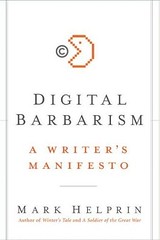
Last month, Digital Barbarism book cover National Review magazine published a review that I penned of Mark Helprin’s new book, Digital Barbarism: A Writer’s Manifesto.  Helprin’s book is both a passionate defense of copyright law as well as a mini-autobiography.  Helprin is one of the great novelists and essayists of the past half-century, and his book A Soldier of a Great War is one of my all-time favorite novels.  I cannot in strong enough words encourage you to read that book; it is profoundly moving. (I almost named my son after the lead character in the book!)

Thus, I was quite excited when I learned that Helprin had penned a defense of copyright and I jumped at the chance to review it when the folks at National Review asked me to do so.  Alas, as you will see in my review, I was terribly disappointed.  I wish Helprin would have stuck with the very reasonable tone he adopted in this excellent podcast interview he did recently with John J. Miller of National Review Online. Unfortunately, he went a different direction in the book, as I make clear in my review:


National Review July 20, 2009

“Man, Machine, and Copyright” a review of Digital Barbarism: A Writer’s Manifesto, by Mark Helprin by Adam Thierer

It would be difficult to think of anyone more ideally suited to pen a passionate defense of copyright law than novelist Mark Helprin.  Helprin has written several of the finest works of modern literature, including his masterpiece, A Soldier of the Great War, a narrative of transcendent beauty. In Digital Barbarism, Helprin sets out to use his formidable gift for the written word to repel the “cyber mob” that has attacked copyright law and called for its curtailment, or even abolition.

Unfortunately, while Helprin occasionally rises to great heights in his defense of copyright, he too often sinks to lamentable lows — by resorting to the same unbecoming rhetorical tactics used by the mob he seeks to condemn. Indeed, his book is filled with gratuitous vitriol and neo-Luddite ramblings about the Internet and Information Age that severely detract from his defense of copyright. This is a shame, because, in places, Digital Barbarism makes a fine case against those critics who wrongly view copyright as an impediment to the creation and diffusion of content. “The availability of information is not and will not be restrained by the copyright system any more than it is or will be restrained by the delivery systems that make it possible,” Helprin argues. Why, he asks, “must ‘content’ be free” when everything else — access to the Internet, digital devices, etc. — costs good money? He notes that the movement that advocates “free,” universal access to all copyrighted material in the name of “openness” and “the public good” would, ironically, “destroy the dream it advocates”: Continue reading →

There’s been plenty written about the death spiral that America’s newspaper industry finds itself stuck in — here’s an amazing summary of the recent online debates — and I’ve spent a lot of time writing on this issue here in the past, too.  Ben Compaine, one of America’s sharpest media analysts and the co-author of the classic study Who Owns the Media?, has added his own two cents in his latest essay over at the Rebuilding Media blog. Like everything Ben writes, it is well worth reading:

If newspapers have essentially been able to thrive on the revenue from advertisers alone (again, with cost of printing more or less covered by circulation revenue), why are they having so much trouble today? The answer is not one single factor, but a major contributor is that newspapers – whether print or digital—are just worth less to advertisers than they were 20 years ago. Back then, local advertisers did not have many options for reaching the mass local audience. What was the alternative for auto dealers? For real estate agents? Supermarkets or department stores? For some, direct mail was one possible option. But that was about it. Using pre-prints instead of ROP became attractive for some large display advertisers, leaving the publishers with a piece of the cash flow. Advertisers were hit with regular rate increases. And they pretty much had to pay, The publishers made good money. But then a double whammy. Just about the time the Internet became a real alternative for classified listings—think Craigslist, Monster.com, eBay, Autotrader.com—and for retailers—think DoubleClick, Google, et al—the boys at the cable operators had perfected the insertion of highly local spots into their feeds. Between 1989 and 2007 local cable advertising increased from $500 million to $4.3 billion—or from 0.4% of all advertising to 1.6%. Advertising in newspapers fell from 26% to 15% in this period. Although some of the highly local advertisers going to cable may have taken some of their funds from budgets for radio or other local media, it is probable that a significant share came from the hides of newspapers. I estimate perhaps up to 20% of the decline in local newspaper advertising share can be attributed to local cable spots. The other whammy, the gorilla in the room, is Internet advertising. No need to elaborate. But its impact on newspapers is not just that it has siphoned off dollars per se. Much more importantly is that the Internet has given most advertisers greater market power against newspaper publishers. Many big advertisers—like car dealers, real estate offices and big box retailers—don’t need the newspapers as much.

Ben’s got it exactly right. The decline of newspapers comes down to the death of  “protectable scarcity” (thanks to Canadian media expert Ken Goldstein for that phrase).  There’s just too much other competition out there online already for our eyes and ears.  We’re witnessing substitution effects on a scale never seen in the media world, with disruptive digital technologies and networks splintering our attention spans.  That de-massification of media means that high fixed cost endeavors like daily newspapers are not going to be able to sustain the cross-subsidies they’ve long gotten from advertisers.

If you want to boil the newspaper death spiral down to an equation, it would look something like this:

Continue reading →