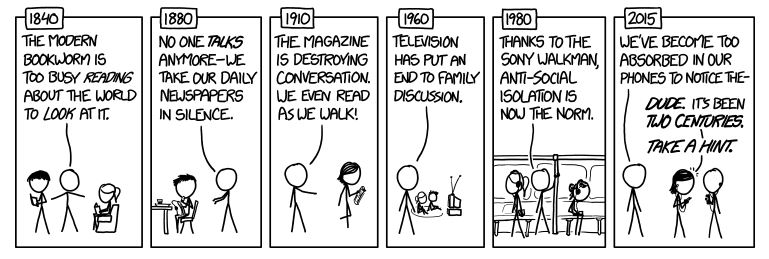
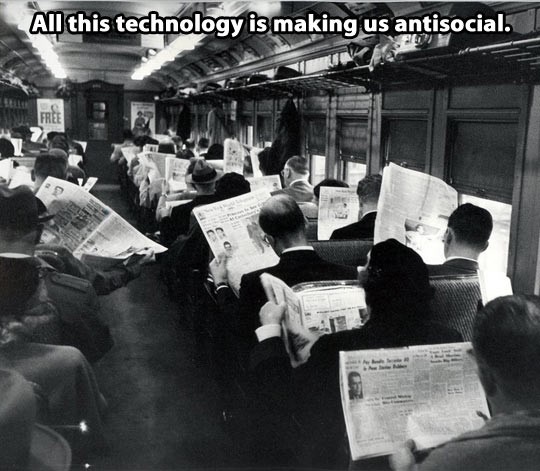
Last week, science writer Michael Shermer tweeted out this old xkcd comic strip that I had somehow missed before. Shermer noted that it represented, “another reply to pessimists bemoaning modern technologies as soul-crushing and isolating.” Similarly, there’s this meme that has been making the rounds on Twitter and which jokes about how newspapers made us as antisocial in the past much as newer technologies supposedly do today.
The sentiments expressed by the comic and that image make it clear how people often tend to romanticize past technologies or fail to remember that many people expressed the same fears about them as critics do today about newer ones. I’ve written dozens of articles about “moral panics” and “techno-panics,” most of which are cataloged here. The common theme of those essays is that, when it comes to fears about innovations, there really is nothing new under the sun. Continue reading →
Timothy B. Lee, founder of The Washington Post’s blog The Switch discusses his approach to reporting at the intersection of technology and policy. He covers how to make tech concepts more accessible; the difference between blogs and the news; the importance of investigative journalism in the tech space; whether paywalls are here to stay; Jeff Bezos’ recent purchase of The Washington Post; and the future of print news.
This morning, the Federal Communications Commission (FCC) released its eagerly-awaited “Future of Media” report. The 475-page final report is entitled, “The Information Needs of Communities: The Changing Media Landscape in a Broadband Age.” [Here’s a 2-page summary and the official press release.] The report is a bit overdue; the effort was supposed to be wrapped up late last year. Comments in the proceeding were filed over a year ago. Here are some of the major ones. Also, here is the 80-page monster filing that I submitted with my former PFF colleagues Berin Szoka and Ken Ferree.
My first reaction after scanning the FCC’s final report is one of relief. For those of us who care about the First Amendment, media freedom, and free-market experimentation with new media business models, it feels like we’ve dodged a major bullet. The report does not recommend sweeping regulatory actions that might have seen Washington inserting itself into the affairs of the press or bailing out dying business models.
The Progress & Freedom Foundation today filed comments in the Federal Communication Commission’s (FCC) “Future of Media” proceeding. Berin Szoka, Ken Ferree, and I urged the FCC to “reject Chicken Little-esque calls for extreme media ‘reform’ solutions,” and counseled policymakers to move cautiously so that media reform can be “organic and bottom-up, not driven by heavy-handed, top-down industrial policies for the press.”
Our 79-page filing covers a wide range of ideas being examined by Washington policymakers to help struggling media outlets and unemployed journalists, or to expand public media / “public interest” content and regulation. Among the major issues explored in our filing:
First Amendment concerns implicated by government subsidies;
The pitfalls of imposing new “public interest” obligations on media operators;
How advertising restrictions could harm the provision of media and news;
Taxes, fees and other regulations to be avoided;
The limited role in reform that public media subsidies can play; and
Positive steps government could take.
We note that as “With many operators struggling to cope with intensifying competition, digitization, declining advertising budgets, and fragmenting audiences, some pundits and policymakers are wondering what the ‘future of media’ entails. The answer: Nobody knows.” While this uncertainty has put concerned policymakers at the ready to “help” the press, we warn that: “There is great danger in rash government intervention.” Instead, policymakers should be “careful to not inhibit potentially advantageous marketplace developments, even if some are highly disruptive.” Marketplace meddling, or government attempts to tinker with private media business models in the hopes that something new and better can be created, are misguided. Moreover, “Our constitutional traditions warn against it, history suggests it would be unwise, and practical impediments render such meddling largely unworkable, anyway.”
Stephanie Clifford of the
New York Times posted a very interesting article this week summarizing a recent “on-the-record chat” the Times staff had with Federal Trade Commission (FTC) chairman Jon Leibowitz and FTC Bureau of Consumer Protection chief David Vladeck. The interview [discussed by Braden here] is profoundly important in that it reveals an alarming disconnect regarding the relationship between “privacy” regulation and the future of media, which were the subjects of their discussion with Times staff. Namely, Leibowitz and Vladeck apparently fail to appreciate how the delicate balance between commercial advertising and journalism is at risk precisely because of the sort of regulations they apparently are ready to adopt. Because the value of online advertising depends on data about its effectiveness and consumers’ likely interests, and because advertising is indispensable to funding media, what’s ultimately at stake here is nothing short of the future of press freedom.
The “Day of Reckoning” Is Upon Us
Leibowitz and Vladeck spend the first half of
The Times interview wringing their hands about “privacy policies,” the declarations made by websites and advertising networks about their data collection and use practices (for which the FTC can and must hold them accountable). But the two feel that privacy policies don’t adequately inform consumers. Chairman Leibowitz claims that online companies “haven’t given consumers effective notice, so they can make effective choices.” And Mr. Vladeck states that advise-and-consent models “depended on the fiction that people were meaningfully giving consent.” But he and the FTC seem ready to abandon the notice and choice model because the “literature is clear” that few people read privacy policies, Vladeck told the Times. He and Leibowitz continue:
“Philosophically, we wonder if we’re moving to a post-disclosure era and what that would look like,” Mr. Vladeck said. “What’s the substitute for it?” He said the commission was still looking into the issue, but it hoped to have an answer by June or July, when it plans to publish a report on the subject. Mr. Leibowitz gave a hint as to what might be included: “I have a sense, and it’s still amorphous, that we might head toward opt-in,” Mr. Leibowitz said.
This clearly foreshadows the regulatory endgame we have long suspected was coming. When the FTC released its “Self-Regulatory Principles for Online Behavioral Advertising” eleven months ago, we asked: “What’s the Harm & Where Are We Heading?” Their answers to both questions have become clearer with each new calculated comment—all apparently intended to slowly “turn up the heat” on the advertising industry so that the proverbial frog will stay in the pot until the water finally boils. Leibowitz’s FTC has simply dodged the “harm” question with a four-part strategy: Continue reading →
With the advent of new technology, newspapers are being threatened. Many are expected to go out of business, and the rest will have to change substantially. Many observers fear that journalism will become too driven by speed, and that judgment and deliberation will be lost. Others said that news reporting would be devalued and only those providing analysis and opinion would survivie. Worst of all, worries that the new technology will lead to a monopoly over information.
A description of the dire situation faced by newspapers today as they face the Internet? No. These are the concerns expressed in the 1840s as the telegraph transformed the news business. This week’s Economist tells the story of how Samuel Morse’s invention was thought to signal the death knell for newspapers, and to thoughtful journalism.
As it turned out, the news business was tranformed. But not in the ways many feared. With faster communications, the quality of news, and of the information Americans received, improved. Newspapers had to adapt, but survived and even prospered. And no one ever created a monopoly over information.
We’ve talked here before about the dangers of a government-subsidized press as a way of “saving journalism.” But I don’t think I’ve ever read anything quite as eloquent on the issue as Seth Lipsky’s editorial in today’s Wall Street Journal entitled “All the News That’s Fit to Subsidize.” Mr. Lipsky is a member of the adjunct faculty at the Columbia Journalism School. In his essay today, he warns of the very real slippery slope associated with proposal to have government step in and somehow bailout newspapers as they find themselves in a time of crisis.Specifically, Mr. Lipsky addressees a new report (“The Reconstruction of American Journalism“) by Leonard Downie (former executive editor of the Washington Post) and co-author Michael Schudson (also of Columbia Journalism School), in which the authors call for a mixture of legal and regulatory changes as well as government subsidies to help prop up failing news operations.
Mr. Lipsky argues that they have “stepped onto an exceptionally slippery slope”: Continue reading →
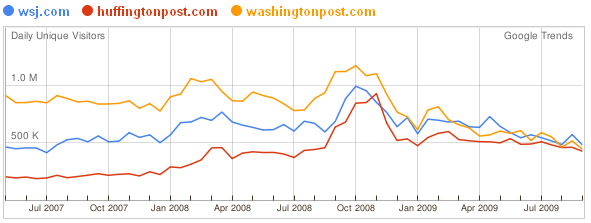
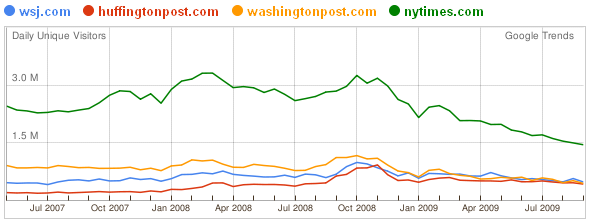
Google Trends for websites reveals all kinds of fascinating insights into the way technology is reshaping the world. Among them is the fact that the HuffingtonPost.com has matured from a scruffy group blog into a new media powerhouse to rival the Wall Street Journal and Washington Post:
Note that the convergence of these three sites has happened both because HuffPo has doubled its audience and because the audience for the WashingtonPost.com has shrunk by half. While WSJ.com’s audience has returned to roughly its pre-election level, the decline of NYTimes.com suggests that the Internet really is splintering audiences and bringing the giants of news media like the “Gray Lady” down from their once unassailable heights:
Two great articles today about the dangers of government getting too involved in the newspaper business as the industry experiences serious marketplace difficulties. Slate’s Jack Shafer (“Saving Newspapers From Their Saviors“) and Mark Hopkins of Silicon Angle (“Obama Administration ‘Open’ to State Run Newspapers“) both raise concerns about President Obama’s recent comments hinting that he is open to legislation that might grant struggling news organizations tax breaks if they were to restructure as nonprofit businesses.
In a piece for the
City Journal back in March entitled “Socializing Media in Order to Save It,” I discussed the specific proposal in question, Senator Benjamin L. Cardin’s (D-MD) bill, S. 673, the “Newspaper Revitalization Act,” which would allow newspapers to become nonprofit organizations in an effort to help them stay afloat. Importantly, however, the measure would also disallow political endorsements on their editorial pages as part of the deal. In my essay, I pointed out how “If the FCC received grant-making authority to dole out subsidies to media operators… it’s hard to imagine how journalists won’t be expected to surrender something in exchange.” And that something would be their journalistic independence.
Shafer and Hopkins raise similar concerns in their essays. Continue reading →
Polish designer Jacek Utko acknowledged that, in the long-run, nothing can save the newspaper as a print medium, but makes a pretty good case newspapers’ ability to stay afloat while figuring out how to make the transition to digital media depends heavily on shaking up the graphic design and layout of papers.
http://video.ted.com/assets/player/swf/EmbedPlayer.swf
If nothing else, this should remind us all that innovation and entrepreneurship aren’t just about technical improvements or better business savvy, but aesthetics, too! The
art of commercial culture is like the oxygen we breath: all around us but something we scarcely notice.
The Technology Liberation Front is the tech policy blog dedicated to keeping politicians' hands off the 'net and everything else related to technology. Learn more about TLF →


 The Technology Liberation Front is the tech policy blog dedicated to keeping politicians' hands off the 'net and everything else related to technology.