A group of regulatory advocates that includes Free Press, Media Access Project and the New America Foundation, have fired off a letter to the Federal Communications Commission (FCC) requesting action against the nation’s #5 mobile provider, MetroPCS. These regulatory groups claim that “new service plans being offered by mobile provider MetroPCS block and discriminate against Internet content, applications and websites.” Wired’s Ryan Singel summarizes what the fight is about:
At issue are new, tiered 4G data plans from the nation’s fifth largest mobile carrier, which specializes in pay-as-you-go mobile-phone service. The new plans offer “unlimited web usage” for all three tiers, which cost $40, $50 and $60 a month. But MetroPCS’s terms exclude video sites other than YouTube from “unlimited web usage,” and block the use of internet-telephony services such as Skype and Tango. The terms of service also make it very unclear whether users would be allowed to use online-radio services such as Pandora.
The parties petitioning the FCC for regulatory intervention claim that “MetroPCS appears to be in violation of the Commission’s recently adopted open Internet rules” even though they note that “these rules have not yet taken effect.”
There are four things I find interesting about this hullabaloo: Continue reading →
I sincerely hope it was a Washington Post editor, and not New America Foundation president Steve Coll, who picked the title for his editorial today, “Why Fox News Should Help Fund NPR.” After all, Coll certainly must be smart enough to know that there is no law or regulation on the books today that gives the Federal Communications Commission (FCC) or any other agency the ability to force private media providers to fund their public media competitors. Moreover, it takes a lot of chutzpah to try to spin NPR’s recent Juan Williams fiasco into an excuse for private media providers like Fox News to fund NPR, but, shockingly, that’s exactly what Coll does. “The Williams imbroglio is teachable, but its lessons actually point in the opposite direction: America’s public media system, including NPR, requires more funding, not less.” Hmm… that’s not exactly the lesson most of the rest of the world took away from this episode!
Coll first argues it makes sense for private media funds to be transferred to NPR becuase “In this time of niche publications and cable networks that thrive on ideological anger, we should be seeking to strengthen NPR’s role as a convener of the public square, a demagogue-free zone where all political and social groups — including conservatives and others opposed to federal funding of public media — should be welcome on equal terms.” This is indicative of the all-too-common “progressive” impulse to force media upon us that we don’t want or even find offensive. To be clear, I am
not one of those people who finds NPR to be a hopelessly biased bastion of Leftist thinking. While I think it’s clear to everyone that many of NPR’s stories and reporters do lean that direction, I also think there’s some outstanding reporting to be found there. But if Steve Coll and his colleagues at the New America Foundation want to see NPR get more funding, they should do the same thing I do: Open up their wallets and make the voluntary choice to fund it. To force everyone else to do so is despicable.
Continue reading →

Tim Wu: Not Looking Happy about Being So Wrong
Three years ago this month, Columbia University Law School professor Tim Wu released a controversial white paper in conjunction with the New America Foundation entitled, “Wireless Net Neutrality: Cellular Carterfone and Consumer Choice in Mobile Broadband.” It contained a litany of accusations regarding supposed corporate shenanigans in the mobile marketplace, including: intentional crippling of features and functionality; refusal to allow 3rd party attachments or intentional curtailment of a market for 3rd party application developers; and various concerns about “discrimination” of one sort or another.
Here at the TLF, we responded quite forcefully. I think every one of us piled on this study in one way or another. (ex: Hance, Jerry, James, Tim Lee, me x 2, + a podcast). I called his proposal “a declaration of surrender” since Prof. Wu was essential calling the game early and raising the white flag on mobile competition. Further, I argued he was essentially asking for “the forced commoditization of cellular networks” which “would necessitate at return to the rate-of-return regulatory methods of the past.” Others were a bit more kind to him, but we were all pretty skeptical of his gloomy claims. However, each of us here also argued that the wireless market (especially the applications side of the market) was still developing and that we’d have to check back in a few years to see how well the hands-off approach worked out.
Well, thankfully, we now know for certain that Tim Wu’s was much too lugubrious in his outlook and far too quick to call for regulatory intervention to solve a non-crisis. On the occasion of the 3rd anniversary of the release of Prof. Wu’s paper, CTIA-The Wireless Association filed a short paper with the FCC taking stock of just how far the mobile marketplace has come in just three short years. The results are really quite remarkable, as CTIA’s letter notes: Continue reading →
This afternoon at the New America Foundation, Jonathan Zittrain and I engaged in a spirited debate about his provocative new book, The Future of the Internet and How to Stop It. As always, Jonathan gave an us an interesting and highly entertaining show, and it was a great honor for me to be given the opportunity to provide some feedback about his book. I’ve been quite critical of the thesis that Jonathan sets forth in his book, and I have discussed my reservations in a lengthy book review and a series of follow-up essays here and elsewhere. (Part 1, 2, 3, 4, 5).
Jonathan opens with about 45 minutes of remarks and I come into the conversation around the 49 mark of the video. Michael Calabrese of NAF also has some comments about Jonathan’s book after I speak and then there is some interaction with the audience.
http://www.youtube.com/v/KDgxGN6cqTA&hl=en&fs=1
 If you’re here in D.C. next Thursday, you might want to drop by the New America Foundation to watch Jonathan Zittrain and me go at it about his important new book, The Future of the Internet and How to Stop It. Our debate will take place on Thursday, November 6th from 3:30 – 5:00 p.m. at New America Foundation headquarters (1630 Connecticut Ave, NW, 7th Floor). My old friend (but frequent intellectual sparring partner) Michael Calabrese will also be speaking. Michael is the Director of New America’s “Wireless Future Program” and one of the all-around nicest guys in the world of tech policy. You can RSVP for the event here.
I’ve been quite critical of the thesis that Jonathan sets forth in his book, and I have discussed my reservations in a lengthy book review and a series of follow-up essays here and elsewhere.
(Part 1, 2, 3, 4, 5). We’ve also debated his book on the an NPR-Boston affiliate station if you care to hear a preview of our debate next week. That show is online here.
I encourage you to join us for what promises to be a very interesting discussion. As I pointed out in my original review of his book, if you have never had the chance to hear Jonathan speak, you’re in for a real treat. He is, bar none, the most entertaining tech policy wonk in the world.
Again, RSVP here.
Over at DrewClark.com, earlier today I reported today that television networks – which in recent years have had a strained relationship with local broadcasters on a variety of fronts – joined with the National Association of Broadcasters in calling for a time out on the politically simmering issue of “white spaces.” Here’s the start of the story, and you can read the full post at DrewClark.com
WASHINGTON, October 23 – The top executives of the four major broadcast networks on Thursday urged the head of the Federal Communications Commission to delay a vote on a politically simmering issue that pits broadcasters against Google and high-tech executives.
In the letter, the CEOs of CBS Corp., NBC Universal and Walt Disney, and the chief operating officer of News Corp., urge that the FCC exercise caution before taking irreparable action with regard to the vacant television channels known as “white spaces.”
Google and the other technology executives, including Microsoft, Motorola, Philips and others, want the FCC to authorize electronic devices that capable of transmitting internet signals over vacant television bands.
The network executives – CBS’s Leslie Moonves, Disney’s Robert Iger, NBC’s Jeffrey Zucker and Peter Chernin of News Corp. – want a time out.
They join their local broadcasting colleagues, as well as manufacturers and users of wireless microphones, like the National Football League and Boadway theater owners, who have been actively lobbying the issue.
[…]
Read the rest of the story at my blog, DrewClark.com – The Politics of Telecom, Media and Technology
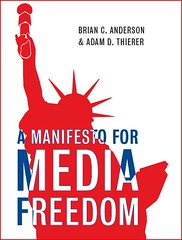 I’m pleased to announce the publication of A Manifesto for Media Freedom, which I co-authored with Brian C. Anderson of the Manhattan Institute. Brian serves as editor of Manhattan Institute’s excellent City Journal and he is the author of best-selling books like South Park Conservatives and Democratic Capitalism and Its Discontents.
In this little manifesto, we highlight one of the central ironies of the Information Age. Namely, that despite “the breathtaking abundance of new and old media outlets for obtaining news, information, and entertainment…”
many people hate this profusion, and never more than when it involves political speech. The current media market, they charge, doesn’t represent true diversity, or isn’t fair, or is subject to manipulation by a small and shrinking group of media barons. They want the government to regulate it into better shape, which just happens to be a shape that benefits them. Doing so… would be a disaster, a kind of soft or not-so-soft tyranny that would wipe out whole sectors of media, curtailing free speech and impoverishing our democracy.
In other words, instead of celebrating the unprecedented cornucopia of media choices at our collective disposal, many policymakers and media critics are calling for just as much media regulation as ever. We itemize these threats in our chapters and they include: efforts to revive the “Fairness Doctrine”, media ownership regulations, “localism” requirements, Net neutrality mandates, a la carte regulations, cable and satellite censorship, video game censorship, regulation of social networking sites, campaign finance-related speech restrictions, and so on.
In each case, we advance a pro-freedom paradigm to counter the advocates of media control. What do we mean by the “media freedom” that we advocate as the alternative to these new regulatory crusades? Here’s how we put it in the book:
Continue reading →

 The Technology Liberation Front is the tech policy blog dedicated to keeping politicians' hands off the 'net and everything else related to technology.