Posts tagged as:

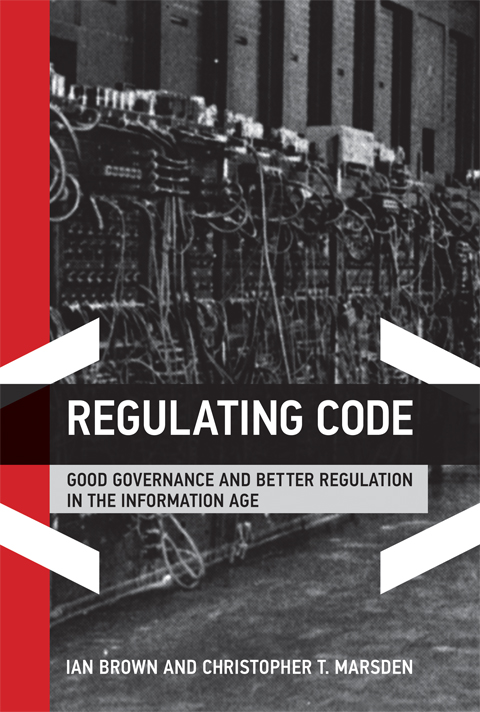
Regulating Code book coverIan Brown and Christopher T. Marsden’s new book, Regulating Code: Good Governance and Better Regulation in the Information Age, will go down as one of the most important Internet policy books of 2013 for two reasons. First, their book offers an excellent overview of how Internet regulation has unfolded on five different fronts: privacy and data protection; copyright; content censorship; social networks and user-generated content issues; and net neutrality regulation. They craft detailed case studies that incorporate important insights about how countries across the globe are dealing with these issues. Second, the authors endorse a specific normative approach to Net governance that they argue is taking hold across these policy arenas. They call their preferred policy paradigm “prosumer law” and it envisions an active role for governments, which they think should pursue “smarter regulation” of code.

In terms of organization, Brown and Marsden’s book follows the same format found in Milton Mueller’s important 2010 book Networks and States: The Global Politics of Internet Governance; both books feature meaty case studies in the middle bookended by chapters that endorse a specific approach to Internet policymaking. (Incidentally, both books were published by MIT Press.) And, also like Mueller’s book, Brown and Marsden’s Regulating Code does a somewhat better job using case studies to explore the forces shaping Internet policy across the globe than it does making the normative case for their preferred approach to these issues. Continue reading →

If you follow me on Twitter, you’ll see in among the last several weeks’ dreck some Tweets skeptical of various themes about the Tea Party movement—chiefly that they’re significantly racist/xenophobic, or that they’re handmaidens of figures like Glenn Beck or Sarah Palin.

I may have been bending over backwards to resist attempts to define the Tea Party movement. In secret, I’ve thought about parallels to punk rock, which seemed at times to have as many strains as people. Part of being punk was not fitting into anyone else’s categories, and the Tea Party seems to have this quality—rejecting Washington, D.C.’s party labels and ideological affiliations.

Well, I’ve finally come across a careful assessment of the Tea Party movement. National Journal‘s Jonathan Rauch spent a good deal of time studying the Tea Party movement and came up with the article (and video), “How Tea Party Organizes Without Leaders.”

The winner paragraph for me:

“Essentially what we’re doing is crowd-sourcing,” says Meckler, whose vocabulary betrays his background as a lawyer specializing in Internet law. “I use the term open-source politics. This is an open-source movement.” Every day, anyone and everyone is modifying the code. “The movement as a whole is smart.”

I do believe there is something special about the Tea Party movement. Somewhat like the Internet regards censorship as damage and routes around it, the Tea Party routes around centralizers’ attempts to capture its mojo.

There are plenty working to capture its mojo: Right-wing and Republican leaders are using it to aggrandize themselves, marching in front of the Tea Party for TV cameras and newspapers. Left-wing groups and progressives are searching for—and finding—the racism and xenophobia that unfortunately does exist in any large collection of average Americans. The decentralized character of the Tea Party movement makes it easy for charlatans to claim its mantle and fund-raise deceptively on the “Tea Party” brand.

There are some bad people in the Tea Party movement, just like there are some bad users of the Internet. But overall a self-organizing political/cultural network will produce better things—and faster—than a hierarchical organization.

I’d love to have the Tea Party movement push for exquisitely libertarian outcomes, and I regret hearing Tea Party participants veer into anything resembling racism, fear of Islam, or anti-immigration rhetoric, but I don’t get to own the Tea Party either.

If there is a theme that doesn’t unfairly push the Tea Party movement into a box, I think it’s “self-government.” It seems like Tea Partiers are tired of being told how to do their politics, tired of being told how their government is going to run them. On the whole, I’ll stand up for a network of people who think like that—but don’t try to push me into a box either.

Update: David Boaz has written an excellent post at Cato@Liberty about the Tea Party movement’s relationships to libertarianism and social conservatism.

I’ve been wading through the FCC’s latest Mobile Wireless Competition Report, and articles about it trying to make sense of what the the agency might be up to on this front.  It’s hard to get a read on where the agency may be going here. As my PFF colleague Mike Wendy suggested in his post on the FCC’s report, “far from press reports which state the FCC clearly determined the market is not ‘effectively competitive,’ well, that’s wrong. In fact, the FCC fails to make any such determination whatsoever.”  Moreover, just flipping through the charts and tables of the 237-page report, one is struck by how dynamic this marketplace is, and how crazy it would be for the FCC to declare it anything other than effectively competitive and highly innovative.

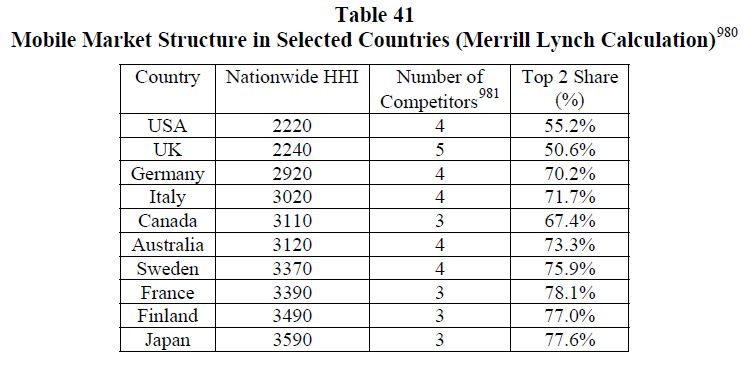
Yet, the FCC and many others seem hung up on industry structure. In particular, there seems to be a lot of hand-wringing about increasing consolidation among the sector’s top players.  But the data the FCC reproduces in the report seem to undermine that concern. For example, here’s a snapshot of the “Mobile Market Structure in Selected Countries,” which appears on pg. 197 of the FCC report.  It shows how much more consolidated foreign mobile markets are relative to the U.S., which is true of wireline markets too.  And you can find much more evidence of how competitive the marketplace is in these two reports.

Continue reading →

Yesterday I engaged in a lively luncheon debate about Net neutrality regulation with Ben Scott of Free Press at a Catholic University Law School event on “Implementing the National Broadband Plan.” To open the debate, I made a very quick 5-Part Case against Net Neutrality Regulation. I argued that the the objections to a Net neutrality regulatory regime can be grouped into 5 major categories: (1) Legal; (2) Economic; (3) Engineering; (4) Practical; and (5) Philosophical / Principled. Down below you will find my working notes to see how I then elaborated on each objection in a bit more detail. And then Ben and I engaged in some spirited banter for the next 45 minutes.

Unfortunately, it doesn’t appear that the video of our debate is online just yet, but once it is I will post it here. However, the folks from NextGenWeb asked me to shoot a short 2 1/2 min video clip after the debate summarizing my remarks. If you can stand the sight of my big fat head in your browser for that long, here ya go:

http://blip.tv/play/gYh4gci5IQI%2Em4v

The 5-Part Case against Net Neutrality Regulation

The objections to a Net neutrality regulatory regime can be grouped into 5 major categories: (1) Legal; (2) Economic; (3) Engineering; (4) Practical; and (5) Philosophical / Principled. Each objection will be briefly summarized below: Continue reading →

I was over at the Federal Communications Commission (FCC) the other day chatting with someone about various regulatory issues and Rush Limbaugh’s WSJ editorial came up.  The person I was speaking with made a comment about how conservatives have really been energized and unified in opposition to the re-imposition to the Doctrine.  I reminded them, however, that it wasn’t always the case that conservatives stood together in the fight over the Fairness Doctrine.  In fact, when I first came to town almost 20 years ago, there were still plenty of conservatives who actually favored it.  I was reminded of that fact when reading a new piece in Engage about “Broadcast ‘Fairness’ in the Twenty-First Century” by my friend Robert Corn-Revere.  Bob is one America’s great First Amendment defenders and his new essay offers an excellent history of efforts to micro-manage speech on the broadcast airwaves over the years.  In it, he reminds us that:

Given the recent vocal opposition to the Fairness Doctrine in the interest of preserving conservative talk radio, it is easy to forget that many prominent conservatives championed the doctrine before its demise. Phyllis Schlafly was a vocal proponent of the Fairness Doctrine because of what she described as “the outrageous and blatant anti-Reagan bias of the TV network newscasts,” and she testified at the FCC in the 1980s in support of the policy “to serve as a small restraint on the monopoly power wielded by Big TV Media.” Senator Jesse Helms was another long-time advocate of the Fairness Doctrine, and conservative groups Accuracy in Media and the American Legal Foundation actively pursued fairness complaints at the FCC against network newscasts.

Likewise, in our book, A Manifesto for Media Freedom, Brian Anderson and I note that some other prominent right-leaning politicians, such as Sen. Trent Lott, favored the Fairness Doctrine.  Moreover, even though most of those conservative individuals and groups have now turned against the Fairness Doctrine, some Republicans still defend (or even seek to expand) the same underlying regulatory concepts that served as the foundation of the Fairness Doctrine.  As Corn-Revere notes: Continue reading →

Some sensible thinking here about broadband pork stimulus plans from Saul Hansell of the New York Times. In his piece on the NYT Bits blog this week, “Does Broadband Need a Stimulus?” he argues that people should stop grumbling about the “relatively small sum” of $6 billion that the new administration has proposed for wiring rural areas and urban centers. Hansell argues:

This also seems to be a rather sound policy choice because, as I look at it, the noise about a broadband gap is hooey. With new cable modem technology becoming available, 19 out of 20 American homes eventually will be able to have Internet service that is faster than any available now anywhere in the world. And that’s without one new cable being laid. That fact hasn’t prevented a lot of folks involved in telecommunications policy from calling for a lot of money to be spent on backhoes and cable riggers. For example, the Communications Workers of America and the Telecommunications Industry Association called for $25 billion in subsidies to network providers as well as tax breaks. The Free Press, a group that advocates for media diversity, recommended spending $44 billion, with an emphasis on subsidizing companies to compete with existing cable and phone companies. Running a new fiber-optic cable to every American home may well increase competition in broadband providers, but it isn’t needed to deliver high-speed Internet service. Current cable modems use just one of the more than 100 channels on a typical cable system and can often offer speeds of 16 megabits per second or more. The next generation of modems, using a technology called Docsis 3, allows several of those video channels to be combined to offer what ultimately can be Internet service as fast as 1 gigabit per second — 10 times faster than is offered in Japan, which generally is regarded as having the fastest broadband infrastructure.

Continue reading →

MM front cover Faithful readers will recall that, several months ago, I penned a 7-part “Media Metrics” series that took a hard look at the health of the media marketplace. Today, the Progress & Freedom Foundation is releasing a greatly expanded version of these essays that I have put together with my PFF colleague Grant Eskelsen. In this 100-page special report, “Media Metrics: The True State of the Modern Media Marketplace,” we begin by noting that heated debates about the state of the media marketplace continue to rage in Washington, and opinions seem to range from grim to outright apocalyptic. As we note on pg. 1:

Many people—including a large number of legislators and regulators—argue that America’s media marketplace is in a miserable state. Some claim that citizens lack choice in media outlets and that options are just as scarce as ever. Others believe that media “localism” is dead or that many groups or niches go underserved because of a lack of true “diversity” in media. Others argue that the market is hopelessly over-concentrated in the hands of a few evil media barons who are hell-bent on force-feeding us corporate propaganda. And still others say that the quality of news and entertainment in our society has deteriorated because of a combination of all of the above. It all sounds quite troubling, but is any of it true?

After taking an objective look at the true state of America’s media marketplace, we conclude that such pessimism is unwarranted. Indeed, a careful review of the facts reveals that—contrary to what those media critics suggest—we have more media choice, more media competition, and more media diversity than ever before. Indeed, to the extent there was ever a “golden age” of media in America, we are living in it today. The media sky has never been brighter and it is getting brighter with each passing year. Continue reading →