Posts tagged as:

Corbin Barthold invited me on Tech Freedom’s “Tech Policy Podcast” to discuss the history of antitrust and competition policy over the past half century. We covered a huge range of cases and controversies, including: the DOJ’s mega cases against IBM & AT&T, Blockbuster and Hollywood Video’s derailed merger, the Sirius-XM deal, the hysteria over the AOL-Time Warner merger, the evolution of competition in mobile markets, and how we finally ended that dreaded old MySpace monopoly!

What does the future hold for Google, Facebook, Amazon, and Netflix? Do antitrust regulators at the DOJ or FTC have enough to mount a case against these firms? Which case is most likely to have legs?

Corbin and I also talked about the of progress more generally and the troubling rise of more and more Luddite thinking on both the left and right. I encourage you to give it a listen:

At the same time FilmOn, an Aereo look-alike, is seeking a compulsory license to broadcast TV content, free market advocates in Congress and officials at the Copyright Office are trying to remove this compulsory license. A compulsory license to copyrighted content gives parties like FilmOn the use of copyrighted material at a regulated rate without the consent of the copyright holder. There may be sensible objections to repealing the TV compulsory license, but transaction costs–the ostensible inability to acquire the numerous permissions to retransmit TV content–should not be one of them. Continue reading →

Congress is considering reforming television laws and solicited comment from the public last month. On Friday, I submitted a letter encouraging the reform effort. I attached the paper Adam and I wrote last year about the current state of video regulations and the need for eliminating the complex rules for television providers.

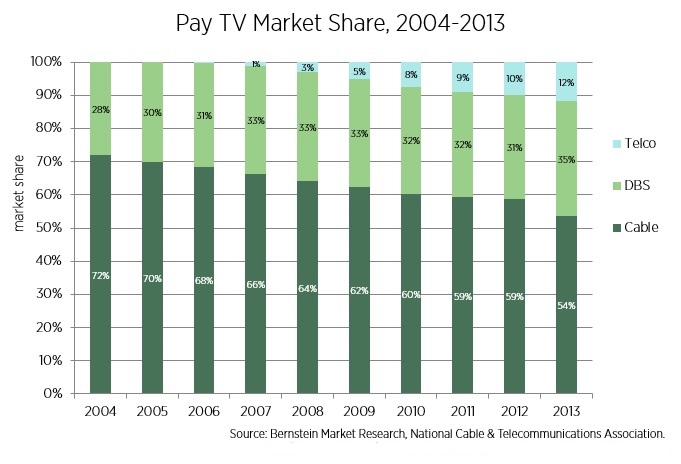
As I say in the letter, excerpted below, pay TV (cable, satellite, and telco-provided) is quite competitive, as this chart of pay TV market share illustrates. In addition to pay TV there is broadcast, Netflix, Sling, and other providers. Consumers have many choices and the old industrial policy for mass media encourages rent-seeking and prevents markets from evolving.

Pay TV Market Share

Continue reading →

The outrage over the FCC’s attempt to write new open Internet rules has caught many by surprise, and probably Chairman Wheeler as well. The rumored possibility of the FCC authorizing broadband “fast lanes” draws most complaints and animus. Gus Hurwitz points out that the FCC’s actions this week have nothing to do with fast lanes and Larry Downes reminds us that this week’s rules don’t authorize anything. There’s a tremendous amount of misinformation because few understand how administrative law works. Yet many net neutrality proponents fear the worst from the proposed rules because Wheeler takes the consensus position that broadband provision is a two-sided market and prioritized traffic could be pro-consumer.

Fast lanes have been permitted by the FCC for years and they can benefit consumers. Some broadband services–like video and voice over Internet protocol (VoIP)–need to be transmitted faster or with better quality than static webpages, email, and file syncs. Don’t take my word for it. The 2010 Open Internet NPRM, which led to the recently struck-down rules, stated,

As rapid innovation in Internet-related services continues, we recognize that there are and will continue to be Internet-Protocol-based offerings (including voice and subscription video services, and certain business services provided to enterprise customers), often provided over the same networks used for broadband Internet access service, that have not been classified by the Commission. We use the term “managed” or “specialized” services to describe these types of offerings. The existence of these services may provide consumer benefits, including greater competition among voice and subscription video providers, and may lead to increased deployment of broadband networks.

I have no special knowledge about what ISPs will or won’t do. I wouldn’t predict in the short term the widespread development of prioritized traffic under even minimal regulation. I think the carriers haven’t looked too closely at additional services because net neutrality regulations have precariously hung over them for a decade. But some of net neutrality proponents’ talking points (like insinuating or predicting ISPs will block political speech they disagree with) are not based in reality.

We run a serious risk of derailing research and development into broadband services if the FCC is cowed by uninformed and extreme net neutrality views. As Adam eloquently said, “Living in constant fear of hypothetical worst-case scenarios — and premising public policy upon them — means that best-case scenarios will never come about.” Many net neutrality proponents would like to smear all priority traffic as unjust and exploitative. This is unfortunate and a bit ironic because one of the most transformative communications developments, cable VoIP, is a prioritized IP service.

There are other IP services that are only economically feasible if jitter, latency, and slow speed are minimized. Prioritized traffic takes several forms, but it could enhance these services:

VoIP. This prioritized service has actually been around for several years and has completely revolutionized the phone industry. Something unthinkable for decades–facilities-based local telephone service–became commonplace in the last few years and undermined much of the careful industrial planning in the 1996 Telecom Act. If you subscribe to voice service from your cable provider, you are benefiting from fast lane treatment. Your “phone” service is carried over your broadband cable, segregated from your television and Internet streams. Smaller ISPs could conceivably make their phone service more attractive by pairing up with a Skype- or Vonage-type voice provider, and there are other possibilities that make local phone service more competitive.

Cloud-hosted virtual desktops. This is not a new idea, but it’s possible to have most or all of your computing done in a secure cloud, not on your PC, via a prioritized data stream. With a virtual desktop, your laptop or desktop PC functions mainly as a dumb portal. No more annoying software updates. Fewer security risks. IT and security departments everywhere would rejoice. Google Chromebooks are a stripped-down version of this but truly functional virtual desktops would be valued by corporations, reporters, or government agencies that don’t want sensitive data saved on a bunch of laptops in their organization that they can’t constantly monitor. Virtual desktops could also transform the device market, putting the focus on a great cloud and (priority) broadband service and less on the power and speed of the device. Unfortunately, at present, virtual desktops are not in widespread use because even small lag frustrates users.

TV. The future of TV is IP-based and the distinction between “TV” and “the Internet” is increasingly blurring, with Netflix leading the way. In a fast lane future, you could imagine ISPs launching pared-down TV bundles–say, Netflix, HBO Go, and some sports channels–over a broadband connection. Most ISPs wouldn’t do it, but an over-the-top package might interest smaller ISPs who find acquiring TV content and bundling their own cable packages time-consuming and expensive.

Gaming. Computer gamers hate jitter and latency. (My experience with a roommate who had unprintable outbursts when Diablo III or World of Warcraft lagged is not uncommon.) Game lag means you die quite frequently because of your data connection and this depresses your interest in a game. There might be gaming companies out there who would like to partner with ISPs and other network operators to ensure smooth gameplay. Priority gaming services could also lead the way to more realistic, beautiful, and graphics-intensive games.

Teleconferencing, telemedicine, teleteaching, etc. Any real-time, video-based service could reach critical mass of subscribers and become economical with priority treatment. Any lag absolutely kills consumer interest in these video-based applications. By favoring applications like telemedicine, providing remote services could become attractive to enough people for ISPS to offer stand-alone broadband products.

This is just a sampling of the possible consumer benefits of pay-for-priority IP services we possibly sacrifice in the name of strict neutrality enforcement. There are other services we can’t even conceive of yet that will never develop. Generally, net neutrality proponents don’t admit these possible benefits and are trying to poison the well against all priority deals, including many of these services.

Most troubling, net neutrality turns the regulatory process on its head. Rather than identify a market failure and then take steps to correct the failure, the FCC may prevent commercial agreements that would be unobjectionable in nearly any other industry. The FCC has many experts who are familiar with the possible benefits of broadband fast lanes, which is why the FCC has consistently blessed priority treatment in some circumstances.

Unfortunately, the orchestrated reaction in recent weeks might leave us with onerous rules, delaying or making impossible new broadband services. Hopefully, in the ensuing months, reason wins out and FCC staff are persuaded by competitive analysis and possible innovations, not t-shirt slogans.

My friend Tim Lee has an article at Vox that argues that interconnection is the new frontier on which the battle for the future of the Internet is being waged. I think the article doesn’t really consider how interconnection has worked in the last few years, and consequently, it makes a big deal out of something that is pretty harmless.

How the Internet used to work

The Internet is a network of networks. Your ISP is a network. It connects to the other ISPs and exchanges traffic with them. Since connections between ISPs are about equally valuable to each other, this often happens through “settlement-free peering,” in which networks exchange traffic on an unpriced basis. The arrangement is equally valuable to both partners.

Not every ISP connects directly to every other ISP. For example, a local ISP in California probably doesn’t connect directly to a local ISP in New York. If you’re an ISP that wants to be sure your customer can reach every other network on the Internet, you have to purchase “transit” services from a bigger or more specialized ISP. This would allow ISPs to transmit data along what used to be called “the backbone” of the Internet. Transit providers that exchange roughly equally valued traffic with other networks themselves have settlement-free peering arrangements with those networks.

How the Internet works now

A few things have changed in the last several years. One major change is that most major ISPs have very large, geographically-dispersed networks. For example, Comcast serves customers in 40 states, and other networks can peer with them in 18 different locations across the US. These 18 locations are connected to each other through very fast cables that Comcast owns. In other words, Comcast is not just a residential ISP anymore. They are part of what used to be called “the backbone,” although it no longer makes sense to call it that since there are so many big pipes that cross the country and so much traffic is transmitted directly through ISP interconnection.

Another thing that has changed is that content providers are increasingly delivering a lot of a) traffic-intensive and b) time-sensitive content across the Internet. This has created the incentive to use what are known as content-delivery networks (CDNs). CDNs are specialized ISPs that locate servers right on the edge of all terminating ISPs’ networks. There are a lot of CDNs—here is one list.

By locating on the edge of each consumer ISP, CDNs are able to deliver content to end users with very low latency and at very fast speeds. For this service, they charge money to their customers. However, they also have to pay consumer ISPs for access to their networks, because the traffic flow is all going in one direction and otherwise CDNs would be making money by using up resources on the consumer ISP’s network.

CDNs’ payments to consumer ISPs are also a matter of equity between the ISP’s customers. Let’s suppose that Vox hires Amazon CloudFront to serve traffic to Comcast customers (they do). If the 50 percent of Comcast customers who wanted to read Vox suddenly started using up so many network resources that Comcast and CloudFront needed to upgrade their connection, who should pay for the upgrade? The naïve answer is to say that Comcast should, because that is what customers are paying them for. But the efficient answer is that the 50 percent who want to access Vox should pay for it, and the 50 percent who don’t want to access it shouldn’t. By Comcast charging CloudFront to access the Comcast network, and CloudFront passing along those costs to Vox, and Vox passing along those costs to customers in the form of advertising, the resource costs of using the network are being paid by those who are using them and not by those who aren’t.

What happened with the Netflix/Comcast dust-up?

Netflix used multiple CDNs to serve its content to subscribers. For example, it used a CDN provided by Cogent to serve content to Comcast customers. Cogent ran out of capacity and refused to upgrade its link to Comcast. As a result, some of Comcast’s customers experienced a decline in quality of Netflix streaming. However, Comcast customers who accessed Netflix with an Apple TV, which is served by CDNs from Level 3 and Limelight, never had any problems. Cogent has had peering disputes in the past with many other networks.

To solve the congestion problem, Netflix and Comcast negotiated a direct interconnection. Instead of Netflix paying Cogent and Cogent paying Comcast, Netflix is now paying Comcast directly. They signed a multi-year deal that is reported to  reduce Netflix’s costs relative to what they would have paid through Cogent. Essentially, Netflix is vertically integrating into the CDN business. This makes sense. High-quality CDN service is essential to Netflix’s business; they can’t afford to experience the kind of incident that Cogent caused with Comcast. When a service is strategically important to your business, it’s often a good idea to vertically integrate.

It should be noted that what Comcast and Netflix negotiated was  not a “fast lane”—Comcast is prohibited from offering prioritized traffic as a condition of its merger with NBC/Universal.

What about Comcast’s market power?

I think that one of Tim’s hangups is that Comcast has a lot of local market power. There are lots of barriers to creating a competing local ISP in Comcast’s territories. Doesn’t this mean that Comcast will abuse its market power and try to gouge CDNs?

Let’s suppose that Comcast is a pure monopolist in a two-sided market. It’s already extracting the maximum amount of rent that it can on the consumer side. Now it turns to the upstream market and tries to extract rent. The problem with this is that it can only extract rents from upstream content producers insofar as it lowers the value of the rent it can collect from consumers. If customers have to pay higher Netflix bills, then they will be less willing to pay Comcast. The fact that the market is two-sided does not significantly increase the amount of monopoly rent that Comcast can collect.

Interconnection fees that are being paid to Comcast (and virtually all other major ISPs) have virtually nothing to do with Comcast’s market power and everything to do with the fact that the Internet has changed, both in structure and content. This is simply how the Internet works. I use CloudFront, the same CDN that Vox uses, to serve even a small site like my Bitcoin Volatility Index. CloudFront negotiates payments to Comcast and other ISPs on my and Vox’s behalf. There is nothing unseemly about Netflix making similar payments to Comcast, whether indirectly through Cogent or directly, nor is there anything about this arrangement that harms “the little guy” (like me!).

For more reading material on the Netflix/Comcast arrangement, I recommend Dan Rayburn’s posts here, here, and here. Interconnection is a very technical subject, and someone with very specialized expertise like Dan is invaluable in understanding this issue.

It seems to me that a lot of the angst about the Comcast-Netflix paid transit deal results from a general discomfort with two-sided markets rather than any specific harm caused by the deal. But is there any reason to be suspicious of two-sided markets per se?

Consider a (straight) singles bar. Men and women come to the singles bar to meet each other. On some nights, it’s ladies’ night, and women get in free and get a free drink. On other nights, it’s not ladies’ night, and both men and women have to pay to get in and buy drinks.

There is no a priori reason to believe that ladies’ night is more just or efficient than other nights. The owner of the bar will benefit if the bar is a good place for social congress, and she will price accordingly. If men in the area are particularly shy, she may have to institute a “mens’ night” to get them to come out. If women start demanding too many free drinks, she may have to put an end to ladies’ night (even if some men benefit from the presence of tipsy women, they may not be as willing as the women to pay the full cost of all of the drinks). Whether a market should be two-sided or one-sided is an empirical question, and the answer can change over time depending on circumstances.

Some commentators seem to be arguing that two-sided markets are fine as long as the market is competitive. Well, OK, suppose the singles bar is the only singles bar in a 100-mile radius? How does that change the analysis above? Not at all, I say.

Analysis of two-sided markets can get very complex, but we shouldn’t let that complexity turn into reflexive opposition.

“Net neutrality is a dead man walking,” Marvin Ammori stated in Wired last week, citing the probable demise of the FCC’s Open Internet rules in court. I’d agree for a different reason. Net neutrality has been dead ever since the FCC released its net neutrality order in December 2010. (This is not to say the damaging rules should be upheld by the DC Circuit. For many reasons, the Order should be struck down.) I agree with Ammori because we already have the Internet “fast lane” many net neutrality proponents wanted to prevent. Since that goal is precluded, all the rules do is hang Damocles’ Sword over ISPs regarding traffic management.

The 2010 rules managed to make both sides unhappy. The ISPs face severe penalties if three FCC commissioners believe ISP network management practices “unreasonably discriminate” against certain traffic. Public interest groups, on the other hand, were dissatisfied because they wanted ISPs reclassified as common carriers to prevent deep-pocketed content creators from allying with ISPs to create an Internet “fast lane” for some companies, relegating most other websites to the so-called “winding dirt road” of the public Internet.

Proponents emphasize different goals of net neutrality (to the point–many argue–it’s hard to discern what the term means). But if preventing the creation of a fast lane is the main goal of net neutrality, it’s dead already. Consider two popularly-cited net neutrality “violations” that do not violate the Open Internet Order: Netflix’ Open Connect program and Comcast not counting its Xfinity video-on-demand (VOD) service against customers’ data limits

Both cases involve the creation of a fast lane for certain content and activists rail against them. Both cases also involve network practices expressly exempted from net neutrality regulations. The FCC exempted these sorts of services because they are important, benefit the public, and should be encouraged. With Open Connect, Netflix scatters its many servers across the country closer to households, which allows its content to stream at a higher quality than most other video sites. Comcast gives its Xfinity VOD fast-lane treatment as well, which is completely legal since VOD from a cable company is a “specialized service” exempt from the rules.

“Specialized service” needs some explanation since it’s a novel concept from the FCC order. The net neutrality rules distinguish between “broadband Internet access service” (BIAS)–to which the regulations apply–and specialized (or managed) services–to which they don’t apply. The exemption of specialized services opens up a dangerous loophole in the view of proponents.

BIAS is what most consider “the Internet.” It’s the everyday websites we access on our computers and smartphones. What are specialized services? In the sleepy month of August the FCC’s Open Internet Advisory Committee released its report on what criteria specialized service needs to meet to be exempt from net neutrality scrutiny (these are influential and advisory, but not binding):

  1. The service doesn’t reach large parts of the Internet, and
  2. The service is an “application level” service.

The Advisory Committee also thought that “capacity isolation” is a good indicator that a service should be exempt. With capacity isolation, the ISP has one broadband connection going to the home but is separating the service’s data stream from the conventional Internet stream consumers use to visit Facebook, YouTube, and the like. This is how Comcast’s streaming of Xfinity to Xboxes is exempt–it is a proprietary network going into the home. As long as carriers don’t divert BIAS capacity for the application, the FCC will likely turn a blind eye.

What are some examples? Specialized service is marked by higher-quality streams that typically don’t suffer from jitter and latency. If you have “digital voice” from Comcast, for example, you are receiving a specialized service–proprietary VoIP. Specialized service can also include data streams like VOD, e-reader downloads, heart monitor data, and gaming services. The FCC exempted these because some are important enough that they shouldn’t compete with BIAS Internet. It would be obviously damaging to have digital phone service or health monitors getting disrupted because others are checking up on their fantasy football team. The FCC also wanted to spur investment in specialized services and video companies like Netflix are considering pairing up with ISPs to deliver a better experience to customers.

That is to say, the net neutrality effort has failed even worse than most realize. The FCC essentially prohibited innovative business models in BIAS, freezing that service into common-carrier-like status. Further, we have an Internet fast lane (which I consider a significant public benefit, though net neutrality proponents often do not). As business models evolve and the costs of server networks fall, our two-tier system will become more apparent.

WP coverThe Mercatus Center at George Mason University has just released a new paper by Brent Skorup and me entitled, “A History of Cronyism and Capture in the Information Technology Sector.” In this 73-page working paper, which we hope to place in a law review or political science journal shortly, we document the evolution of government-granted privileges, or “cronyism,” in the information and communications technology marketplace and in the media-producing sectors. Specifically, we offer detailed histories of rent-seeking and regulatory capture in: the early history of the telephony and spectrum licensing in the United States; local cable TV franchising; the universal service system; the digital TV transition in the 1990s; and modern video marketplace regulation (i.e., must-carry and retransmission consent rules, among others.

Our paper also shows how cronyism is slowly creeping into new high-technology sectors.We document how Internet companies and other high-tech giants are among the fastest-growing lobbying shops in Washington these days. According to the Center for Responsive Politics, lobbying spending by information technology sectors has almost doubled since the turn of the century, from roughly $200 million in 2000 to $390 million in 2012.  The computing and Internet sector has been responsible for most of that growth in recent years. Worse yet, we document how many of these high-tech firms are increasingly seeking and receiving government favors, mostly in the form of targeted tax breaks or incentives. Continue reading →

Gina Keating, author of Netflixed: The Epic Battle for America’s Eyeballs, discusses the startup of Netflix and their competition with Blockbuster.

Keating begins with the history of the company and their innovative improvements to the movie rental experience. She discusses their use of new technology and marketing strategies in DVD rental, which inspired Blockbuster to adapt to the changing market.

Keating goes on to describe Netflix’s transition to internet streaming and Blockbuster’s attempts to retain their market share.

Download

Related Links


Of all the shockingly naive and shamelessly self-serving editorials I’ve read by businesspeople in recent years, today’s Wall Street Journal oped by Netflix general counsel David Hyman really takes the cake. It’s an implicit plea to policymakers for broadband price controls. Hyman doesn’t like the idea of broadband operators potentially pricing bandwidth according to usage /demand and he wants action taken to stop it. Of course, why wouldn’t he say that? It’s in Netflix’s best interest to ensure that somebody else besides them picks up the tab for increased broadband consumption!

But Hyman tries to pull a fast one on the reader and suggest that scarcity is an economic illusion and that any effort by broadband operators to migrate to usage-based pricing schemes is simply a nefarious, anti-consumer plot that must be foiled. “Consumers and regulators need to take heed of what is happening and avoid winding up like the proverbial frog in a pot of boiling water,” Hyman warns. “It’s time to jump before it’s too late.”

Rubbish! The only thing policymakers need to do is avoid myopic, misguided advice like Hyman’s, which isn’t based on one iota of economic theory or evidence.

Continue reading →