Sen. Josh Hawley (R-MO) recently delivered remarks at the National Conservatism Conference and a Young America’s Foundation conference in which he railed against political and academic elites, arguing that, “the old era is ending and the old ways will not do.” “It’s time that we stood up to big government, to the people in government who think they know better,” Hawley noted at the YAF event. “[W]e are for free competition… we are for the free market.”
That’s all nice-sounding rhetoric but it sure doesn’t seem to match up with Hawley’s recent essays and policy proposals, which are straight out of the old era’s elitist and highly paternalistic Washington-Knows-Best playbook. Specifically, Hawley has called for a top-down, technocratic regulatory regime for the Internet and the digital economy more generally. Hawley has repeatedly made claims that digital technology companies have gotten a sweetheart deal from government and they they have censored conservative voices. That’s utter nonsense, but those arguments have driven his increasingly fanatic rhetoric and command-and-control policy proposals. If he succeeds in his plan to empower unelected bureaucrats inside the Beltway to reshape the Internet, it will destroy one of the greatest American success stories in recent memory. It’s hard to understand how that could be labelled “conservative” in any sense of the word. Continue reading →
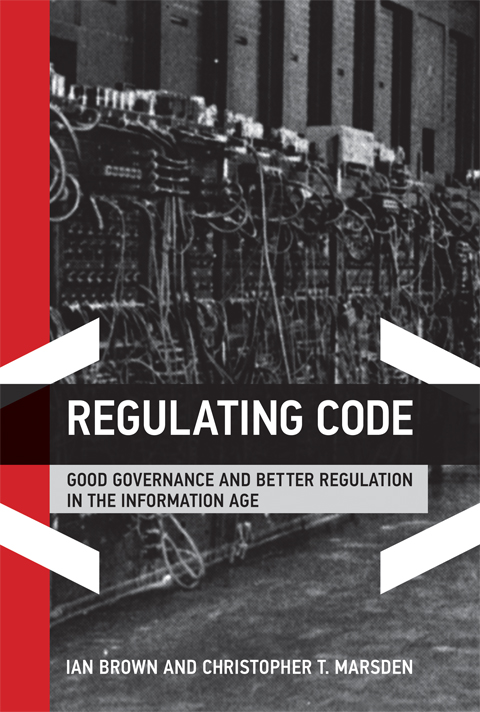
Ian Brown and Christopher T. Marsden’s new book, Regulating Code: Good Governance and Better Regulation in the Information Age, will go down as one of the most important Internet policy books of 2013 for two reasons. First, their book offers an excellent overview of how Internet regulation has unfolded on five different fronts: privacy and data protection; copyright; content censorship; social networks and user-generated content issues; and net neutrality regulation. They craft detailed case studies that incorporate important insights about how countries across the globe are dealing with these issues. Second, the authors endorse a specific normative approach to Net governance that they argue is taking hold across these policy arenas. They call their preferred policy paradigm “prosumer law” and it envisions an active role for governments, which they think should pursue “smarter regulation” of code.
In terms of organization, Brown and Marsden’s book follows the same format found in Milton Mueller’s important 2010 book Networks and States: The Global Politics of Internet Governance; both books feature meaty case studies in the middle bookended by chapters that endorse a specific approach to Internet policymaking. (Incidentally, both books were published by MIT Press.) And, also like Mueller’s book, Brown and Marsden’s Regulating Code does a somewhat better job using case studies to explore the forces shaping Internet policy across the globe than it does making the normative case for their preferred approach to these issues. Continue reading →
The Internet’s greatest blessing — its general openness to all speech and speakers — is also sometimes its biggest curse. That is, you cannot expect to have the most widely accessible, unrestricted communications platform the world has ever known and not also have some imbeciles who use it to spew insulting, vile, and hateful comments.
It is important to put things in perspective, however. Hate speech is not the norm online. The louts who spew hatred represent a small minority of all online speakers. The vast majority of online speech is of a socially acceptable — even beneficial — nature.
Still, the problem of hate speech remains very real and a diverse array of strategies are needed to deal with it. The sensible path forward in this regard is charted by Abraham H. Foxman and Christopher Wolf in their new book, Viral Hate: Containing Its Spread on the Internet. Their book explains why the best approach to online hate is a combination of education, digital literacy, user empowerment, industry best practices and self-regulation, increased watchdog / press oversight, social pressure and, most importantly, counter-speech. Foxman and Wolf also explain why — no matter how well-intentioned — legal solutions aimed at eradicating online hate will not work and would raise serious unintended consequences if imposed.
In striking this sensible balance, Foxman and Wolf have penned the definitive book on how to constructively combat viral hate in an age of ubiquitous information flows. Continue reading →
Earlier today on Twitter, I listed what I thought were the Top 5 “Biggest Internet Policy Issues of 2012.” In case you don’t follow me on Twitter — and shame on you if you don’t! — here were my choices:
Copyright wars reinvigorated post-SOPA; tide starting to turn in favor of copyright reform. [TLF posts on copyright.]
Privacy still red-hot w ECPA reform, online advertising regs & kids’ privacy issues all pending. [TLF posts on privacy.]
WCIT makes Internet governance / NetFreedom a major issue worldwide. [TLF posts on Net governance.]
Antitrust threat looms larger w pending Google case + Apple books investigation. [TLF posts on antitrust.]
Cybersecurity regulatory push continues in both legislative (CISPA) & executive branch. [TLF posts on cybersecurity.]
Lists like these are entirely subjective, of course, but I am basing my list on the general amount of chatter I tended to see and hear about each topic over the course of the year.
What do you think the top tech policy issues of the year were?
I’ve been hearing more rumblings about “API neutrality” lately. This idea, which originated with Jonathan Zittrain’s book, The Future of the Internet–And How to Stop It, proposes to apply Net neutrality to the code/application layer of the Internet. A blog called “The API Rating Agency,” which appears to be written by Mehdi Medjaoui, posted an essay last week endorsing Zittrain’s proposal and adding some meat to the bones of it. (My thanks to CNet’s Declan McCullagh for bringing it to my attention).
Medjaoui is particularly worried about some of Twitter’s recent moves to crack down on 3rd party API uses. Twitter is trying to figure out how to monetize its platform and, in a digital environment where advertising seems to be the only business model that works, the company has decided to establish more restrictive guidelines for API use. In essence, Twitter believes it can no longer be a perfectly open platform if it hopes to find a way to make money. The company apparently believes that some restrictions will need to be placed on 3rd party uses of its API if the firm hopes to be able to attract and monetize enough eyeballs.
While no one is sure whether that strategy will work, Medjaoui doesn’t even want the experiment to go forward. Building on Zittrain, he proposes the following approach to API neutrality:
Absolute data to 3rd party non-discrimination : all content, data, and views equally distributed on the third party ecosystem. Even a competitor could use an API in the same conditions than all others, with not restricted re-use of the data.
Limited discrimination without tiering : If you don’t pay specific fees for quality of service, you cannot have a better quality of service, as rate limit, quotas, SLA than someone else in the API ecosystem.If you pay for a high level Quality of service, so you’ll benefit of this high level quality of service, but in the same condition than an other customer paying the same fee.
First come first served : No enqueuing API calls from paying third party applications, as the free 3rd-party are in the rate limits.
Before I critique this, let’s go back and recall why Zittrain suggested we might need API neutrality for certain online services or digital platforms. Continue reading →
On Monday it was my great pleasure to participate in a Cato Institute briefing on Capitol Hill about “Internet Taxation: Should States Be Allowed to Tax outside Their Borders?” Also speaking was my old friend Dan Mitchell, a senior fellow with Cato. From the event description: “State officials have spent the last 15 years attempting to devise a regime so they can force out-of-state vendors to collect sales taxes, but the Supreme Court has ruled that such a cartel is not permissible without congressional approval. Congress is currently considering the Main Street Fairness Act, a bill that would authorize a multistate tax compact and force many Internet retailers to collect sales taxes for the first time. Is this sensible? Are there alternative ways to address tax “fairness” concerns in this context?”
Watch the video for our answers. Also, here’s the big Cato paper that Veronique de Rugy and I penned for Cato on this back in 2003 and here’s a shorter recent piece we did for Mercatus.
We learned from The Wall Street Journal yesterday that “Federal Communications Commission Chairman Julius Genachowski gets a little peeved when people suggests that he wants to regulate the Internet.” He told a group of Journal reporters and editors today that: “I don’t see any circumstances where we’d take steps to regulate the Internet itself,” and “I’ve been clear repeatedly that we’re not going to regulate the Internet.”
We’re thankful to hear Chairman Julius Genachowski to make that promise. We’ll certainly hold him to it. But you will pardon us if we remain skeptical (and, in advance, if you hear a constant stream of “I told you so” from us in the months and years to come). If the Chairman is “peeved” at the suggestion that the FCC might be angling to extend its reach to include the Internet and new media platforms and content, perhaps he should start taking a closer look at what his own agency is doing—and think about the precedents he’s setting for future Chairmen who might not share his professed commitment not to regulate the ‘net. Allow us to cite just a few examples:
Net Neutrality Notice of Proposed Rulemaking
We’re certainly aware of the argument that the FCC’s proposed net neutrality regime is not tantamount to Internet regulation—but we just don’t buy it. Not for one minute.
First, Chairman Genachowski seems to believe that “the Internet” is entirely distinct from the physical infrastructure that brings “cyberspace” to our homes, offices and mobile devices. The WSJ notes, “when pressed, [Genachowski] admitted he was referring to regulating Internet content rather than regulating Internet lines.” OK, so let’s just make sure we have this straight: The FCC is going to enshrine in law the principle that “gatekeepers” that control the “bottleneck” of broadband service can only be checked by having the government enforce “neutrality” principles in the same basic model of “common carrier” regulation that once applied to canals, railroads, the telegraph and telephone. But when it comes to accusations of “gatekeeper” power at the content/services/applications “layers” of the Internet, the FCC is just going to step back and let markets sort things out? Sorry, we’re just not buying it. Continue reading →
Harvard Berkman Center professor Jonathan Zittrain has published another pessimistic, Steve-Jobs-is-Taking-Us-Straight-To-Cyber-Hell editorial building on the gloomy thesis he set forth in his 2008 book, The Future of the Internet and How to Stop It. His latest piece appears in the Financial Times and it’s entitled, “A Fight over Freedom at Apple’s Core. Concerning the recent Apple iPad announcement, Zittrain warns: “Mr Jobs ushered in the personal computer era and now he is trying to usher it out.”
I’m not going to go into yet another lengthy dissertation about what it so misguided about his thesis that cyberspace is becoming more “regulable” and that digital “generativity” is dying because of the rise of devices like the iPhone & iPad, or sites like Facebook. Instead, I will just point you to the many things I’ve written before explaining just how far off the mark Prof. Zittrain is on this point. [See the complete list down below + video of our debate.]
But let me just say this… Ignoring that fact that he is an iPhone user himself — which makes no sense considering that he thinks of Apple as the font of all cyber-evil — he can’t muster any substantive empirical evidence proving that the Net and digital devices are being more “closed, sterile, and tethered,” as he repeatedly claims in his book and editorials. And that’s not surprising because the reality is that the digital world is more open and generative than ever, and even if there are some “closed” devices and systems out there, they are actually quite innovative and not perfectly closed as Zittrain suggests. The spectrum of “open vs. closed” systems and devices is incredible diverse and nothing is
perfectly “open” or “closed.” We can have the best of both worlds: many open systems with some partial “walled gardens” here and there (or hybrid systems combining both). Regardless, we are witnessing greater digital “generativity” and innovation with each passing year. Until Zittrain can prove the opposite, his thesis must be considered a failure.
Finally, I want to associate myself with this excellent critique of the Zittrain thesis by Prof. Ed Felten, who points out that Zittrain’s argument doesn’t even work for the iPad, which I would agree is a fairly “closed appliance” in the Zittrainian scheme of the things:
The PBS documentary series Frontline aired a new program last night called “Digital Nation: Life on the Virtual Frontier.” [You can watch it online at that link.] Produced by Rachel Dretzin and Douglas Rushkoff, the 90-minute special touched on several themes we have debated here through the years including:
concerns about information overload and multitasking;
the role of computers and digital technology in education & learning; and,
the nature and impact of virtual reality and virtual worlds on real-world life and culture.
As a student of information history, I’m particularly interested in these subjects because I’ve written frequently about the lively debates between techno-optimists and techno-pessimists throughout history. (See my latest essay: “Are You An Internet Optimist or Pessimist? The Great Debate over Technology’s Impact on Society.“) I thought Dretzin and Rushkoff did a nice job covering a lot of ground in a very short amount of time and providing balance from folks on both sides of the optimist/pessimist spectrum. Below I’ll just summarize a few notes I took while watching “Digital Nation” and offer a few thoughts on these controversial topics. Mostly, I’ll just discuss the first two, interrelated issues. (My thoughts on the third issue — virtual worlds and virtual reality, can be found in these videos from my recent speech in Second Life).
by Berin Szoka & Adam Thierer, Progress Snapshot 5.11 (PDF)
Ten years ago, Nobel Prize-winning economist Milton Friedman lamented the “Business Community’s Suicidal Impulse:” the persistent propensity to persecute one’s competitors through regulation or the threat thereof. Friedman asked: “Is it really in the self-interest of Silicon Valley to set the government on Microsoft?” After yesterday’s FCC vote’s to open a formal “Net Neutrality” rule-making, we must ask whether the high-tech industry—or consumers—will benefit from inviting government regulation of the Internet under the mantra of “neutrality.”
The hatred directed at Microsoft in the 1990s has more recently been focused on the industry that has brought broadband to Americans’ homes (Internet Service Providers) and the company that has done more than any other to make the web useful (Google). Both have been attacked for exercising supposed “gatekeeper” control over the Internet in one fashion or another. They are now turning their guns on each other—the first strikes in what threatens to become an all-out, thermonuclear war in the tech industry over increasingly broad neutrality mandates. Unless we find a way to achieve “Digital Détente,” the consequences of this increasing regulatory brinkmanship will be “mutually assured destruction” (MAD) for industry and consumers.
New Fronts in the Neutrality Wars
The FCC’s proposed rules would apply to all broadband providers, including wireless, but not to Google or many other players operating in other layers of the Net who favor such broadband-specific rules. With this rulemaking looming, AT&T came after Google with letters to the FCC in late September and then another last week accusing the company of violating neutrality principles in their business practices and arguing that any neutrality rules that apply to ISPs should apply equally to Google’s panoply of popular services. In particular, AT&T accused Google of “search engine bias,” suggesting that only government-enforced neutrality mandates could protect consumers from Google’s supposed “monopolist” control.
The promise made yesterday by the FCC—to only apply neutrality principles to the infrastructure layer of the Net—is hollow and will ultimately prove unenforceable. Continue reading →
The Technology Liberation Front is the tech policy blog dedicated to keeping politicians' hands off the 'net and everything else related to technology. Learn more about TLF →




 The Technology Liberation Front is the tech policy blog dedicated to keeping politicians' hands off the 'net and everything else related to technology.