Posts tagged as:

Nate Anderson of Ars Technica has posted an interview with Sen. Al Franken (D-MN) about Defining Internet “Freedom”. Neither Sen. Franken nor Mr. Anderson ever get around to defining that term in their exchange, but the clear implication from the piece is that “freedom” means freedom for the government to plan more and for policymakers to more closely monitor and control the Internet economy.  The clearest indication of this comes when Sen. Franken repeats the old saw that net neutrality regulation is “the First Amendment issue of our time.”

As a lover of liberty, I find this corruption of language and continued debasement of the term “freedom” to be extremely troubling. The thinking we see at work here reflects the ongoing effort by many cyber-progressives (or “cyber-collectivists,” as I prefer to call them) to redefine Internet freedom as liberation from the supposed tyranny of the marketplace and the corresponding empowerment of techno-cratic philosopher kings to guide us toward a more enlightened and noble state of affairs. We are asked to ignore our history lessons, which teach us that centralized planning and bureaucracy all too often lead to massively inefficient outcomes, myriad unforeseen unintended consequences, bureaucratic waste, and regulatory capture.  Instead, we are asked to believe that high-tech entrepreneurs are the true threat to human progress and liberty. They are cast as nefarious villains and their innovations, we are told, represent threats to our “freedom.” We even hear silly comparisons likening innovators like Apple to something out of George Orwell’s 1984.  Continue reading →

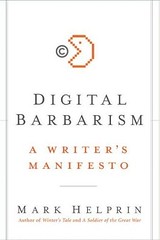
Last month, Digital Barbarism book cover National Review magazine published a review that I penned of Mark Helprin’s new book, Digital Barbarism: A Writer’s Manifesto.  Helprin’s book is both a passionate defense of copyright law as well as a mini-autobiography.  Helprin is one of the great novelists and essayists of the past half-century, and his book A Soldier of a Great War is one of my all-time favorite novels.  I cannot in strong enough words encourage you to read that book; it is profoundly moving. (I almost named my son after the lead character in the book!)

Thus, I was quite excited when I learned that Helprin had penned a defense of copyright and I jumped at the chance to review it when the folks at National Review asked me to do so.  Alas, as you will see in my review, I was terribly disappointed.  I wish Helprin would have stuck with the very reasonable tone he adopted in this excellent podcast interview he did recently with John J. Miller of National Review Online. Unfortunately, he went a different direction in the book, as I make clear in my review:


National Review July 20, 2009

“Man, Machine, and Copyright” a review of Digital Barbarism: A Writer’s Manifesto, by Mark Helprin by Adam Thierer

It would be difficult to think of anyone more ideally suited to pen a passionate defense of copyright law than novelist Mark Helprin.  Helprin has written several of the finest works of modern literature, including his masterpiece, A Soldier of the Great War, a narrative of transcendent beauty. In Digital Barbarism, Helprin sets out to use his formidable gift for the written word to repel the “cyber mob” that has attacked copyright law and called for its curtailment, or even abolition.

Unfortunately, while Helprin occasionally rises to great heights in his defense of copyright, he too often sinks to lamentable lows — by resorting to the same unbecoming rhetorical tactics used by the mob he seeks to condemn. Indeed, his book is filled with gratuitous vitriol and neo-Luddite ramblings about the Internet and Information Age that severely detract from his defense of copyright. This is a shame, because, in places, Digital Barbarism makes a fine case against those critics who wrongly view copyright as an impediment to the creation and diffusion of content. “The availability of information is not and will not be restrained by the copyright system any more than it is or will be restrained by the delivery systems that make it possible,” Helprin argues. Why, he asks, “must ‘content’ be free” when everything else — access to the Internet, digital devices, etc. — costs good money? He notes that the movement that advocates “free,” universal access to all copyrighted material in the name of “openness” and “the public good” would, ironically, “destroy the dream it advocates”: Continue reading →

When people ask me why I do what I do for a living — and, more specifically, why I focus all my attention on digital media and technology policy — I often respond by showing them the new gadgets or software I am playing with at any given time.  I just love digital technology.  I am swimming in a sea of digital gadgets, consumer electronics, online applications, computing software, video games, and all sorts of cyber-stuff.

Anyway, even though this is a technology policy blog, I sometimes highlight new digital toys or applications that have changed my life for the better. As the year winds down, therefore, I thought I would share with you five technologies that improved my life and productivity in 2008. I’d also love to hear from all of you about the technologies that you fell in love with this year in case I might have missed them. Here’s my list:

#1) Naturally Speaking 10:

Nat Speak boxThanks to Nate Anderson’s outstanding review over at Ars Technica, I finally made the plunge and bought Dragon Naturally Speaking 10 earlier this month.  Wow, what a life-changer. I had played around with an earlier version of this market-leading speech recognition technology and found it somewhat clunky and unreliable. But Ver. 10, has ironed out almost all the old problems and become an incredibly sophisticated piece of software in the process. I love the way I can use simple voice commands to navigate menus in Microsoft Word and in Firefox. Perhaps best of all, I can dictate random rants into a pocket recording device and then upload them to Naturally Speaking (via a USB connection) and have them instantly transcribed. I’m even composing blog entries like this using it! Only problem is inserting HTML code; that’s still a hassle. Also, I find that switching from one input device to another definitely affects the quality of the transcription. Once you “train” Naturally Speaking using one device, it makes sense to stick with it. It’s not just the quality of the microphone; it’s also the proximity to your mouth that makes a difference. Regardless, this is one great product and, best of all, it’s should help save my rapidly-aging hands from becoming prematurely arthritic! All those years of video games and keyboards have taken their toll. Continue reading →