I came across an article last week in the AV Club that caught my eye. The title is: “The Telecommunications Act of 1996 gave us shitty cell service, expensive cable.” The Telecom Act is the largest update to the regulatory framework set up in the 1934 Communications Act. The basic thrust of the Act was to update the telephone laws because the AT&T long-distance monopoly had been broken up for a decade. The AV Club is not a policy publication but it does feature serious reporting on media. This analysis of the Telecom Act and its effects, however, omits or obfuscates important information about dynamics in media since the 1990s.
The AV Club article offers an illustrative collection of left-of-center critiques of the Telecom Act. Similar to Glass-Steagall repeal or
Citizens United, many on the left are apparently citing the Telecom Act as a kind of shorthand for deregulatory ideology run amuck. And like Glass-Steagall repeal and Citizens United, most of the critics fundamentally misstate the effects and purposes of the law. Inexplicably, the AV Club article relies heavily on a Common Cause white paper from 2005. Now, Common Cause typically does careful work but the paper is hopelessly outdated today. Eleven years ago Netflix was a small DVD-by-mail service. There was no 4G LTE (2010). No iPhone or Google Android (2007). And no Pandora, IPTV, and a dozen other technologies and services that have revolutionized communications and media. None of the competitive churn since 2005, outlined below, is even hinted at in the AV Club piece. The actual data undermine the dire diagnoses about the state of communications and media from the various critics cited in the piece. Continue reading →
For decades Congress has gradually deregulated communications and media. This poses a significant threat to the FCC’s jurisdiction because it is the primary regulator of communications and media. The current FCC, exhibiting alarming mission creep, has started importing its legacy regulations to the online world, like Title II common carrier regulations for Internet providers. The FCC’s recent proposal to “open up” TV set top boxes is consistent with the FCC’s reinvention as the US Internet regulator, and now the White House has supported that push.
There are a lot of issues with the set top box proposal but I’ll highlight a few. I really don’t even like referring to it as “the set top box proposal” because the proposal is really aimed at the future of TV–video viewing via apps and connected devices. STBs are a sideshow and mostly just provide the FCC a statutory hook to regulate TV apps. Even that “hook” is dubious–the FCC arbitrarily classifies apps and software as “navigation devices” but concludes that actual TV devices like Chromecast, Roku, smartphones, and tablets aren’t navigation devices. And, despite what activists say, this isn’t about “cable” either but all TV distributors (“MVPDs”) like satellite and telephone companies and Google Fiber, most of whom are small TV players. Continue reading →
Last Friday I attended a fascinating conference hosted by the Duke Law School’s Center for Innovation Policy about television regulation and competition. It’s remarkable how quickly television competition has changed and how online video providers are putting pressure on old business models.
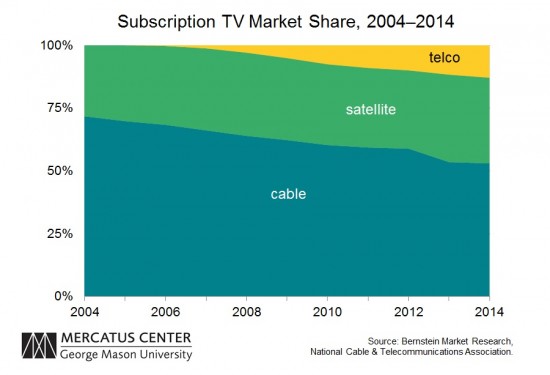
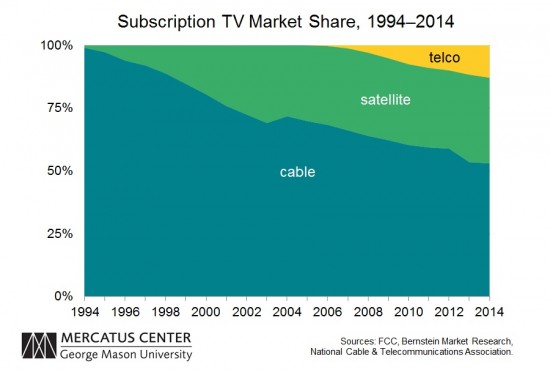
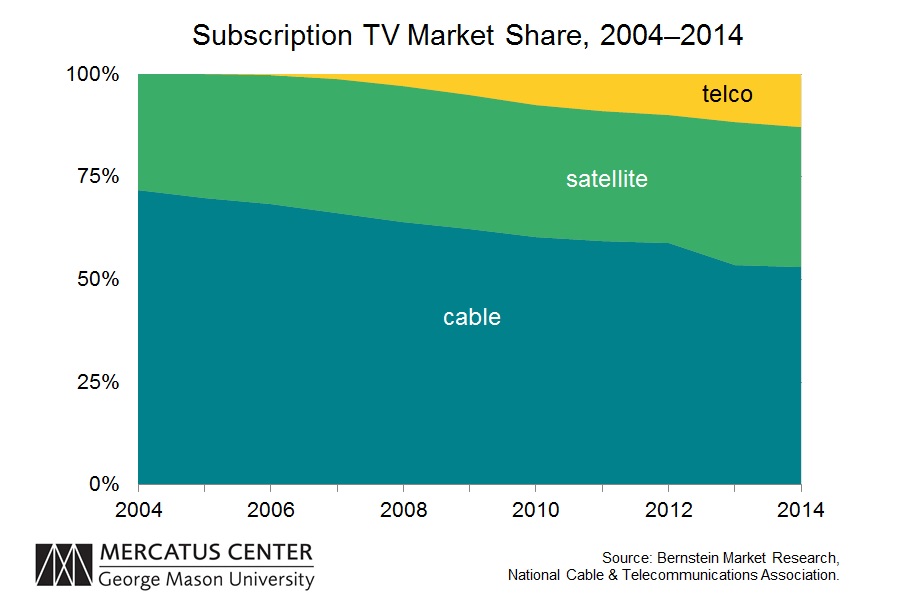
I’ve been working on a project about competition in technology, communications, and media and one chart that stands out is one that shows increasing competition in pay television, below. Namely, that cable providers have lost nearly 15 million subscribers since 2002. Cable was essentially the only game in town in 1990 for pay television (about 100% market share). Yet today, cable’s market share approaches 50%. This competitive pressure accounts for some cable companies trying to merge in recent years.
Much of this churn by subscribers was to satellite providers but it’s the “telephone” companies providing TV that’s really had a competitive impact in recent years. Telcos went from about 0% market share in 2005 to 13% in 2014. This new competition can be tied to Congress finally allowing telephone companies to provide TV in 1996. However, these new services didn’t really get started until a decade ago when 1) digital and IP technology improved, and 2) the FCC made it clear by deregulating DSL ISPs that telephone companies could expect a market return for investing in fiber broadband nationwide.
UPDATE:
And below is market share data going back ten more years to 1994 using FCC data, which uses a slightly different measurement methodology (hence the kink around 2003-2004). I’ve also omitted market share of Home Satellite Dish (those large dishes you sometimes see in rural areas). Though HSD has negligible market share today, it had a few million subscribers in the mid-1990s. I may add HSD later.
The Federal Communications Commission (FCC) recently sought additional comment on whether it should eliminate its network non-duplication and syndicated exclusivity rules (known as the “broadcasting exclusivity” rules). It should just as well have asked whether it should eliminate its rules governing broadcast television. Local TV stations could not survive without broadcast exclusivity rights that are enforceable both legally and practicably.
The FCC’s broadcast exclusivity rules “do not create rights but rather provide a means for the parties to exclusive contracts to enforce them through the Commission rather than the courts.” (Broadcast Exclusivity Order, FCC 88-180 at ¶ 120 (1988)) The rights themselves are created through private contracts between TV stations and video programming vendors in the same manner that MVPDs create exclusive rights to distribute cable network programming.
Local TV stations typically negotiate contracts for the exclusive distribution of national broadcast network or syndicated programming in their respective local markets in order to preserve their ability to obtain local advertising revenue. The FCC has long recognized that, “When the same program a [local] broadcaster is showing is available via cable transmission of a duplicative [distant] signal, the [local] broadcaster will attract a smaller audience, reducing the amount of advertising revenue it can garner.” (Program Access Order, FCC 12-123 at ¶ 62 (2012)) Enforceable broadcast exclusivity agreements are thus necessary for local TV stations to generate the advertising revenue that is necessary for them to survive the government’s mandatory broadcast television business model.
The FCC determined nearly fifty years ago that it is an anticompetitive practice for multichannel video programming distributors (MVPDs) to import distant broadcast signals into local markets that duplicate network and syndicated programming to which local stations have purchased exclusive rights. (
See First Exclusivity Order, 38 FCC 683, 703-704 (1965)) Though the video marketplace has changed since 1965, the government’s mandatory broadcast business model is still required by law, and MVPD violations of broadcast exclusivity rights are still anticompetitive. Continue reading →
The D.C. Circuit has struck down as arbitrary and capricious the FCC’s “cable cap.” The cap prevented a single cable operator from serving more than 30% of U.S. homes—precisely the same percentage limit struck down by the court in 2001. The court ruled that the FCC had failed to demonstrate that “allowing a cable operator to serve more than 30% of all cable subscribers would threaten to reduce either competition or diversity in programming.”
The court’s decision rested on the two critical charts (both generated by my PFF colleague Adam Thierer in his excellent
Media Metrics special report) at the heart of the PFF amicus brief I wrote with our president, Ken Ferree:
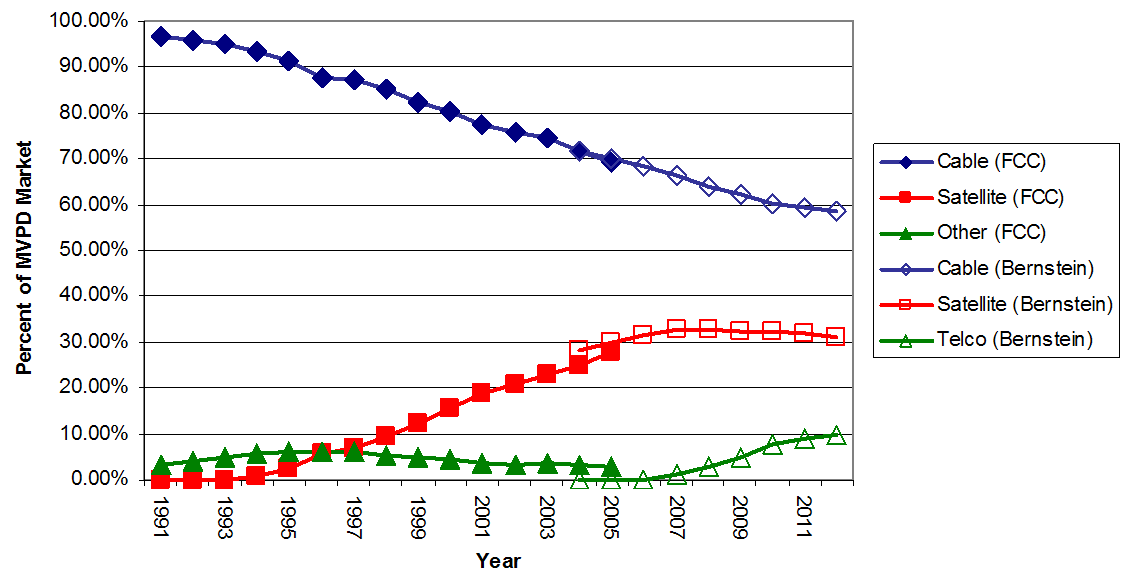
First, the record is replete with evidence of ever increasing competition among video providers: Satellite and fiber optic video providers have entered the market and grown in market share since the Congress passed the 1992 Act, and particularly in recent years. Cable operators, therefore, no longer have the bottleneck power over programming that concerned the Congress in 1992.
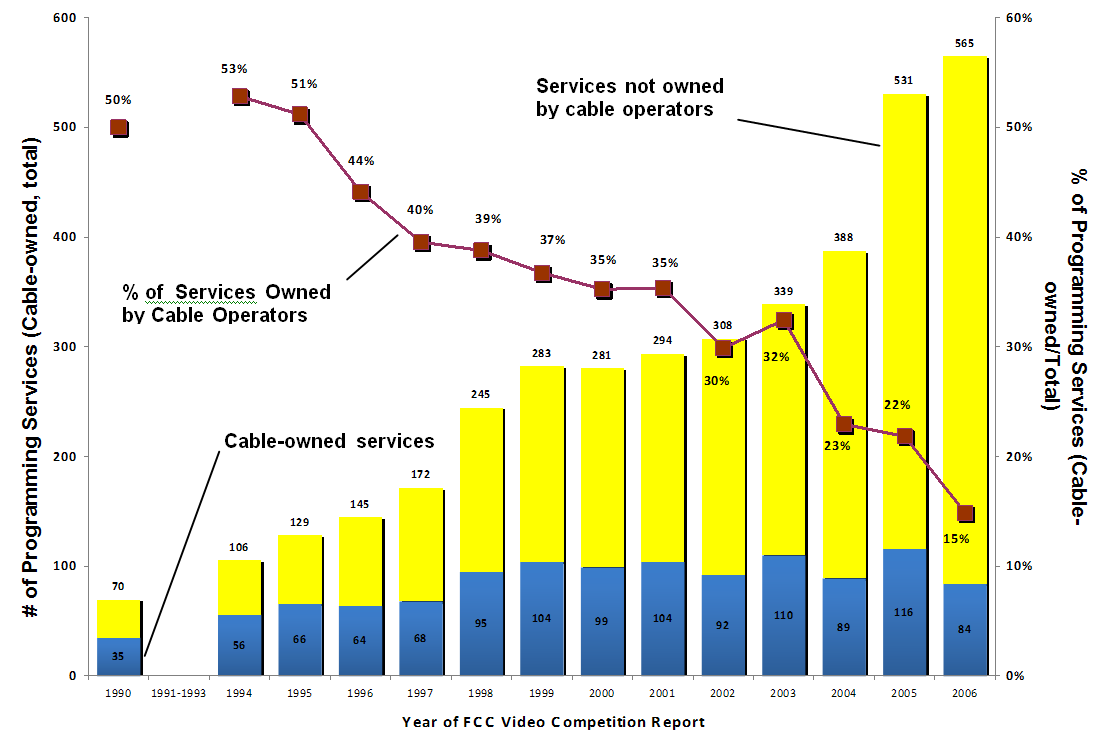
Second, over the same period there has been a dramatic increase both in the number of cable networks and in the programming available to subscribers.
Our chart shows the explosion in the number of programmers (though not the total amount of programming), as well as the falling rate of affiliation between cable operators and programmers, which was among the prime factors motivating Congress when it authorized a cable cap in the 1992 Cable Act:
Continue reading →
This ongoing series has explored the increasing ability of consumers to “cut the cord” to traditional video distributors (cable, satellite, etc.) and instead receive a mix of “television” programming and other forms of video programming over the Internet. As I’ve argued, this change not only means lower monthly bills for those “early adopter” consumers who actually do “cut the cord”, but, in the coming years, a total revolution in the traditional system of content creation and distribution on which the FCC’s existing media regulatory regime is premised.
This revolution has two key parts:
- Conduits: The growing inventory—and popularity—of sites such as Hulu, Amazon Unboxed and the XBox 360 Marketplace (or software such as Apple’s iTunes store), that allow users to view or download video content. Drawing an analogy to the FCC’s term “Multichannel Video Programming Distibutor” or MVPD (cable, direct broadcast satellite, telco fiber, etc.), I’ve dubbed these sites “Internet Video Programming Distributors” or IVPDs.
- Interface: The hardware and software that allows users to display that content easily on a device of their choice, especially their home televisions.
While much of the conversation about “interface” has focused on special hardware that brings IVPD content to televisions through set-top boxes such as the Roku box or game consoles like the XBox 360, at least one company is making waves with a software solution. From the NYT:
Boxee bills its software as a simple way to access multiple Internet video and music sites, and to bring them to a large monitor or television that one might be watching from a sofa across the room.
Some of Boxee’s fans also think it is much more: a way to euthanize that costly $100-a-month cable or satellite connection.
“Boxee has allowed me to replace cable with no remorse,” said Jef Holbrook, a 27-year-old actor in Columbus, Ga., who recently downloaded the Boxee software to the $600 Mac Mini he has connected to his television. “Most people my age would like to just pay for the channels they want, but cable refuses to give us that option. Services like Boxee, that allow users choice, are the future of television.” ….
Boxee gives users a single interface to access all the photos, video and music on their hard drives, along with a wide range of television shows, movies and songs from sites like Hulu,Netflix, YouTube, CNN.com and CBS.com.
Continue reading →
Continuing the “Cutting the (Video) Cord” series started by my PFF colleague Adam Thierer: The WSJ had two great pieces yesterday about the increasing competitive relevance of television distributed by Internet—a trend that was at the heart of an amicus
brief PFF recently filed in support of C omcast’s challenge of the FCC’s 30% cap on cable ownership. The first WSJ piece declares that:
After more than a decade of disappointment, the goal of marrying television and the Internet seems finally to be picking up steam. A key factor in the push are new TV sets that have networking connections built directly into them, requiring no additional set-top boxes for getting online. Meanwhile, many consumers are finding more attractive entertainment and information choices on the Internet — and have already set up data networks for their PCs and laptops that can also help move that content to their TV sets.
The easier it is for consumers to receive traditional television programming (in addition to other kinds of video content) distributed over the Internet on their television, the less “gatekeeper” or “bottleneck” power cable distributors have over programming. So the Netflix-capable and Yahoo-widget-capable televisions described by the WSJ piece go a long way to increasing the substitutability of what we call Internet Video Programming Distributors (IVPDs) for Multichannel Video Programming Distributors (MVPDs), such as cable, satellite television and fiber services offered by telcos such as Verizon’s FiOS.
While such televisions are only expected to reach 14% of all TV sales by 2012, one must remember that a growing number of set-top boxes (
e.g., the Roku Digitial Video Player, game consoles like the Microsoft XBox 360 and Sony PlayStation 3, and TiVo DVRs) allow users to users to receive IVPD programming on their existing televisions.
As we argued in our amicus brief, the immense competitive importance of IVPDs lies not in the potential for some users to “cut the cord” to cable and other MVPDs (though that will surely happen), but in the immediate impact IVPDs have as an alternative distribution channel for programmers. In the pending D.C. Circuit case, we argue that both the FCC’s 30% cap, issued in December 2007, and the underlying portions of the 1992 Cable Act authorizing such a cap should be struck down as unconstitutional because the ready availability of IVPDs as an alternative distribution channel means that cable no longer has the “special characteristic” of gatekeeper/bottleneck power that would justify imposing such a unique burden on the audience size of cable operators. (Of course, Direct Broadcast Satellite and Telco Fiber are also eating away at cable’s share of the MVPD marketplace.)
The second WSJ piece, an op/ed, illustrates beautifully how cable operators are already losing “market power” (or at least negotiating leverage) in a very tangible way: they’re having to pay more for programming. Specifically, the Journal describes how Viacom plaid chicken with Time Warner—and won. Continue reading →
Ken Ferree and I just filed an amicus brief with the D.C. Circuit in what could be among the most important First Amendment cases involving economic regulation in years: Comcast’s challenge to the FCC’s cap on the maximum size of a cable operator’s nationwide subscriber-audience. While few may feel righteous indignation at limitations targeted at large corporations such as Comcast or Time Warner, the larger principle at stake here is deeply important: Will the First Amendment provide a meaningful check on what USC law professor Chris Yoo has called “architectural censorship” (i.e., so-called “structural” regulations that “have the unintended consequence of reducing the quantity, quality, and diversity of media content”).
In a nutshell, we argue that that:
- The provisions of the 1992 Cable Act authorizing the FCC to impose a “cable cap” are outdated in world of media abundance and vibrant platform competition.
- Because cable is no longer the unique “bottleneck” or “gatekeeper” that it was in 1992, these statutory provisions (not just the FCC’s 30% rule) must be subject to strict scrutiny under the First Amendment as a limitation on free speech.
- Because there are “less restrictive means” of ensuring cable operators do not impede the flow of video programming to consumers, the court should strike down these provisions.
- Even if the court upholds the statute, it should nonetheless strike down the cap issued by the FCC in December 2007 (30% of all Multichannel Video Programming (MVPD) subscribers as based on an outdated model of the video marketplace.
I encourage you to read our brief (below). I’ve provided a summary below, along with some additional commentary we just couldn’t cover under our 3500 word limit.
Strict Scrutiny. Yoo’s article Architectural Censorship and the FCC is essential reading for anyone who believes that government regulations on the size and shape of the “soapbox” can have huge effects on speech itself. Yoo argues that the First Amendment should check this kind of regulation–however “content-neutral” it might seem–under “strict scrutiny”, which requires that the government show that a regulation is the “least restrictive means” available for advancing a “compelling government interest.” But Yoo ultimately concludes (pp. 713-718, PDF pp. 45-50) that, under existing precedent, most “architectural censorship will be effectively insulated from meaningful judicial review.” Continue reading →


 The Technology Liberation Front is the tech policy blog dedicated to keeping politicians' hands off the 'net and everything else related to technology.