Posts tagged as:

Discourse magazine has just published my review of Where Is My Flying Car?, by J. Storrs Hall, which I argue is the most important book on technology policy written in the past quarter century. Hall perfectly defines what is at stake if we fail to embrace a pro-progress policy vision going forward. Hall documents how a “Jetsons” future was within our grasp, but it was stolen away from us. What held back progress in key sectors like transportation, nanotech & energy was anti-technological thinking and the overregulation that accompanies it. “[T]he Great Stagnation was really the Great Strangulation,” he argues. The culprits: negative cultural attitudes toward innovation, incumbent companies or academics looking to protect their turf, litigation-happy trial lawyers, and a raft of risk-averse laws and regulations.

Hall coins the term “the Machiavelli Effect” to identify why many people simultaneously fear the new and different, and they also want to protect whatever status quo they benefit from (or at least feel comfortable with). He builds on this passage from Niccolò Machiavelli’s classic 1532 study of political power, “The Prince”: Continue reading →

There is a war going on in the conservative movement over free speech issues and FCC Commissioner Mike O’Reilly just became a causality of that skirmish. Neil Chilson and I just posted a new essay about this over on the Federalist Society blog. As we note there:

Plenty of people claim to favor freedom of expression, but increasingly the First Amendment has more fair-weather friends than die-hard defenders. Michael O’Rielly, a Commissioner at the Federal Communications Commission (FCC), found that out the hard way this week. Last week, O’Rielly delivered an important speech before the Media Institute highlighting a variety of problematic myths about the First Amendment, as well as “a particularly ominous development in this space.” In a previous political era, O’Rielly’s remarks would have been mainstream conservative fare. But his well-worded warnings are timely with many Democrats and Republicans – including some in the White House – looking to resurrect analog-era speech mandates and let Big Government reassert control over speech decisions in the United States.

Shortly after delivering his remarks, the White House yanked O’Rielly’s nomination to be reappointed to the agency. It was a shocking development that was likely motivated by growing animosities between Republicans on the question of how much control the federal government–and the FCC in particular–should exercise over speech platforms, including platforms that the FCC has no authority to regulate.

For the 30 years that I have been covering media and technology policy, I’ve heard conservatives rail against the Fairness Doctrine, Net Neutrality and arbitrary Big Government only to see many of them now reverse suit and become the biggest defenders of these things as it pertains to speech controls and FCC regulation. It will certainly be interesting to see what a potential future Biden Administration does with the various new regulations that some in the GOP are seeking to impose. Continue reading →

Sen. Josh Hawley (R-MO) recently delivered remarks at the National Conservatism Conference and a Young America’s Foundation conference in which he railed against political and academic elites, arguing that, “the old era is ending and the old ways will not do.” “It’s time that we stood up to big government, to the people in government who think they know better,” Hawley noted at the YAF event. “[W]e are for free competition… we are for the free market.”

That’s all nice-sounding rhetoric but it sure doesn’t seem to match up with Hawley’s recent essays and policy proposals, which are straight out of the old era’s elitist and highly paternalistic Washington-Knows-Best playbook. Specifically, Hawley has called for a top-down, technocratic regulatory regime for the Internet and the digital economy more generally. Hawley has repeatedly made claims that digital technology companies have gotten a sweetheart deal from government and they they have censored conservative voices. That’s utter nonsense, but those arguments have driven his increasingly fanatic rhetoric and command-and-control policy proposals. If he succeeds in his plan to empower unelected bureaucrats inside the Beltway to reshape the Internet, it will destroy one of the greatest American success stories in recent memory. It’s hard to understand how that could be labelled “conservative” in any sense of the word. Continue reading →

This essay originally appeared on The Bridge under the title “Confessions of a Vidiot” on July 16, 2019.


I have a confession: I’m 50 years old and still completely in love with video games.

Image result for Time magazine video games coverI feel silly saying that, even though I really shouldn’t. Video games are now fully intertwined with the fabric of modern life and, by this point, there have been a couple of generations of adults who, like me, have played them actively over the past few decades. Somehow, despite the seemingly endless moral panics about video games, we came out alright. But that likely will not stop some critics from finding new things to panic over.

As a child of the 1970s, I straddled the divide between the old and new worlds of gaming. I was (and remain) obsessed with board and card games, which my family played avidly. But then Atari’s home version of “Pong” landed in 1976. The console had rudimentary graphics and controls, and just one game to play, but it was a revelation. After my uncle bought Pong for my cousins, our families and neighbors would gather round his tiny 20-inch television to watch two electronic paddles and a little dot move around the screen.

Every kid in the world immediately began lobbying their parents for a Pong game of their own, but then a year later something even more magical hit the market: Atari’s 2600 gaming platform. It was followed by Mattel’s “Intellivision” and Coleco’s “ColecoVision.” The platform wars had begun, and home video games had gone mainstream.

My grandmother, who lived with us at the time, started calling my brother and me “vidiots,” which was short for “video game idiots.” My grandmother raised me and was an absolute treasure to my existence, but when it came to video games (as well as rock music), the generational tensions between us were omnipresent. She was constantly haranguing my brother and me about how we were never going to amount to much in life if we didn’t get away from those damn video games!

I used to ask her why she never gave us as much grief about playing board or card games. She thought those were mostly fine. There was just something about the electronic or more interactive nature of video games that set her and the older generation off.

And, of course, there was the violence. There is no doubt that video games contained violent themes and images that were new to the gaming experience. In the analog gaming era, violent action was left mostly to the imagination. With electronic games, it was right there for us to see in all its (very bloody) glory. Continue reading →

[This essay originally appeared on the AIER blog on May 28, 2019. The USA TODAY also ran a shorter version of this essay as a letter to the editor on June 2, 2019.]

In a hotly-worded USA Today op-ed last week, Senator Josh Hawley (R-Missouri) railed against social media sites Facebook, Instagram, and Twitter. He argued that, “social media wastes our time and resources,” and is “a field of little productive value” that have only “given us an addiction economy.” Sen. Hawley refers to these sites as “parasites” and blames them for a litany of social problems (including an unproven link to increased suicide), leading him to declare that, “we’d be better off if Facebook disappeared.”

As far as moral panics go, Sen. Hawley’s will go down as one for the ages. Politicians have always castigated new technologies, media platforms, and content for supposedly corrupting the youth of their generation. But Sen. Hawley’s inflammatory rhetoric and proposals are something we haven’t seen in quite some time.

He sounds like those fire-breathing politicians and pundits of the past century who vociferously protested everything from comic books to cable television, the waltz to the Walkman, and rock-and-roll to rap music. In order to save the youth of America, many past critics said, we must destroy the media or media platforms they are supposedly addicted to. That is exactly what Sen. Hawley would have us do to today’s leading media platforms because, in his opinion, they “do our country more harm than good.”

We have to hope that Sen. Hawley is no more successful than past critics and politicians who wanted to take these choices away from the public. Paternalistic politicians should not be dictating content choices for the rest of us or destroying technologies and platforms that millions of people benefit from. Continue reading →

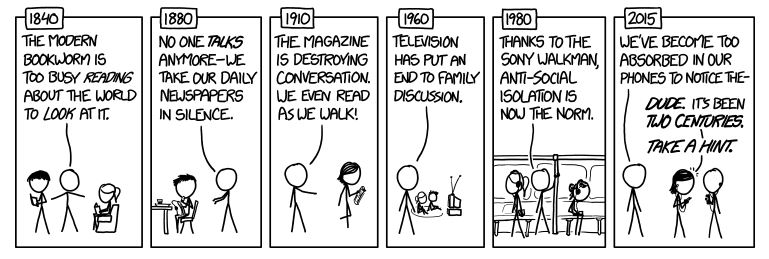
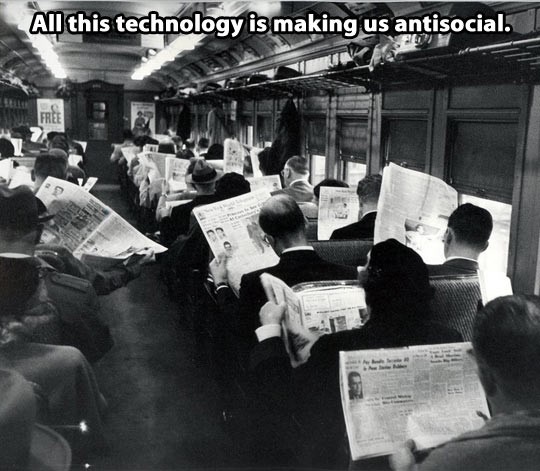
Last week, science writer Michael Shermer tweeted out this old xkcd comic strip that I had somehow missed before. Shermer noted that it represented, “another reply to pessimists bemoaning modern technologies as soul-crushing and isolating.” Similarly, there’s this meme that has been making the rounds on Twitter and which jokes about how newspapers made us as antisocial in the past much as newer technologies supposedly do today.

‏The sentiments expressed by the comic and that image make it clear how people often tend to romanticize past technologies or fail to remember that many people expressed the same fears about them as critics do today about newer ones. I’ve written dozens of articles about “moral panics” and “techno-panics,” most of which are cataloged here. The common theme of those essays is that, when it comes to fears about innovations, there really is nothing new under the sun. Continue reading →

It was my pleasure this week to be invited to deliver some comments at an event hosted by the Information Technology and Innovation Foundation (ITIF) to coincide with the release of their latest study, “The Privacy Panic Cycle: A Guide to Public Fears About New Technologies.” The goal of the new ITIF report, which was co-authored by Daniel Castro and Alan McQuinn, is to highlight the dangers associated with “the cycle of panic that occurs when privacy advocates make outsized claims about the privacy risks associated with new technologies. Those claims then filter through the news media to policymakers and the public, causing frenzies of consternation before cooler heads prevail, people come to understand and appreciate innovative new products and services, and everyone moves on.” (p. 1)

As Castro and McQuinn describe it, the privacy panic cycle “charts how perceived privacy fears about a technology grow rapidly at the beginning, but eventually decline over time.” They divide this cycle into four phases: Trusting Beginnings, Rising Panic, Deflating Fears, and Moving On. Here’s how they depict it in an image:

Privacy Panic Cycle - 1


Continue reading →

I’ve spent a lot of time here through the years trying to identify the factors that fuel moral panics and “technopanics.” (Here’s a compendium of the dozens of essays I’ve written here on this topic.) I brought all this thinking together in a big law review article (“Technopanics, Threat Inflation, and the Danger of an Information Technology Precautionary Principle”) and then also in my new booklet, “Permissionless Innovation: The Continuing Case for Comprehensive Technological Freedom.”

One factor I identify as contributing to panics is the fact that “bad news sells.” As I noted in the book, “Many media outlets and sensationalist authors sometimes use fear-based tactics to gain influence or sell books. Fear mongering and prophecies of doom are always effective media tactics; alarmism helps break through all the noise and get heard.”

In line with that, I want to highly recommend you check out this excellent new oped by John Stossel of Fox Business Network on “Good News vs. ‘Pessimism Porn‘.”  Stossel correctly notes that “the media win by selling pessimism porn.” He says:

Are you worried about the future? It’s hard not to be. If you watch the news, you mostly see violence, disasters, danger. Some in my business call it “fear porn” or “pessimism porn.” People like the stuff; it makes them feel alive and informed. Of course, it’s our job to tell you about problems. If a plane crashes — or disappears — that’s news. The fact that millions of planes arrive safely is a miracle, but it’s not news. So we soak in disasters — and warnings about the next one: bird flu, global warming, potential terrorism. I won Emmys hyping risks but stopped winning them when I wised up and started reporting on the overhyping of risks. My colleagues didn’t like that as much.

He continues on to note how, even though all the data clearly proves that humanity’s lot is improving, the press relentlessly push the “pessimism porn.” Continue reading →

What Unites Advocates of Speech Controls & Privacy Regulation? [pdf]

by Adam Thierer & Berin Szoka The Progress & Freedom Foundation, Progress on Point No. 16.19

Anyone who has spent time following debates about speech and privacy regulation comes to recognize the striking parallels between these two policy arenas. In this paper we will highlight the common rhetoric, proposals, and tactics that unite these regulatory movements. Moreover, we will argue that, at root, what often animates calls for regulation of both speech and privacy are two remarkably elitist beliefs:

  1. People are too ignorant (or simply too busy) to be trusted to make wise decisions for themselves (or their children); and/or,
  2. All or most people share essentially the same values or concerns and, therefore, “community standards” should trump household (or individual) standards.

While our use of the term “elitism” may unduly offend some understandably sensitive to populist demagoguery, our aim here is not to launch a broadside against elitism as Time magazine culture critic William H. Henry once defined it: “The willingness to assert unyieldingly that one idea, contribution or attainment is better than another.”[1] Rather, our aim here is to critique that elitism which rises to the level of political condescension and legal sanction. We attack not so much the beliefs of some leaders, activists, or intellectuals that they have a better idea of what it in the public’s best interest than the public itself does, but rather the imposition of those beliefs through coercive, top-down mandates.

That sort of elitism—elitism enforced by law—is often the objective of speech and privacy regulatory advocates. Our goal is to identify the common themes that unite these regulatory movements, explain why such political elitism is unwarranted, and make it clear how it threatens individual liberty as well as the future of free and open Internet. As an alternative to this elitist vision, we advocate an empowerment agenda: fostering an environment in which users have the tools and information they need to make decisions for themselves and their families. Continue reading →

My friend Anne Collier of Net Family News, one of America’s great sages on child safety issues, has produced a terrific list of reasons “Why Technopanics are Bad.”  Technopanics and moral panics are topics I’ve spent quite a bit of time commenting on here. (See 1, 2, 3, 4.) Anne is a rare voice of sanity and sensible advice when it comes to online child safety issues and I encourage you to read all her excellent work on the subject, including her book with Larry Magid, MySpace Unraveled: A Parent’s Guide to Teen Social Networking.  Anyway, here’s Anne’s list, and I encourage you to go over to her site and contribute your thoughts and suggestions about what else to add:

Technopanics are bad because they…
  • Cause fear, which interferes with parent-child communication, which in turn puts kids at greater risk.
  • Cause schools to fear and block digital media when they need to be teaching constructive use, employing social-technology devices and teaching new media literacy and citizenship classes throughout the curriculum.
  • Turn schools into barriers rather than contributors to young people’s constructive use.
  • Increase the irrelevancy of school to active young social-technology users via the sequestering or banning of educational technology and hamstring some of the most spirited and innovative educators.
  • Distract parents, educators, policymakers from real risks – including, for example, child-pornography laws that do not cover situations where minors can simultaneously be victim and “perpetrator” and, tragically, become registered sex offenders in cases where there no criminal intent (e.g., see this).
  • Reduce the competitiveness of US education among developed countries already effectively employing educational technology and social media in schools.
  • Reduce the competitiveness of US technology and media businesses practicing good corporate citizenship where youth online safety is concerned.
  • Lead to bad legislation, which aggravates above outcomes and takes the focus off areas where good laws on the books can be made relevant to current technology use.
  • Widen the participation gap for youth – technopanics are barriers for children and teens to full, constructive participation in participatory culture and democracy.