I’ve been floating around in conservative policy circles for 30 years and I have spent much of that time covering media policy and child safety issues. My time in conservative circles began in 1992 with a 9-year stint at the Heritage Foundation, where I launched the organization’s policy efforts on media regulation, the Internet, and digital technology. Meanwhile, my work on child safety has spanned 4 think tanks, multiple blue ribbon child safety commissions, countless essays, dozens of filings and testimonies, and even a multi-edition book.
During this three-decade run, I’ve tried my hardest to find balanced ways of addressing some of the legitimate concerns that many conservatives have about kids, media content, and online safety issues. Raising kids is the hardest job in the world. My daughter and son are now off at college, but the last twenty years of helping them figure out how to navigate the world and all the challenges it poses was filled with difficulties. This was especially true because my daughter and son faced completely different challenges when it came to media content and online interactions. Simply put, there is no one-size-fits-all playbook when it comes to raising kids or addressing concerns about healthy media interactions. Continue reading →
James Pethokousis of AEI interviews me about the current miserable state of modern science fiction, which is just dripping with dystopian dread in every movie, show, and book plot. How does all the techno-apocalyptica affect societal and political attitudes about innovation broadly and emerging technologies in particular. Our discussion builds on my recent a recent Discourse article, “How Science Fiction Dystopianism Shapes the Debate over AI & Robotics.” [Pasted down below.] Swing on over to Jim’s “Faster, Please” newsletter and hear what Jim and I have to say. And, for a bonus question, Jim asked me is we doing a good job of inspiring kids to have a sense of wonder and to take risks. I have some serious concerns that we are falling short on that front.
CollegeHumor has created this amazing video, “Black Mirror Episodes from Medieval Times,” which is a fun parody of the relentless dystopianism of the Netflix show “Black Mirror.” If you haven’t watched Black Mirror, I encourage you to do so. It’s both great fun and ridiculously bleak and over-the-top in how it depicts modern or future technology destroying all that is good on God’s green earth.
The CollegeHumor team picks up on that and rewinds the clock about a 1,000 years to imagine how Black Mirror might have played out on a stage during the medieval period. The actors do quick skits showing how books become sentient, plows dig holes to Hell and unleash the devil, crossbows destroy the dexterity of archers, and labor-saving yokes divert people from godly pursuits. As one of the audience members says after watching all the episodes, “technology will truly be the ruin of us all!” That’s generally the message of not only Black Mirror, but the vast majority of modern science fiction writing about technology (and also a huge chunk of popular non-fiction writing, too.)
[Based on forthcoming article in the Minnesota Journal of Law, Science & Technology, Vol. 14 Issue 1, Winter 2013, http://mjlst.umn.edu]
I hope everyone caught these recent articles by two of my favorite journalists, Kashmir Hill (“Do We Overestimate The Internet’s Danger For Kids?”) and Larry Magid (“Putting Techno-Panics into Perspective.”) In these and other essays, Hill and Magid do a nice job discussing how society responds to new Internet risks while also explaining how those risks are often blown out of proportion to begin with.
NPR science correspondent Shankar Vedantam had a great spot on NPR’s Morning Edition today about the disputes among social scientists over the impact of violent video games on kids. [“It’s A Duel: How Do Violent Video Games Affect Kids?”] You won’t be surprised to hear I wholeheartedly agree with Texas A&M psychologist Chris Ferguson, who noted in the spot:
Ferguson says it’s easy to think senseless video game violence can lead to senseless violence in the real world. But he says that’s mixing up two separate things. “Many of the games do have morally objectionable material and I think that is where a lot of the debate on this issue went off the rails,” he said. “We kind of mistook our moral concerns about some of these video games, which are very valid — I find many of the games to be morally objectionable — and then assumed that what is morally objectionable is harmful.”
I’ve written about Ferguson’s work and these issues more generally many times over through the years here at the TLF. Here are some of the most relevant essays:
John Naughton, a professor at the Open University in the U.K. and a columnist for the U.K. Guardian, has a new essay out entitled “Only a Fool or Nicolas Sarkozy Would Go to War with Facebook.” I enjoyed it because it touches upon two interrelated concepts that I’ve spent years writing about: “moral panic” and “third-person effect hypothesis” (although Naughton doesn’t discuss the latter by name in his piece.) To recap, let’s define those terms:
“Moral Panic” / “Techno-Panic“: Christopher Ferguson, a professor at Texas A&M’s Department of Behavioral, Applied Sciences and Criminal Justice, offers the following definition: “A moral panic occurs when a segment of society believes that the behavior or moral choices of others within that society poses a significant risk to the society as a whole.” By extension, a “techno-panic” is simply a moral panic that centers around societal fears about a specific contemporary technology (or technological activity) instead of merely the content flowing over that technology or medium.
“Third-Person Effect Hypothesis“: First formulated by psychologist W. Phillips Davison in 1983, “this hypothesis predicts that people will tend to overestimate the influence that mass communications have on the attitudes and behavior of others. More specifically, individuals who are members of an audience that is exposed to a persuasive communication (whether or not this communication is intended to be persuasive) will expect the communication to have a greater effect on others than on themselves.” While originally formulated as an explanation for how people convinced themselves “media bias” existed where none was present, the third-person-effect hypothesis has provided an explanation for other phenomenon and forms of regulation, especially content censorship. Indeed, one of the most intriguing aspects about censorship efforts historically is that it is apparent that many censorship advocates desire regulation to protect others, not themselves, from what they perceive to be persuasive or harmful content. That is, many people imagine themselves immune from the supposedly ill effects of “objectionable” material, or even just persuasive communications or viewpoints they do not agree with, but they claim it will have a corrupting influence on others.
All my past essays about moral panics and third-person effect hypothesis can be found here. These theories are also frequently on display in the work of some of the “Internet pessimists” I have written about here, as well as in many bills and regulatory proposals floated by lawmakers. Which brings us back to the Naughton essay.
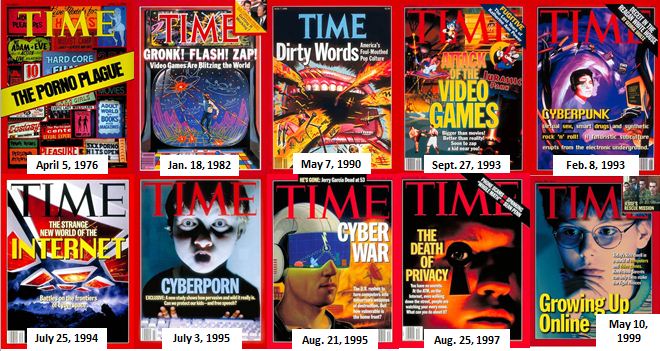
In this essay, I will suggest that (1) while “moral panics” and “techno-panics” are nothingnew, their cycles seem to be accelerating as new communications and information networks and platforms proliferate; (2) new panics often “crowd-out” or displace old ones; and (3) the current scare over online privacy and “tracking” is just the latest episode in this ongoing cycle.
What Counts as a “Techno-Panic”?
First, let’s step back and define our terms. Christopher Ferguson, a professor at Texas A&M’s Department of Behavioral, Applied Sciences and Criminal Justice, offers the following definition: “A moral panic occurs when a segment of society believes that the behavior or moral choices of others within that society poses a significant risk to the society as a whole.” By extension, a “techno-panic” is simply a moral panic that centers around societal fears about a specific contemporary technology (or technological activity) instead of merely the content flowing over that technology or medium. In her brilliant 2008 essay on “The MySpace Moral Panic,” Alice Marwick noted: Continue reading →
I spend a lot of time here trying to debunk media “moral panics,” “techno-panics,” or unfounded hysteria over the impact of commercialism in general on kids. To believe what some politicians and regulatory agitators have to say, today’s youth always seem at the precipice of the moral abyss. Our misguided youth are seemingly all going straight to hell and they dragging our culture and society down with them.
Except they’re not. It’s all the same old tripe we’ve heard one generation after another. As the late University of North Carolina journalism professor Margaret A. Blanchard once noted: “[P]arents and grandparents who lead the efforts to cleanse today’s society seem to forget that they survived alleged attacks on their morals by different media when they were children. Each generation’s adults either lose faith in the ability of their young people to do the same or they become convinced that the dangers facing the new generation are much more substantial than the ones they faced as children.” And Thomas Hine, author of
The Rise and Fall of the American Teenager, argues that: “We seem to have moved, without skipping a beat, from blaming our parents for the ills of society to blaming our children. We want them to embody virtues we only rarely practice. We want them to eschew habits we’ve never managed to break.”
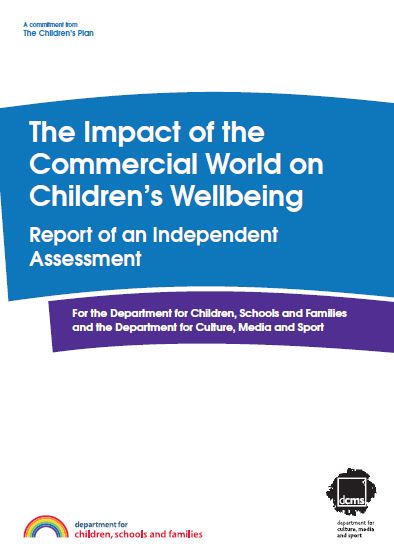
Anyway, I was reminded of this again today as I was finally reading through a report published last year by the U.K.’s Department for Children, Schools and Families and the Department for Culture, Media and Sport. It’s entitled “The Impact of the Commercial World on Children’s Wellbeing” and it is very much worth your attention. Several people had recommended I check it out in recent months, but I’m ashamed to say I am only now getting around to it as I prepare an amicus brief for the Supreme Court’s review of a California video game law. But this U.K. report is not to be missed. Here are a few of the choice bits from the study: Continue reading →
As I’ve noted here before, Ferguson has penned many importantarticlesraisingquestions about the claims made by some other psychologists (and politicians) that there is causal relationship between exposure to violent video games and youth aggression. Ferguson has shown there are reasons to be skeptical of such claims — both methodologically and practically-speaking. More on that down below.
In his latest piece, however, Ferguson, a professor at Texas A&M’s Department of Behavioral, Applied Sciences and Criminal Justice, is more fully developing moral panic theory, which he describes as follows: “A moral panic occurs when a segment of society believes that the behavior or moral choices of others within that society poses a significant risk to the society as a whole.” To illustrate the various forces at work that drive moral panics, Ferguson uses this “Moral Panic Wheel”:
Regular readers will recall my great interest in video games and the public policy debates surrounding efforts to regulate “violent” games in particular. One thing I bring up in almost every essay I write on this subject is how fears about kids and video games are almost always overblown and that kids can typically separate fantasy from reality. Nonetheless, kids have active imaginations and adults sometimes fear that which they cannot understand or appreciate. Friendly mentoring and open-minding parenting can go a long way to encouraging kids to make smart choices and understand where to draw lines, whereas efforts to demonize video games and youth culture almost always backfire.
Anyway, what got me thinking about all this again was an entertaining column in today’s
Washington Post by Ron Stanley (“Who Needs a TV to Play Video Games“), which describes the author’s experiences with his nephew when they played out video game-like scenarios using traditional toys and household items. It’s a wonderful piece worth reading in its entirety, but here’s the key takeaway that I’d like to discuss:
There was no evidence that television and video games had stifled the kids’ creativity. Nor was there any evidence that technology had made them smarter than earlier generations. They simply had a different frame of reference, one that included video games and computers as well as ponies, pet stores and sword fights. Children play with the tools at hand, and they’re great at thinking metaphorically — at imagining that a landspeeder is a sentient robot or that a stick is a gun or that salt-and-pepper shakers are a bride and groom or that a card table is a horse’s stable.
They’re also geniuses at figuring out simple mechanics. My 6-year-old nephew had to explain to me that miniature low-rider cars don’t roll very well on carpet and will flip over more than if racing on hardwood floors. Novice that I was, I was choosing cars that looked the coolest. And they are geniuses at intuiting rules and systems, and at re-creating these rules and systems in their own play. Children who play lots of card games will invent their own card games. Children who play lots of board games will invent their own board games. And children who play lots of video games will invent their own video-game-like games when they don’t have access to the game controllers.
The Technology Liberation Front is the tech policy blog dedicated to keeping politicians' hands off the 'net and everything else related to technology. Learn more about TLF →

![Moral Panic Wheel [Ferguson]](http://farm4.static.flickr.com/3080/3219688961_6d255b309f.jpg)

 The Technology Liberation Front is the tech policy blog dedicated to keeping politicians' hands off the 'net and everything else related to technology.