Over at Discourse magazine I’ve posted my latest essay on how conservatives are increasingly flirting with the idea of greatly expanding regulatory control of private speech platforms via some sort of common carriage regulation or new Fairness Doctrine for the internet. It begins:
Conservatives have traditionally viewed the administrative state with suspicion and worried about their values and policy prescriptions getting a fair shake within regulatory bureaucracies. This makes their newfound embrace of common carriage regulation and media access theory (i.e., the notion that government should act to force access to private media platforms because they provide an essential public service) somewhat confusing. Recent opinions from Supreme Court Justice Clarence Thomas as well as various comments and proposals of Sen. Josh Hawley and former President Trump signal a remarkable openness to greater administrative control of private speech platforms.
Given the takedown actions some large tech companies have employed recently against some conservative leaders and viewpoints, the frustration of many on the right is understandable. But why would conservatives think they are going to get a better shake from state-regulated monopolists than they would from today’s constellation of players or, more importantly, from a future market with other players and platforms?
I continue on to explain why conservatives should be skeptical of the administrative state being their friend when it comes to the control of free speech. I end by reminding conservatives what President Ronald Reagan said in his 1987 veto of legislation to reestablish the Fairness Doctrine: “History has shown that the dangers of an overly timid or biased press cannot be averted through bureaucratic regulation, but only through the freedom and competition that the First Amendment sought to guarantee.”
Read more at Discourse, and down below you will find several other recent essays I’ve written on the topic.
Here’s a new animated explainer video that I narrated for the Federalist Society’s Regulatory Transparency Project. The 3-minute video discusses how earlier “tech giants” rose and fell as technological innovation and new competition sent them off to what the New York Times once appropriately called “The Hall of Fallen Giants.” It’s a continuing testament to the power of “creative destruction” to upend and reorder markets, even as many pundits insist that there’s no possibility change can happen.
Interoperability is a topic that has long been of interest to me. How networks, platforms, and devices work with each other–or sometimes fail to–is an important engineering, business, and policy issue. Back in 2012, I spilled out over 5,000 words on the topic when reviewing John Palfrey and Urs Gasser’s excellent book, Interop: The Promise and Perils of Highly Interconnected Systems.
I’ve always struggled with the interoperability issues, however, and often avoided them became of the sheer complexity of it all. Some interesting recent essays by sci-fi author and digital activist Cory Doctorow remind me that I need to get back on top of the issue. His latest essay is a call-to-arms in favor of what he calls “adversarial interoperability.” “[T]hat’s when you create a new product or service that plugs into the existing ones without the permission of the companies that make them,” he says. “Think of third-party printer ink, alternative app stores, or independent repair shops that use compatible parts from rival manufacturers to fix your car or your phone or your tractor.”
Doctorow is a vociferous defender of expanded digital access rights of many flavors and his latest essays on interoperability expand upon his previous advocacy for open access and a general freedom to tinker. He does much of this work with the Electronic Frontier Foundation (EFF), which shares his commitment to expanded digital access and interoperability rights in various contexts.
I’m in league with Doctorow and EFF on some of these things, but also find myself thinking they go much too far in other ways. At root, their work and advocacy raise a profound question: should there be any general right to exclude on digital platforms? Although he doesn’t always come right out and say it, Doctorow’s work often seems like an outright rejection of any sort of property rights in networks or platforms. Generally speaking, he does not want the law to recognize any right for tech platforms to exclude using digital fences of any sort. Continue reading →
Does anyone remember Blockbuster and Hollywood Video? I assume most of you do, but wow, doesn’t it seem like forever ago when we actually had to drive to stores to get movies to watch at home? What a drag that was!
Yet, just 15 years ago, that was the norm and those two firms were the titans of video distribution, so much so that federal regulators at the Federal Trade Commission looked to stop their hegemony through antitrust intervention. But then those firms and whatever “market power” they possessed quickly evaporated as a wave of Schumpeterian creative destruction swept through video distribution markets. Both those firms and antitrust regulators had completely failed to anticipate the tsunami of technological and marketplace changes about to hit in the form of alternative online video distribution platforms as well as the rise of smartphones and robust nationwide mobile networks.
Today, this serves as a cautionary tale of what happens when regulatory hubris triumphs over policy humility, as Trace Mitchell and I explain in this new essay for
National Review Online entitled, “The Crystal Ball of Antitrust Regulators Is Cracked.” As we note:
There is no discernable end point to the process of entrepreneurial-driven change. In fact, it seems to be proliferating rapidly. To survive, even the most successful companies must be willing to quickly dispense with yesterday’s successful business plans, lest they be steamrolled by the relentless pace of technological change and ever-shifting consumer demands. It is easy to understand why some people find it hard to imagine a time when Amazon, Apple, Facebook, and Google won’t be quite as dominant as they are today. But it was equally challenging 20 years ago to imagine that those same companies could disrupt the giants of that era.
Hopefully today’s policymakers will have a little more patience and trust competition and continued technological innovation to bring us still more wonderful video choices.
On Monday, April 16th, the Technology Policy Institute hosted an event on “Facebook & Cambridge Analytica: Regulatory & Policy Implications.” I was invited to deliver some remarks on a panel that included Howard Beales of George Washington University, Stuart Ingis of Venable LLP, Josephine Wolff of the Rochester Institute of Technology, and Thomas Lenard of TPI, who moderated. I offered some thoughts about the potential trade-offs associated with treating Facebook like a regulated public utility. I wrote an essay here last week on that topic. My remarks at the event begin at the 13:45 mark of the video.
If there is one thing I have learned in almost 23 years of covering communications and media regulation it is this: No matter how well-intentioned, regulation often has unintended consequences that hurt the very consumers the rules are meant to protect. Case in point: “universal service” mandates that require a company to serve an entire area as a condition of offering service at all. The intention is noble: Get service out to everyone in the community, preferably at a very cheap rate. Alas, the result of mandating that result is clear: You get less competition, less investment, less innovation, and less consumer choice. And often you don’t even get everyone served.
U.S. policy long favored extending service to all. AT&T touted its “universal service” in advertisements more than a century ago. The concept was codified in a 1934 law requiring nationwide “wire and radio services” to reach everyone at “reasonable charges.” In exchange for wiring a community, telecommunications providers often gained a monopoly. Cities made similar deals with cable-TV providers beginning in the 1960s.
The problem, of course, is that while this model allowed for the slow spread of service to
most communities, it came at a very steep cost: Monopoly and plain vanilla service. I documented this in a 1994 essay entitled, “Unnatural Monopoly: Critical Moments in the Development of the Bell System Monopoly.” As well-intentioned regulatory mandates started piling up, competition slowly disappeared. And a devil’s deal was eventually cut between regulators and AT&T to adopt the company’s advertising motto — “One Policy, One System, Universal Service” — as the de facto law of the land. Continue reading →
Jerry Ellig, senior research fellow at the Mercatus Center at George Mason University, discusses the the FCC’s lifeline assistance benefit funded through the Universal Service Fund (USF). The program, created in 1997, subsidizes phone services for low-income households. The USF is not funded through the federal budget, rather via a fee from monthly phone bills — reaching an all-time high of 17% of telecomm companies’ revenues last year. Ellig discusses the similarities between the USF fee and a tax, how the fee fluctuates, how subsidies to the telecomm industry have boomed in recent years, and how to curb the waste, fraud and abuse that comes as a result of the lifeline assistance benefit.
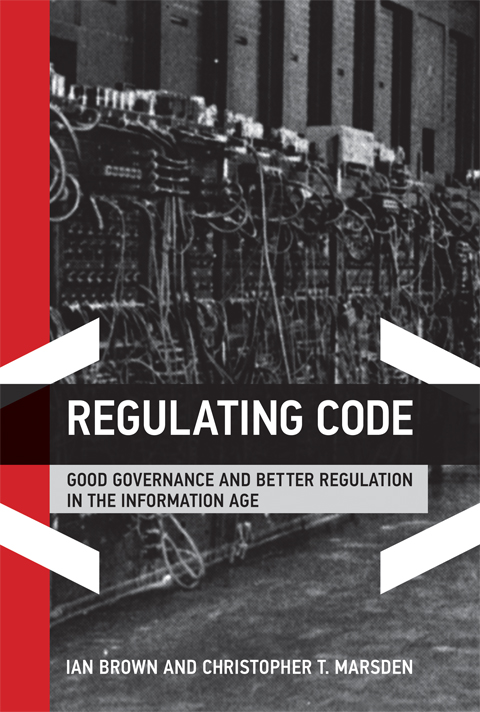
Ian Brown and Christopher T. Marsden’s new book, Regulating Code: Good Governance and Better Regulation in the Information Age, will go down as one of the most important Internet policy books of 2013 for two reasons. First, their book offers an excellent overview of how Internet regulation has unfolded on five different fronts: privacy and data protection; copyright; content censorship; social networks and user-generated content issues; and net neutrality regulation. They craft detailed case studies that incorporate important insights about how countries across the globe are dealing with these issues. Second, the authors endorse a specific normative approach to Net governance that they argue is taking hold across these policy arenas. They call their preferred policy paradigm “prosumer law” and it envisions an active role for governments, which they think should pursue “smarter regulation” of code.
In terms of organization, Brown and Marsden’s book follows the same format found in Milton Mueller’s important 2010 book Networks and States: The Global Politics of Internet Governance; both books feature meaty case studies in the middle bookended by chapters that endorse a specific approach to Internet policymaking. (Incidentally, both books were published by MIT Press.) And, also like Mueller’s book, Brown and Marsden’s Regulating Code does a somewhat better job using case studies to explore the forces shaping Internet policy across the globe than it does making the normative case for their preferred approach to these issues. Continue reading →
I plan to write more about broadband competition and the impact of Google Fiber but in the meantime, there is a New York Timesarticle on the subject that I’ll briefly address.
That means that in most American neighborhoods, consumers are stuck with a broadband monopoly. And monopolies don’t strive to offer the best, cheapest service. Rather, they use speed as a tool to discriminate by price — coaxing consumers who are willing to pay for high-speed broadband into more costly and profitable tiers.
In this paper, I note that to the extent public utility-style regulation has been debated within the Internet policy arena over the past decade, the focus has been almost entirely on the physical layer of the Internet. The question has been whether Internet service providers should be considered “essential facilities” or “natural monopolies” and regulated as public utilities. The debate over “net neutrality” regulation has been animated by such concerns.
While that debate still rages, the rhetoric of public utilities and essential facilities is increasingly creeping into policy discussions about other layers of the Internet, such as the search layer. More recently, there have been rumblings within academic and public policy circles regarding whether social media platforms, especially social networking sites, might also possess public utility characteristics. Presumably, such a classification would entail greater regulation of those sites’ structures and business practices.
Proponents of treating social media platforms as public utilities offer a variety of justifications for regulation. Amorphous “fairness” concerns animate many of these calls, but privacy and reputational concerns are also frequently mentioned as rationales for regulation. Proponents of regulation also sometimes invoke “social utility” or “social commons” arguments in defense of increased government oversight, even though these notions lack clear definition.
Social media platforms do not resemble traditional public utilities, however, and there are good reasons why policymakers should avoid a rush to regulate them as such. Continue reading →
The Technology Liberation Front is the tech policy blog dedicated to keeping politicians' hands off the 'net and everything else related to technology. Learn more about TLF →

 The Technology Liberation Front is the tech policy blog dedicated to keeping politicians' hands off the 'net and everything else related to technology.