What are we to make of this peculiar new term “permissionless innovation,” which has gained increasing currency in modern technology policy discussions? And how much relevance has this notion had—or
should it have—on those conversations about the governance of emerging technologies? That’s what I’d like to discuss here today.
Uncertain Origins, Unclear Definitions
I should begin by noting that while I have written a book with the term in the title, I take no credit for coining the phrase “permissionless innovation,” nor have I been able to determine who the first person was to use the term. The phrase is sometimes attributed to Grace M. Hopper, a computer scientist who was a rear admiral in the United States Navy. She once famously noted that, “It’s easier to ask forgiveness than it is to get permission.”
“Hopper’s Law,” as it has come to be known in engineering circles, is probably the most concise articulation of the general notion of “permissionless innovation” that I’ve ever heard, but Hopper does not appear to have ever used the actual phrase anywhere. Moreover, Hopper was not
necessarily applying this notion to the realm of technological governance, but was seemingly speaking more generically about the benefit of trying new things without asking for the blessing of any number of unnamed authorities or overseers—which could include businesses, bosses, teachers, or perhaps even government officials. Continue reading →
If the FCC had adopted the eligibility restrictions proposed by PISC in 2007, the United States would not have achieved the LTE leadership touted by current FCC Chairman Genachowski.
I was pleased to see FCC Chairman Genachowski praise the market-based policies of his predecessors in his remarks at Vox last week. He noted that the United States is currently leading the world in next generation mobile wireless services with 69 percent of the world’s LTE subscribers, which he attributes to “smart government policies.” He didn’t mention, however, that the “smart government policies” that led to America’s renewed mobile leadership were based on market principles adopted by the previous FCC. Continue reading →
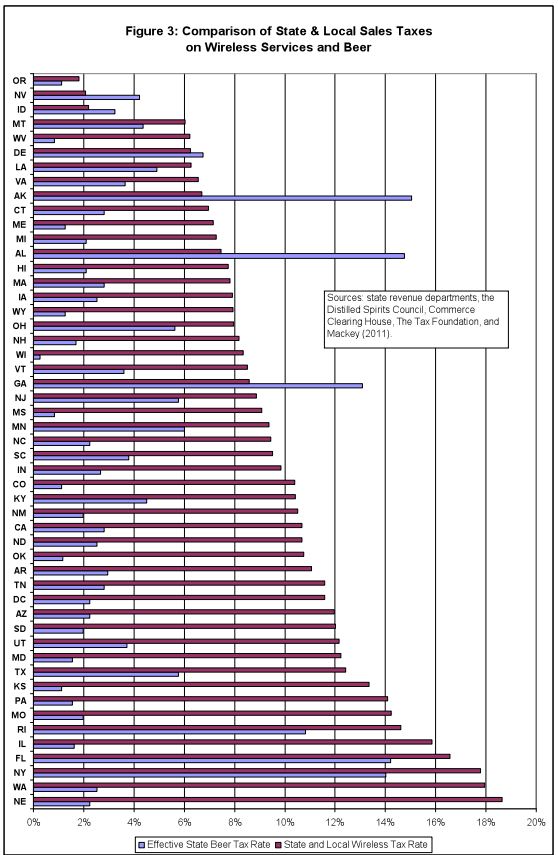
As we’ve noted herebefore, state and local politicians just love wireless taxes. They are going up, up, up. Dan Rothschild outlined this disturbing trend in his recent Mercatus Center paper making “The Case Against Taxing Cell Phone Subscribers,” and I discussed it in my recent Forbes essay lambasting the “Talking Tax.” Another new study by Glenn Woroch of the Georgetown University School of Business notes how “The ‘Wireless Tax Premium’ Harms American Consumers and Squanders the Potential of the Mobile Economy.” Woroch estimates that “the American consumer forgoes over $15 billion in surplus annually compared to when cell phones receive the
same tax treatment as other goods and service.” Read the entire study but I want to draw everyone’s attention to this chart that appears on page 7 of the report comparing state and local wireless taxes burdens to beer taxes. It really makes you realize just how drunk on wireless taxes are local lawmakers have become! [Click to enlarge. Red bar = wireless taxes.]
My latest Forbes column notes how “Taxes On Talking Are On the Rise Across the U.S.” with levies on mobile phones and devices skyrocketing. I build my argument around data and arguments found in Dan Rothschild’s excellent recent Mercatus Center paper, which makes “The Case Against Taxing Cell Phone Subscribers,” as well as an important recent study by Scott Mackey, an economist and partner at KSE Partners LLP, which documents the growing burden of these wireless taxes and fees.
“Wireless users now face a combined federal, state, and local tax and fee burden of 16.3%, a rate two times higher than the average retail sales tax rate and the highest wireless rate since 2005,” Mackey finds. Mobile tax rates range from a high of 23.7% in Nebraska to a low of 6.9% in Oregon. 48 states have an average combined wireless tax rate above 11%. These burdensome taxes on talking just don’t make any sense, argues Rothschild. “There is no economic justification for these high tax rates: reducing cell phone ownership is not a public policy goal, cell phone use by one customer does not affect other customers or other people, and these taxes fall disproportionately on lower-income households.”
You can read my entire essay here, but also make sure to re-read Dan Rothschild’s guest post here at the TLF on the issue. It’s much better than my own treatment. For me, the key point is this: If the primary policy goal in this arena is to build out a first-class communications and data infrastructure and make sure all Americans have access to it, discriminatory taxes on wireless services and networks are highly counter-productive. Policymakers should hang up on the Talking Tax.
[The following essay is a guest post from Dan Rothschild, Managing Director of the State and Local Policy Project at the Mercatus Center at George Mason University.]
Policy makers may be tempted to hike taxes on cell phones, or to create (or “equalize”) taxes on untaxed (or “under taxed”) parts of wireless telephony, such as cell phone data plans or e-readers with cellular connections. As I argue in a recent issue of Mercatus on Policy, this is a bad idea for a number of reasons. Continue reading →
To believe some of the worrywarts around Washington, we find ourselves in the midst of a miserable mobile marketplace experience. Regulatory advocates like New America Foundation, Free Press, Public Knowledge and others routinely claim that the sky is falling on consumers and that far-reaching regulation of the wireless sector is needed to save the day.
I hope those folks are still willing to listen to facts, becuase those facts tell a very different story. Specifically, I invite critics to flip through the latest presentation by Internet market watchers Mary Meeker and Matt Murphy of Kleiner Perkins Caufield & Byers on “Top Mobile Internet Trends” and then explain to me how we can label this marketplace anything other than what it really is: One of the greatest capitalist success stories of modern times. Just about every metric illustrates the explosive growth of technological innovation in the U.S. mobile arena. I’ve embedded the entire slideshow down below, but two particular slides deserve to be showcased.
A group of regulatory advocates that includes Free Press, Media Access Project and the New America Foundation, have fired off a letter to the Federal Communications Commission (FCC) requesting action against the nation’s #5 mobile provider, MetroPCS. These regulatory groups claim that “new service plans being offered by mobile provider MetroPCS block and discriminate against Internet content, applications and websites.” Wired’s Ryan Singel summarizes what the fight is about:
At issue are new, tiered 4G data plans from the nation’s fifth largest mobile carrier, which specializes in pay-as-you-go mobile-phone service. The new plans offer “unlimited web usage” for all three tiers, which cost $40, $50 and $60 a month. But MetroPCS’s terms exclude video sites other than YouTube from “unlimited web usage,” and block the use of internet-telephony services such as Skype and Tango. The terms of service also make it very unclear whether users would be allowed to use online-radio services such as Pandora.
The parties petitioning the FCC for regulatory intervention claim that “MetroPCS appears to be in violation of the Commission’s recently adopted open Internet rules” even though they note that “these rules have not yet taken effect.”
There are four things I find interesting about this hullabaloo: Continue reading →
Pundits are foaming at the mouth about AT&T’s just-announced end to unlimited data packages for smartphones. Here is Jeff Jarvis calling the move “cynical,” “retrograde,” and “evil.” However, he provides no evidence that this is anything but AT&T facing economic reality. The iPhone was a revolution, and how much data people consume given an awesome device turned out to be much more than AT&T was ready for. Now they’re asking their customers who use the most data to pay more, and this is evil?
Not only is it not evil, it’s incredibly fair. Most people will probably pay less for service. The cheapest of AT&T’s new plans is $15 for 200 MB of data. That’s $15 cheaper than their current $30 for unlimited iPhone use. According to AT&T, 65 percent of their customers use less than 200 MB of data a month. I consider myself a heavy iPhone user, and I just came back from a trip to NYC on which my iPhone was the only device I took with me, and yet with 2 days left in my billing cycle, I’ve used 154 MB of data. So, AT&T’s change will actually be a price-cut for me and the majority of AT&T customers.
The Congressional Internet Caucus Advisory Committee is hosting their second annual State of the Mobile Net conference this Wednesday, April 21 at the DC Hyatt Regency (400 New Jersey Ave NW). The conference runs 12-5 pm followed by a cocktail reception. This conference and the larger State of the Net conference are probably the two best annual Internet policy events in DC, so I hope you’ll attend! This year’s SOMN includes a bonus: a “Growing Up with the Mobile Net” seminar coordinated by Common Sense Media, 9-11:45 am. I’ll be on the first panel of the morning on Kids’ Privacy on the Mobile Net: Is it PII or TMI? with:
Amanda Lenhart of the Pew Internet & American Life Project, veritable goddess of cyber-sociological data (check out her terrific Social Media & Young Adults report);
Phyllis Marcus, who handles childrens’ privacy and COPPA issues at the FTC (and is one of my favorite people there); and
Alan Simpson, Common Sense Media, a tireless advocate for educating children & parents.
I can only assume Alan asked me to be on this distinguished panel panel to represent kids directly on account of my baby-faced-ness! Jerry Rubin famously said, “Don’t trust anyone over thirty”—so I’ve still got 3.5 months of trustworthiness to go! (Or perhaps he actually read the huge PFF paper Adam Thierer and I did last summer about COPPA and my recent post on the FTC’s recently announced COPPA implementation review or my testimony on Maine’s COPPA 2.0 law.) Anyway, the rest of the day looks great (so register here), including these sessions: Continue reading →
As we mentioned yesterday, in a new series of essays, we will be examining proposals being put forward today that would have the government play a greater role in sustaining struggling media enterprises, “saving journalism,” or promoting more “public interest” content. With many traditional media operators struggling, and questions being raised about how journalism in particular will be supported in the future, Washington policymakers are currently considering what role government can and should play in helping media providers reinvent themselves in the face of tumultuous technological change wrought by the Digital Revolution. We will be releasing 6 or 7 essays on this topic leading up to our big filing in the FCC’s “Future of Media” proceeding (deadline is May 7th).
In the first installment of our series, we will critique an old idea that’s suddenly gained new currency: taxing media devices or distribution systems to fund media content. We argue that such media income redistribution is fundamentally inconsistent with American press traditions, highly problematic under the First Amendment, difficult to implement in a world of media abundance and platform convergence, and likely to cause serious negative side effects. Bottom line: Don’t tax our iPhones or broadband to subsidize media!
We’ve attached the entire text of the piece below. (Installment #2, on broadcast spectrum taxes to subsidize public media, will be released next week.)
The Technology Liberation Front is the tech policy blog dedicated to keeping politicians' hands off the 'net and everything else related to technology. Learn more about TLF →




 The Technology Liberation Front is the tech policy blog dedicated to keeping politicians' hands off the 'net and everything else related to technology.