Jeff Jonas has published an important post: “Your Movements Speak for Themselves: Space-Time Travel Data is Analytic Super-Food!”
More than you probably realize, your mobile device is a digital sensor, creating records of your whereabouts and movements:
Mobile devices in America are generating something like 600 billion geo-spatially tagged transactions per day. Every call, text message, email and data transfer handled by your mobile device creates a transaction with your space-time coordinate (to roughly 60 meters accuracy if there are three cell towers in range), whether you have GPS or not. Got a Blackberry? Every few minutes, it sends a heartbeat, creating a transaction whether you are using the phone or not. If the device is GPS-enabled and you’re using a location-based service your location is accurate to somewhere between 10 and 30 meters. Using Wi-Fi? It is accurate below 10 meters.
The process of deploying this data to markedly improve our lives is underway. A friend of Jonas’ says that space-time travel data used to reveal traffic tie-ups shaves two to four hours off his commute each week. When it is put to full use, “the world we live in will fundamentally change. Organizations and citizens alike will operate with substantially more efficiency. There will be less carbon emissions, increased longevity, and fewer deaths.”
This progress is not without cost:
Continue reading →
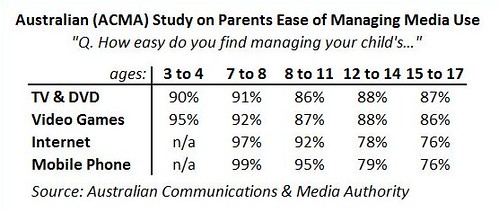
An interesting new survey has just been released by the Australian Communications and Media Authority (ACMA), which is the rough equivalent of the Federal Communications Commission here in the U.S., but with somewhat broader authority. ACMA’a latest report is entitled Use of Electronic Media and Communications: Early Childhood to Teenage Years and it takes a look at media technology usage among Australian youngsters in 5 age groupings (3 to 4 years of age, 7 to 8, 8 to 11, 12 to 14, and 15 to 17).
The survey also asked Australian parents “How easy do you find managing your child’s ___ use.” They asked that question for four different media or communications technologies: TV & DVD; video games; Internet; and mobile devices. They results, summarized in the table below, were quite interesting and seem to indicate that Australian parents find it much easier to manage their children’s media use than some of their elected leaders imagine.
Continue reading →
I’m intrigued by this new bill that Rep. Peter King has introduced to prevent video voyeurism. H.R. 414, the “Camera Phone Predator Alert Act” finds that “children and adolescents have been exploited by photographs taken in dressing rooms and public places with the use of a camera phone.” To remedy this problem, King’s “Phone Predator Alert” bill would require that:
any mobile phone containing a digital camera that is manufactured for sale in the United States shall sound a tone or other sound audible within a reasonable radius of the phone whenever a photograph is taken with the camera in such phone. A mobile phone manufactured after such date shall not be equipped with a means of disabling or silencing such tone or sound.
In other words, cameras would have to get noisy again! Old timers will recall the days when our cameras were noisier than a box of rocks. Today’s digital cameras and camera phones, by contrast, are increasingly silent, but that also opens up the door to potential abuse by some creeps out there. While I don’t believe there’s evidence pointing to a national epidemic of digital voyeurism, there’s no doubt that some people — including many youngsters — are having their privacy invaded in this fashion.
I find King’s solution at once to be both ingenious and futile. It’s ingenious in that, if we could truly force it upon everyone, it might actually go along way towards solving this problem. The noisy camera would again act as the prime deterrent to such an act.
Continue reading →
“Hasn’t Steve Jobs learned anything in the last 30 years?” asks Farhad Manjoo of Slate in an interesting piece about “The Cell Phone Wars” currently raging between Apple’s iPhone and the Google’s new G1, Android-based phone. Manjoo wonders if whether Steve Jobs remembers what happen the last time he closed up a platform: “because Apple closed its platform, it was IBM, Dell, HP, and especially Microsoft that reaped the benefits of Apple’s innovations.” Thus, if Jobs didn’t learn his lesson, will he now with the iPhone? Manjoo continues:
Well, maybe he has—and maybe he’s betting that these days, “openness” is overrated. For one thing, an open platform is much more technically complex than a closed one. Your Windows computer crashes more often than your Mac computer because—among many other reasons—Windows has to accommodate a wider variety of hardware. Dell’s machines use different hard drives and graphics cards and memory chips than Gateway’s, and they’re both different from Lenovo’s. The Mac OS, meanwhile, has to work on just a small range of Apple’s rigorously tested internal components—which is part of the reason it can run so smoothly. And why is your PC glutted with viruses and spyware? The same openness that makes a platform attractive to legitimate developers makes it a target for illegitimate ones.
I discussed these issues in greater detail in my essay on”Apple, Openness, and the Zittrain Thesis” and in a follow-up essay about how the Apple iPhone 2.0 was cracked in mere hours. My point in these and other essays is that the whole “open vs. closed” dichotomy is greatly overplayed. Each has its benefits and drawbacks, but there is no reason we need to make a false choice between the two for the sake of “the future of the Net” or anything like that.
In fact, the hybrid world we live in — full of a wide variety of open and proprietary platforms, networks, and solutions — presents us with the best of all worlds. As I argued in my original review of Jonathan Zittrain’s book, “Hybrid solutions often make a great deal of sense. They offer creative opportunities within certain confines in an attempt to balance openness and stability.” It’s a sign of great progress that we now have different open vs. closed models that appeal to different types of users. It’s a false choice to imagine that we need to choose between these various models.
Continue reading →

 The Technology Liberation Front is the tech policy blog dedicated to keeping politicians' hands off the 'net and everything else related to technology.