[Fellow members of the Society for the Prevention of Vice, I urge you to take immediate action to continue our crusade to clean up America’s media marketplace by ridding it of the scourge of media hyper-violence. A clip has come to our attention that merits particular concern and I hope you will agree something must be done by our government before such filth gets widespread dissemination. So, please join me in signing this petition to the FCC to take action now—for the children—before such unspeakable acts of violence are mimicked by millions of youth across America.]
TO: Julius Genachowski, Chairman, Federal Communications Commission
FROM: Adam Thierer, President, Society for the Prevention of Vice (formerly known as the Society for Soft Pillow Fights)
RE: Another example of unspeakable media violence that must be stopped
Dear Chairman Genachowski:
A video has come to our attention that displays, once again, the media industry’s utter disregard for human decency and the dignity of life, and we hope you will agree something must be done to stop its dissemination before it is too late. In this video:
- A man’s nose is seemingly twisted off his face (as he screams in agony) and then his face is forced onto a grinding machine while sparks fly off his burning flesh (he again screams in agony);
- A shoe with an extended spike is inserted into a man’s head and then his eyeball and then his ear lobe (he screams in agony each time);
- The man who was impaled with said shoe spike then bites the offender’s foot (he, too, screams in agony);
- A blow-torch is used to light a man’s buttocks afire (he screams in agony);
- A man climbs a pole, plays with live electrical wires, is then is electrocuted after chewing on said wires, and then falls to the ground still shaking from the voltage running through his body (he screams in agony);
- A wrench is dropped on a man’s head (he screams in agony) and he then uses said wrench to hit another man over the head and violently twist his nose with it (he screams in agony); and
- Finally, the electrocuted man has a light bulb inserted into one ear and a screwdriver into the other (he screams in agony and then, bizarrely, he laughs to end the clip — as if he is mocking the depravity of what we have just witnessed!)
I have attached a clip of this unspeakably evil carnival of pain, but I warn you that it could forever darken your soul. Can you imagine, sir, if earlier generations of American youth had seen this? Could America have produced “The Greatest Generation” if the youth of the World War II era had grown up watching such filth? We now know from several psychological studies that children will mimic whatever they see on the screen. If they see such depictions of violence in media, they will reenact it themselves in the real world. In other words, “monkey see-monkey do.” Please, on behalf of all those signing this petition, and for the sake of our children, I beg you to help us put a stop to this moral outrage before our great civilization decays and withers away in a sea of media hyper-violence such as this: Continue reading →
Dennis McCauley of Gamepolitics.com takes on that issue today in a column:
In the United States, the FBI tracks annual statistics on police officer slayings as well as assaults on police officers. I compared these figures to the various release dates for the three major GTA console game releases to date (GTA III, GTA Vice City, GTA San Andreas) and plotted the whole thing on the chart below. It’s a bit like the well-known video games vis-a-vis juvenile crime graph created by Duke Ferris of GameRevolution a few years back, although with a much narrower focus.The FBI statistics portray a much different picture than that painted by critics like Thompson and Grossman.
 In the chart, I’ve plotted FBI figures for police officers feloniously killed (blue line) and police officers assaulted (red line, listed in thousands). As can be seen, police officer murders peaked at 70 in 1997 (i.e., four years
before GTA III) and again in 2001. GTA III was released in late October that year, so if the game caused that year’s spike, it would have had only two months in which to do so. (also, the 2001 figures don’t count the 72 officers lost when the World Trade Centers collapsed).
The chart shows that since GTA III was released police killings have been trending downward to a low of 48 in 2006. Although the FBI has not yet posted 2007 numbers, the National Law Enforcement Officers Memorial Fund lists 68 police officers as having been shot to death in 2007. But it’s worth pointing out that while there may have been a spike in police slayings last year, there was no corresponding GTA release. There hasn’t been a new Grand Theft Auto console title issued since San Andreas in October, 2004.
In the chart, I’ve plotted FBI figures for police officers feloniously killed (blue line) and police officers assaulted (red line, listed in thousands). As can be seen, police officer murders peaked at 70 in 1997 (i.e., four years
before GTA III) and again in 2001. GTA III was released in late October that year, so if the game caused that year’s spike, it would have had only two months in which to do so. (also, the 2001 figures don’t count the 72 officers lost when the World Trade Centers collapsed).
The chart shows that since GTA III was released police killings have been trending downward to a low of 48 in 2006. Although the FBI has not yet posted 2007 numbers, the National Law Enforcement Officers Memorial Fund lists 68 police officers as having been shot to death in 2007. But it’s worth pointing out that while there may have been a spike in police slayings last year, there was no corresponding GTA release. There hasn’t been a new Grand Theft Auto console title issued since San Andreas in October, 2004.
I’ve commented more on these issues in my essay on “Why hasn’t violent media turned us into a nation of killers?”
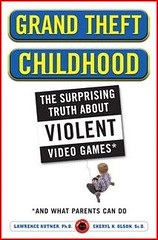 Don’t judge a book by its cover (or its title, for that matter). I’m usually faithful to that maxim, but I must admit that when I first saw the title and cover of “<a href="http://www.amazon.com/Grand-Theft-Childhood-Surprising-Violent/dp/0743299515/ref=pd_bbs_sr_1?ie=UTF8&s=books&qid=1208179493&sr=8-1″>Grand Theft Childhood: The Surprising Truth About Violent Video Games and What Parents Can Do,” I rolled my eyes and thought to myself, “here we go again.” I figured that I was in for another tedious anti-gaming screed full of myths and hysteria about games and gamers. Boy, was I wrong. Massively wrong.
Lawrence Kutner, PhD, and Cheryl K. Olson, ScD, cofounders and directors of the Harvard Medical School Center for Mental Health and Media, have written the most thoroughly balanced and refreshingly open-minded book about video games ever penned. They cut through the stereotypes and fear-mongering that have thus far pervaded the debate over the impact of video games and offer parents and policymakers common-sense advice about how to approach these issues in a more level-headed fashion. They argue that:
Today, an amalgam of politicians, health professionals, religious leaders and children’s advocates are voicing concerns about video games that are identical to the concerns raised one, two and three generations ago with the introduction of other new media. Most of these people have the best of intentions. They really want to protect children from evil influences. As in the past, a few have different agendas and are using the issue manipulatively. Unfortunately, many of their claims are based on scanty evidence, inaccurate assumptions, and pseudoscience. Much of the current research on violent video games is both simplistic and agenda driven. (p. 55)
They note that these groups, “probably worry too much about the wrong things and too little about more subtle issues and complex effects that are much more likely to affect our children.” They continue:
Continue reading →
Today and tomorrow I am attending a terrific conference at Penn State University called, “Playing to Win: The Business and Social Frontiers of Videogames.” It features panel discussions about various legal and business issues facing the video game industry, as well as discussions about how video games are used to aid teaching and learning. There are also panels on multiplayer online worlds and virtual reality environments and the issues surrounding both. [They will apparently be posting videos from the conference on their site shortly.]
 The folks at PSU were kind enough to invite me to deliver the luncheon keynote on Day 1 and I decided to provide a broad overview of the policy issues facing video games that I have covered in some of my past work. My presentation was entitled, “Video Games, Ratings, Parental Controls, & Public Policy: Where Do We Stand?” and the entire 36-slide presentation is now available online here. Down below, I thought I would just outline a couple of the key themes I touched upon in my presentation.
Continue reading →

 The Technology Liberation Front is the tech policy blog dedicated to keeping politicians' hands off the 'net and everything else related to technology.