[This represents a bit of a departure from the traditional format of my ongoing “Media Deconsolidiation Series,” but you will see how it ties in…]
So, some guy from the (Un)Free Press — the activist group that wants to regulate every facet of the media and broadband universe — has created a scary looking chart about “Information Control” [seen below]. It’s based loosely on the Periodic Table of Elements, you know, to give it the aura of science and fact. In reality, it’s just another silly scare tactic that tells us very little about the true nature of our modern media marketplace.
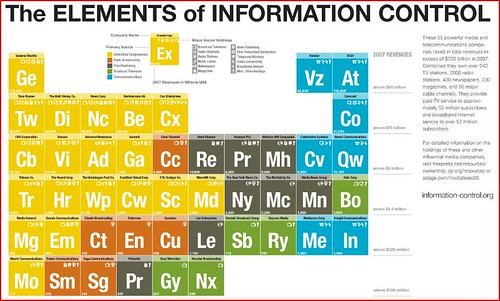
The chart is accompanied by the typical Free Press gloom-and-doom rhetoric about the unfolding media apocalypse. “Nearly everything you see, hear and read that isn’t from a friend — whether on TV, the radio, or even on the Web — comes from a for-profit gatekeeper.” And then comes the obligatory A.J. Liebling quote about how “Freedom of the press belongs to those who own one,” followed quickly by the typical punch line about how just a handful of companies (in this case 55 of ’em) are puppeteering all our thoughts in America today:
Combined, these 55 powerful media and telecommunications companies raked in total revenues in excess of $700 billion in 2007. Together they own over 540 TV stations, 2000 radio stations, 430 newspapers, 230 magazines, and 80 major cable channels in the United States. They provide paid TV service to approximately 52 million subscribers and broadband Internet service to over 57 million subscribers. They’re the bottlenecks through which our news, our entertainment, and our political discourse must travel. What they want to promote becomes prominent; what they suppress stays out of the mainstream. As such, these companies are the elements of information control.
Oh my God! We are all just brainwashed sheep!
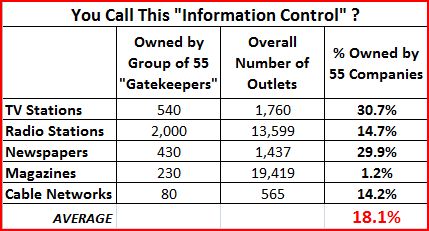
Except we’re not. It amazes me how these “information control” and “media monopoly” myths keep getting widespread circulation. But the first thing to note is how the media reformistas can’t get even their story straight when it comes to how many “monopolists” are supposedly out there today. As I noted in my 2005 book, Media Myths: Making Sense of the Debate over Media Ownership, the critics seem to just pull their numbers out of a hat. Some say as few as 3 companies control everything. Others says 5 or 6. Still others say it might be a few dozen. And now this guy says its 55. Hey, that’s progress that even the Free Press should love!
Regardless of the number, does this really represent the totality of our modern media universe? Do those 55 companies really “own most of the 21st-century presses in America” as the “Info Control” website states? Answer: NOT. EVEN. CLOSE. Here are the facts. [I happened to have compiled them for a PFF special report entitled Media Metrics: The True State of the Modern Media Marketplace to debunk myths just like this.]
Continue reading →
Back in the mid- and even late 1990s, I was engaged in a lot of dreadfully boring telecom policy debates in which the proponents of regulation flatly refused to accept the argument that the hegemony of wireline communications systems would ever be seriously challenged by wireless networks. Well, we all know how that story is playing out today. People are increasingly “cutting the cord” and opting to live a wireless-only existence. For example, this recent Nielsen Mobile study on wireless substitution reports that, although only 4.2% of homes were wireless-only at the end of 2003…
At the end of 2007, 16.4 percent of U.S. households had abandoned their landline phone for their wireless phone, but by the end of June 2008, just 6 months later, that number had increased to 17.1 percent. Overall, this percentage has grown by 3-4 percentage points per year, and the trend doesn’t seem to be slowing. In fact, a Q4 2007 study by Nielsen Mobile showed that an additional 5 percent of households indicated that they were “likely” to disconnect their landline service in the next 12 months, potentially increasing the overall percentage of wireless-only households to nearly 1 in 5 by year’s end.
And one wonders about how many homes are like mine — we just keep the landline for emergency purposes or to redirect phone spam to that number instead of giving out our mobile numbers. Beyond that, my wife and I are pretty much wireless-only people and I’m sure there’s a lot of others like us out there.
Anyway, I’ve been having a strange feeling of deva vu lately as I’ve been engaging in policy debates about the future of the video marketplace. Like those old telecom debates of the last decade, we are now witnessing a similar debate — and set of denials — playing out in the video arena. Many lawmakers and regulatory advocates (and even some industry folks) are acting as if the old ways of doing business are the only ways that still count. In reality, things are changing rapidly as video content continues to migrate online.
I was reminded of that again this weekend when I was reading Nick Wingfield’s brilliant piece in the
Wall Street Journal entitled “Turn On, Tune Out, Click Here.” It is must-reading for anyone following development in this field. As Wingfield notes:
Continue reading →
 Having covered free speech and media policy issues for many years now, one of the arguments I hear a lot is that we moderns have an unnatural fascination with murder, mayhem, and violence as well as gossip and celebrities. Social critics and proponents of media content regulation often wax nostalgic about the supposed “good ol’ days” when all we thought and talked about was enlightened and enriching topics.
It’s all complete nonsense. Anyone who has seriously studied our nation’s history — or, for that matter, the history of any country or civilization — knows that we humans have
always been fascinated by the morbid and tales of debauchery, especially when those tales involve public officials or celebrities.
I was reminded of this again today when reading two articles in the
Washington Post.
Continue reading →
My ongoing media DE-consolidation series represents an effort to set the record straight regarding one of the leading myths about the media marketplace today: the notion that rampant consolidation is taking place and that operators are only growing larger and devouring more and more companies.
Nothing could be further from the truth. Over the past 3 to 5 years, traditional media operators and sectors have been coming apart at the seams in the face of unprecedented innovation and competition. The volume of divestiture activity has been quite intense, and most traditional media operators have been getting smaller, not bigger. “Traditional media’s numbers are shrinking,” argued FCC Commissioner Robert McDowell in a recent speech. “The ironic truth is,” McDowell continued, that “in many cases, media consolidation has actually become media divestiture. Companies… have been shedding properties to raise capital for new ventures.”
And so that trend continues today with the announcement from Cox Enterprises that it will be selling almost all its newspapers. According to the The Atlanta Journal-Constitution:
Continue reading →
 Faithful readers will recall that, several months ago, I penned a 7-part “Media Metrics” series that took a hard look at the health of the media marketplace. Today, the Progress & Freedom Foundation is releasing a greatly expanded version of these essays that I have put together with my PFF colleague Grant Eskelsen. In this 100-page special report, “Media Metrics: The True State of the Modern Media Marketplace,” we begin by noting that heated debates about the state of the media marketplace continue to rage in Washington, and opinions seem to range from grim to outright apocalyptic. As we note on pg. 1:
Many people—including a large number of legislators and regulators—argue that America’s media marketplace is in a miserable state. Some claim that citizens lack choice in media outlets and that options are just as scarce as ever. Others believe that media “localism” is dead or that many groups or niches go underserved because of a lack of true “diversity” in media. Others argue that the market is hopelessly over-concentrated in the hands of a few evil media barons who are hell-bent on force-feeding us corporate propaganda. And still others say that the quality of news and entertainment in our society has deteriorated because of a combination of all of the above. It all sounds quite troubling, but is any of it true?
After taking an objective look at the true state of America’s media marketplace, we conclude that such pessimism is unwarranted. Indeed, a careful review of the facts reveals that—contrary to what those media critics suggest—we have more media choice, more media competition, and more media diversity than ever before. Indeed, to the extent there was ever a “golden age” of media in America, we are living in it today. The media sky has never been brighter and it is getting brighter with each passing year.
Continue reading →
Bruce Owen, America’s preeminent media economist–with apologies to Harold Vogel, who at least deserves an honorable mention–has written another splendid piece for Cato’s Regulation magazine, this one entitled, “The Temptation of Media Regulation.”
This latest essay deals primarily with the many fallacies surrounding so-called “a la carte” regulation of the video marketplace, and I encourage you to read it to see Owen’s powerful refutation of the twisted logic behind that regulatory crusade. But I wanted to highlight a different point that Bruce makes right up front in his essay because it is something I am always stressing in my work too.
In some of my past work on free speech and media marketplace regulation, I have argued that there is very little difference between Republicans and Democrats when it comes to these issues. They are birds of feather who often work closely together to regulate speech and media. Whether it is broadcast ‘indecency’ controls; proposals to extend those controls to cable & satellite TV; campaign finance laws; efforts to limit or rollback ownership regulations; or even must carry and a la carte, the story is always the same: It’s one big bipartisan regulatory love fest. [And the same goes for regulation of the Internet, social networking sites, and video games.]
Owen explains why that is the case:
Continue reading →
Back in 2005, I threw away a book I was writing. Well, I didn’t exactly toss it in a garbage can or take a match to the manuscript; I just abandoned the project to work on other things, including a different book and a big law review article. I’m still mad at myself for never finishing it up because I think it put forward a provocative thesis: Censorship is dead. Specifically, as I argued in the first lines of the book, “A confluence of social, legal and, most importantly, technological developments is slowly undermining the ability of legislators and regulators, at all levels of government, to control the nature or quality of speech or media programming.” Accordingly, the running title for the book was: “The End of Censorship?: The Future of Content Controls in a World of Media Convergence.”
Anyway, I recently unearthed an old draft of this discarded manuscript and thought I might as well at least throw the introduction online. In it, I outline my thesis and the “5 Reasons Content Controls Will Break Down.” I also highlight how governments will fight back and discuss what alternatives are out there to address concerns about objectionable content. Someone out there might be interested in all this even though much of what I say here is now widely accepted or been said better by others. I’ve stripped out all the footnotes and cut out significant sections to make what follows more readable. So, here it goes…
“The End of Censorship? The Future of Content Controls in a World of Media Convergence.”
Content regulation–at least as it has been traditionally defined and enforced in the United States–is doomed. A confluence of social, legal and, most importantly, technological developments is slowly undermining the ability of legislators and regulators, at all levels of government, to control the nature or quality of speech or media programming. Specifically, it is the
distribution channel-based system of content regulation employed in the U.S. and many other nations that is breaking down. That is, the ability of governments to regulate speech and expression by regulating its distribution channel or provider (such as broadcasting), represents in increasingly ineffective and illogical method of policing content flows.
The demise of traditional content controls may take many years–potentially even decades–to play out, but signs of the impending death of the old regulatory regime are already evident.
Continue reading →
A few weeks ago, I outlined the amazing keynote address that Harvard University law professor Laurence H. Tribe delivered at PFF’s annual Aspen Summit. Now you can read it for yourself. PFF has just published the transcript of his speech, which was entitled, “Freedom of Speech and Press in the 21st Century: New Technology Meets Old Constitutionalism.”
Professor Tribe provides a 14-part indictment of new government proposals to regulate “excessively violent” content. But he also speaks more broadly about the importance of defending the First Amendment from attacks on many different platforms, and for many different types of content. Here’s one of my favorite passages from the concluding section of his remarks:
The broad lesson of this discussion of television violence is the centrality of the First Amendment’s opposition to having government as big brother regulate who may provide what information content to whom, whether or not for a price. The large problem that this exposes is that especially in a post-9/11 world, where grownups understandably fear for themselves and for their children and worry about the brave new world of online cyber reality that their kids can navigate more fluently than they can, it is enormously tempting to forget or to subordinate the vital principles of constitutional liberty. Even if, after years of litigation and expenditure, the First Amendment prevails, it can be worn down dramatically by having to wage that fight over and over and over.
Amen to that. And that, in a nutshell, describes what much of my research agenda at PFF has been focused on. It is a pleasure to add Prof. Tribe’s address to our growing body of research on the sanctity of freedom of speech and centrality of the First Amendment to our democratic republic as we continue “to wage that fight over and over and over.”
The Parents Television Council has a new report out this week about the supposed decline of the TV “Family Hour.” The City Journal has just posted my response to that PTC report here. It begins as follows…
Who Killed TV’s “Family Hour”?
It’s not who you think.
by Adam D. Thierer
7 September 2007
The nonprofit Parents Television Council (PTC) released a report this week lamenting the supposed death of broadcast television’s “family hour.” Though neither the Federal Communications Commission nor Congress ever mandated it, 8 to 9 PM Monday through Saturday (Eastern time), and 7 to 9 PM on Sunday, have traditionally been devoted to family-friendly programming. But the PTC’s new report claims that these blocks of time are now “no place for children,” because “corporate interests have hijacked the family hour” and “have pushed more and more adult-oriented programming to the early hours of the evening.”
One might respond to this claim by questioning the PTC’s methodology, particularly its definitions of foul language. Simon Vozick-Levinson of Entertainment Weekly’s “PopWatch Blog” takes this approach, accusing the PTC of “cooking the numbers” to suit its cultural agenda. But I don’t want to engage in methodological nit-picking, since it quickly devolves into a subjective squabble about acceptable language and appropriate programming. Instead, I want to point out the fundamental flaw in the report’s premise. The family hour may well be dead—but parents, not broadcasters, were the ones who killed it.
… read the rest at the City Journal’s website.

 The Technology Liberation Front is the tech policy blog dedicated to keeping politicians' hands off the 'net and everything else related to technology.