Dan Rather actually made the following two contradictory statements in the same speech:
I personally encourage the president to establish a White House commission on public media.
and then:
A truly free and independent press is the red beating heart of democracy and freedom.
He’s right that the free press is a “watchdog on power.” But that’s not compatible with the idea that, as reported, “the government makes an effort to ensure the survival of the free press.” A press funded, promoted, propped up, subsidized by government is not a free press. Nor is it in any position to be a watchdog; it’s more likely to become a megaphone for the states preferred ideas and expansion of government in other spheres, like health care, energy, finance, telecommunications, scientific research and policy and so on.
Democracy as a concept and political system is not at stake, as Rather thinks, when a particular business model engaged in public communications and broadcasting suffers at a particular point in history. It’s been beaten to death, but everyone knows the transformative importance of the Internet and its role in making voices heard that never had a chance when Rather and his two rival channels dominated the news and airwaves for 30 minutes each evening.
Continue reading →
This is just a listing of the installments of my ongoing “Media Deconsolidation Series.” I needed to create a single repository of all the essays so I could point back to them in future articles and papers. For those not familiar with it, this series represents an effort to set the record straight regarding the many myths surrounding the media marketplace. These myths are usually propagated by a group of radical anti-media regulatory activists who I call the “media reformistas.” Sadly, however, many policymakers, journalists, and members of the public are buying into some of these myths, too.
In particular, I have spent much time here debunking the notion that rampant consolidation is taking place and that media operators are only growing larger and devouring more and more companies. In fact, nothing could be further from the truth. Over the past several years, traditional media operators and sectors have been coming apart at the seams in the face of unprecedented innovation and competition. The volume of divestiture activity has been quite intense, and most traditional media operators have been getting smaller, not bigger. As a result, America’s media marketplace is growing more fragmented and atomistic with each passing day.
Anyway, here’s the series so far…
Continue reading →
There’s much to discuss as Obama shapes his administration (more on this at OpenMarket.org) but arguably one of the most important unanswered questions is who Obama will pick to staff the Federal Communications Commission.
CNET reports that Henry Rivera, a lawyer and former FCC Commissioner, has been selected to head the transition team tasked with reshaping the FCC. This selection gives us a glimpse of what the FCC’s agenda will look like under Obama, and it’s quite troubling.
Rivera has embraced a media “reform” agenda aimed at promoting minority ownership of broadcast media outlets. A couple weeks ago, Rivera sent a letter to the FCC that backed rules originally conceived by the Media Access Project to create a new class of stations to which only “small and distressed businesses” (SDB) could belong. The S-Class stations would be authorized to sublease digital spectrum and formulate must-carry programming, with the caveat that only half of the content can be “commercial”. To avoid the Constitutional issues surrounding racial quotas, eligibility for SDB classification would be based on economic status, rather than the racial composition of would-be station owners.
The S-Class proposal, like other media reform proposals, falsely assumes that current owners of media outlets are failing to meet the demands of their audience for a diverse range of content. The proposal also ignores the fact that consumers already enjoy an abundance of voices from all viewpoints, as we’ve discussed extensively here on TLF.
Continue reading →
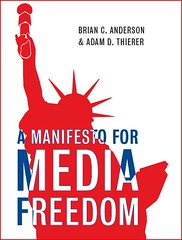 I’m pleased to announce the publication of A Manifesto for Media Freedom, which I co-authored with Brian C. Anderson of the Manhattan Institute. Brian serves as editor of Manhattan Institute’s excellent City Journal and he is the author of best-selling books like South Park Conservatives and Democratic Capitalism and Its Discontents.
In this little manifesto, we highlight one of the central ironies of the Information Age. Namely, that despite “the breathtaking abundance of new and old media outlets for obtaining news, information, and entertainment…”
many people hate this profusion, and never more than when it involves political speech. The current media market, they charge, doesn’t represent true diversity, or isn’t fair, or is subject to manipulation by a small and shrinking group of media barons. They want the government to regulate it into better shape, which just happens to be a shape that benefits them. Doing so… would be a disaster, a kind of soft or not-so-soft tyranny that would wipe out whole sectors of media, curtailing free speech and impoverishing our democracy.
In other words, instead of celebrating the unprecedented cornucopia of media choices at our collective disposal, many policymakers and media critics are calling for just as much media regulation as ever. We itemize these threats in our chapters and they include: efforts to revive the “Fairness Doctrine”, media ownership regulations, “localism” requirements, Net neutrality mandates, a la carte regulations, cable and satellite censorship, video game censorship, regulation of social networking sites, campaign finance-related speech restrictions, and so on.
In each case, we advance a pro-freedom paradigm to counter the advocates of media control. What do we mean by the “media freedom” that we advocate as the alternative to these new regulatory crusades? Here’s how we put it in the book:
Continue reading →

 The Technology Liberation Front is the tech policy blog dedicated to keeping politicians' hands off the 'net and everything else related to technology.