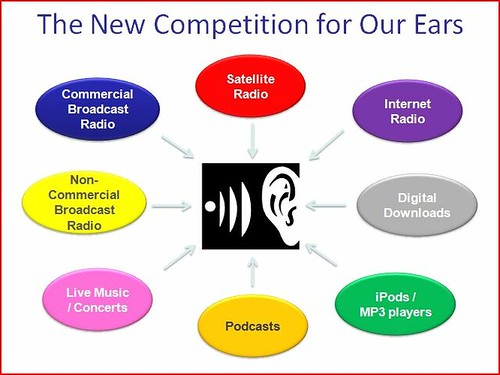
Much ink is spilled over the expanding array of video marketplace choices that are competing for the attention of our eyeballs, but much less is usually written about the competition for our ears. As this excellent new Business Week article by Olga Kharif makes clear, competition and innovation in the audio marketplace has never been more vibrant. It’s something I’ve pointed out here before and here’s a chart I created for my Media Metrics report to highlight all the new competition for our ears. We’ve come a long way since the days of my youth, when transistor radios and vinyl records were the extent of audio competition!
Jack Shafer, editor at large of Slate, is my favorite media pundit. Everything he does is worth reading, and his column this week is no different. It’s entitled “The Digital Slay-Ride: What’s killing newspapers is the same thing that killed the slide rule,” and in it he notes how “Hardly a day goes by, it seems, without some laid-off or bought-out journalist writing a letter of condolence to himself and his profession.” “The underlying cause of their grief,” Shafer argues, “can be traced to the same force that has destroyed other professions and industries: digital technology.” He recalls how people scoffed back in 1993 when Wired founder Louis Rossetto’s said that the “digital revolution is whipping through our lives like a Bengali typhoon” and destroying the old order. But no one is laughing anymore. As I noted in my Media Metrics report, digital disruption and disintermediation has completely upended the media marketplace, as well as countless others. Toward that end, Shafer actually starts a list of professions or technologies that have been “typhooned” by the digital revolution. It’s a pretty amazing (and entertaining) list for those of us old enough to remember when all these things were dominate in our society and economy. Can you think of others?
• Bank tellers
• Typewriters
• Typesetting
• Carburetors
• Vacuum tubes
• Slide rules
• Disc jockeys
• Stockbrokers
• Telephone operators
• Yellow pages
• Repair guys
• Bookbinders
• Pimps (displaced by the cell phone and the Web)
• Cassette and reel-to-reel recorders
• VCRs
• Turntables
• Video stores
• Record stores
• Bookstores
• Recording industry
• Courier/messenger services
• Travel agencies
• Print and cinematic porn
• Porn actors
• Stenographers
• Wired telcos
• Drummers
• Toll collectors (slayed by the E-ZPass)
• Book publishing (especially reference works)
• Conventional-watch makers
• “Browse” shopping
• U.S. Postal Service
• Printing-press makers
• Film cameras
• Kodak (and other film-stock makers)
This is just a listing of the installments of my ongoing “Media Deconsolidation Series.” I needed to create a single repository of all the essays so I could point back to them in future articles and papers. For those not familiar with it, this series represents an effort to set the record straight regarding the many myths surrounding the media marketplace. These myths are usually propagated by a group of radical anti-media regulatory activists who I call the “media reformistas.” Sadly, however, many policymakers, journalists, and members of the public are buying into some of these myths, too.
In particular, I have spent much time here debunking the notion that rampant consolidation is taking place and that media operators are only growing larger and devouring more and more companies. In fact, nothing could be further from the truth. Over the past several years, traditional media operators and sectors have been coming apart at the seams in the face of unprecedented innovation and competition. The volume of divestiture activity has been quite intense, and most traditional media operators have been getting smaller, not bigger. As a result, America’s media marketplace is growing more fragmented and atomistic with each passing day.
Anyway, here’s the series so far…
Continue reading →
I’m fond of quoting Diane Mermigas, editor-at-large at MediaPost, who is one of the finest media market watchers in the journalism business today. Her latest MediaPost column offers another sobering look at the radical changing sweeping through the media marketplace today. In that article, she notes that even though we are in an era of Big Government bailouts for financial institutions and (possibly) auto makers, old media operators will be left to to fend for themselves, and many will likely die off as a result:
What we do know is there will be no federally funded bail for media, Internet, entertainment and advertising. Big media by definition is not nimble and innovative enough to simply dump what’s not working, modify what can be saved, and grow what works. There isn’t much that big media companies can bank on or reliably forecast moving into 2009. They are hamstrung between deteriorating traditional costs and revenues and evolving digital business models that do not offset the losses, generating less than 10% of their overall incomes. Big media isn’t just being ravaged by recession; it is being sacked by a technological transformation of enormous proportions.
I discussed a lot of the forces behind the current media meltdown in my recent PFF special report, “Media Metrics: The True State of America’s Marketplace.” As I noted there, this Schumpeterian “creative destruction” we are witnessing today is a normal (but gut-wrenching) part of any major technological transformation, and it need not be addressed with government subsides or interference. However, the problem for many traditional media providers is, as I noted in my special report:
Continue reading →
In a City Journal article earlier this year, I wondered “how long some local papers have left when they are barred from restructuring their businesses or partnering with other local media operators to stem the bleeding and reinvent their business models.” I was responding to the Senate’s smack-down of a half-hearted reform effort that FCC chairman Kevin Martin pushed through in November 2007, which proposed relaxing the FCC’s newspaper/broadcast cross-ownership rule. That rule, unrevised since going into effect in 1975, prohibits a newspaper operator from also owning a radio or television station in the same media market. However, waivers were granted to grandfather in some combined newspaper and broadcast operations that had existed long before the ban took effect. Martin’s proposal was to simply tweak the rule to permit similar combinations in just the nation’s 20 largest media markets.
Martin’s limited liberalization proposal, however, led to howls of disapproval from FCC democrats like Michael Copps and many folks on both side of the aisle in Congress. Supposedly, this was nothing more than a “giveaway” to the newspaper industry, which critics said was doing just fine. It really makes you wonder if any of those critics even both reading the news about newspapers today.
As I have documented here on many occasions, as well as in my big Media Metrics report, the newspaper industry is in huge trouble with every financial variable of importance rapidly heading south. Alan Mutter does a good job here of summarizing “the secular forces dragging down newspapers: Declining readership, shrinking advertising, high fixed costs and growing online competition that makes it increasingly difficult to charge the premium ad rates that were possible prior to the Internet.” As a result of these forces, everyday brings another headline like this one today in the New York Times: “The Star-Ledger of Newark Plans 40% Cut,” or this one in the Wall Street Journal: “Some Newspapers Shed Unprofitable Readers.” The numbers are just miserable, and they just get worse and worse.
Continue reading →
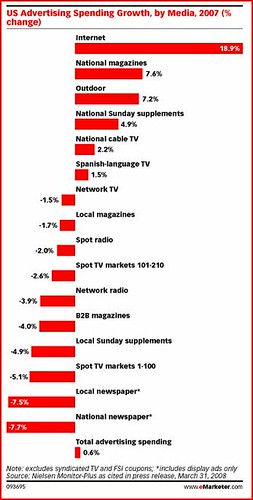 As we’ve discussed here before, newspapers are struggling. We all know that. The question is what, if anything, will save them? Most pundits tend to point to a two-fold solution: (1) get serious about leveraging the natural local advantages newspapers hold; (2) and find away to do so online as quickly as possible before they lose the bulk of the local online ad market to other competitors. This is why there’s a lot of talk these days about turning traditional papers into “hyper-local” web portals for their communities. Of course, there’s no guarantee that will work, especially in light of changing attitudes about “media localism.”
But let’s assume that that is indeed the best path forward. Will it really save newspapers? As eMarketer reports in today’s newsletter on “Can Local Web Ads Save Newspapers,” it’s a bit of a good news–bad news story:
The good news is that newspaper site ad revenues are growing along with other online ad spending, especially for local news sites. Local newspaper online ad revenues are predicted to reach $3.7 billion this year, according to eMarketer calculations based on Borrell Associates data.
The bad news is that this spending will not make up for print ad losses for some time, according to Lisa Phillips, senior analyst at eMarketer. Ms. Phillips noted that advertisers still pay more for print readers than for online readers. “This is a transition that will take several years,” she said. “Local advertisers are paying attention to the shift in reader behavior, but it will take a while for everyone to adjust.”
And so we will have to wait to see how it all plays out. But I am highly skeptical that traditional newspapers operators will be able to make up anywhere near the amount of revenue online that they are hemorrhaging over on the print side of the business. There’s just too much other competition out there online already for our eyes and ears. The age of “protectable scarcity” is dead and that means newspapers just don’t have the lock on local or regional markets they once did.
Terrific piece here from Ed Felten on how new technologies and cultural trends are undermining traditional conceptions of “media localism.” It’s a theme I have written on at length, most recently in this essay on “Our Continued Wishful Thinking about ‘Media Localism‘.” Anyway, as Felten correctly notes in the conclusion of his essay:
New technologies undermine the rationale for localist policies. It’s easier to get far-away content now — indeed the whole notion that content is bound to a place is fading away. With access to more content sources, there are more possible venues for local programming, making it less likely that local programming will be unavailable because of the whims or blind spots of a few station owners. It’s getting easier and cheaper to gather and distribute information, so more people have the means to produce local programming. In short, we’re looking at a future with more non-local programming and more local programming.
That’s exactly right. As Grant Eskelsen and I argue in Chapter 6 of our new Media Metrics book:
The decline of “localism” in media is a much-lamented but quite natural phenomenon as citizens gain access to news and entertainment sources of broader scale and scope. Although it is impossible to scientifically measure exactly how much “local” fare citizens demand—and defining the term is another challenge—we know that they still receive a wealth of information about developments in their communities. However, it is also evident that, left to their own devices, many citizens have voluntarily flocked to national (and even international) sources of news and entertainment. […]
[But] the demise of “localism” has been greatly exaggerated. The
relative decline in local media is simply a natural development resulting from the voluntary choices made by millions of American citizens, but the tools for producing, distributing, and acquiring local content are more robust than ever.
Over at Technology 360, Dennis Haarsager points out that there’s probably too much gloom-and-doom out there in the blogosphere regarding the future of various media platforms. He did phrase searches “to see how the media stacked up in the death department.” He got back the following results:
“death of television”, 13,000 results
“death of TV”, 28,200 results
“death of radio”, 227,000 results
“death of newspapers”, 331,000 results
“death of blogs”, “death of the blogs”, “death of the blog”, 81,400 results
“death of the web”, 215,000 results
“death of the net”, 746,000 results
“death of the internet”, 1,910,000 results
No doubt—as Mark Twain might have said—the rumors of the death of media have been greatly exaggerated. And, as Mike Mansick of TechDirt points out, not all papers or media outlets are facing gloom and doom scenarios.
Nonetheless, many traditional media sectors and providers
do find themselves in troubled waters today as tsunami of creative destruction tears through their markets. In our new “Media Metrics” report, Grant Eskelsen and I show how two sectors in particular—radio broadcasting and newspapers—are getting hammered particularly hard by a sort of “media perfect storm”:
-
loss of protected markets or “protected scarcity” = there’s just no guaranteed audience anymore
-
rapid technological change = the way media is created and transmitted has been completely transformed
-
massive inflow of new competitors / platforms = no way to stop the deluge of new voices, including user-generated content
-
loss of consumer confidence and allegiance = people have plenty of other places to turn their attention
-
loss of advertiser confidence and allegiance = advertisers have plenty of other places to promote their goods and services (including direct-to-consumer appeals and ‘word-of-mouth’ marketing efforts)
-
loss of investor confidence and allegiance = shareholders have lots of other places to invest their capital today
The results have been particularly grim for newspaper in recent months as various reports have noted.
Continue reading →
 Faithful readers will recall that, several months ago, I penned a 7-part “Media Metrics” series that took a hard look at the health of the media marketplace. Today, the Progress & Freedom Foundation is releasing a greatly expanded version of these essays that I have put together with my PFF colleague Grant Eskelsen. In this 100-page special report, “Media Metrics: The True State of the Modern Media Marketplace,” we begin by noting that heated debates about the state of the media marketplace continue to rage in Washington, and opinions seem to range from grim to outright apocalyptic. As we note on pg. 1:
Many people—including a large number of legislators and regulators—argue that America’s media marketplace is in a miserable state. Some claim that citizens lack choice in media outlets and that options are just as scarce as ever. Others believe that media “localism” is dead or that many groups or niches go underserved because of a lack of true “diversity” in media. Others argue that the market is hopelessly over-concentrated in the hands of a few evil media barons who are hell-bent on force-feeding us corporate propaganda. And still others say that the quality of news and entertainment in our society has deteriorated because of a combination of all of the above. It all sounds quite troubling, but is any of it true?
After taking an objective look at the true state of America’s media marketplace, we conclude that such pessimism is unwarranted. Indeed, a careful review of the facts reveals that—contrary to what those media critics suggest—we have more media choice, more media competition, and more media diversity than ever before. Indeed, to the extent there was ever a “golden age” of media in America, we are living in it today. The media sky has never been brighter and it is getting brighter with each passing year.
Continue reading →

 The Technology Liberation Front is the tech policy blog dedicated to keeping politicians' hands off the 'net and everything else related to technology.