Matt Lasar of Ars
tells us not to worry about the Fairness Doctrine being revived, only to go on and cite several lawmakers who have said they’d like to revive it. Meanwhile, over at the American Spectator, somebody called “The Prowler” seems to have all sorts of unnamed sources on the Hill telling him the Fairness Doctrine will be revived any day now.
Who knows what to believe. But let’s keep our eye on the real issue here. The danger is not that the Fairness Doctrine gets back on the books in the same form; it’s that versions of it sneak in through the back door via other regulatory initiatives. As Cord Blomquist pointed out here last April, “localism is the new Fairness Doctrine.” There are a lot of people are running around Washington today insisting that government must intervene in the marketplace to “save media localism” and “strengthen the public interest obligations” of local TV and radio broadcasters. There’s been an FCC proceeding open on this issue for some time, and everything about it reeks of the Fairness Doctrine in drag.
This effort is being spearheaded by the media reformistas whose short-term goal is to reinvigorate the amorphous “public interest standard” such that the FCC has open-ended powers to regulate everything under the sun going forward. That’s why a key part of the “localism” battle is their effort to breathe new life into “ascertainment rules,” which used to be more formal and required broadcasters to strictly report everything they aired and did in their communities. There’s lots of talk of ensuring more “accountability” from broadcasters regarding how they serve their local communities, and there’s even rumblings of “local community boards” who will sit as mini-free speech Star Chambers and pass judgment on whether local media outlets are doing their job. Again, it’s all just the Fairness Doctrine by another name. Continue reading →
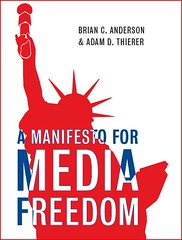 I’m pleased to announce the publication of A Manifesto for Media Freedom, which I co-authored with Brian C. Anderson of the Manhattan Institute. Brian serves as editor of Manhattan Institute’s excellent City Journal and he is the author of best-selling books like South Park Conservatives and Democratic Capitalism and Its Discontents.
In this little manifesto, we highlight one of the central ironies of the Information Age. Namely, that despite “the breathtaking abundance of new and old media outlets for obtaining news, information, and entertainment…”
many people hate this profusion, and never more than when it involves political speech. The current media market, they charge, doesn’t represent true diversity, or isn’t fair, or is subject to manipulation by a small and shrinking group of media barons. They want the government to regulate it into better shape, which just happens to be a shape that benefits them. Doing so… would be a disaster, a kind of soft or not-so-soft tyranny that would wipe out whole sectors of media, curtailing free speech and impoverishing our democracy.
In other words, instead of celebrating the unprecedented cornucopia of media choices at our collective disposal, many policymakers and media critics are calling for just as much media regulation as ever. We itemize these threats in our chapters and they include: efforts to revive the “Fairness Doctrine”, media ownership regulations, “localism” requirements, Net neutrality mandates, a la carte regulations, cable and satellite censorship, video game censorship, regulation of social networking sites, campaign finance-related speech restrictions, and so on.
In each case, we advance a pro-freedom paradigm to counter the advocates of media control. What do we mean by the “media freedom” that we advocate as the alternative to these new regulatory crusades? Here’s how we put it in the book:
Continue reading →

 The Technology Liberation Front is the tech policy blog dedicated to keeping politicians' hands off the 'net and everything else related to technology.