There’s much to discuss as Obama shapes his administration (more on this at OpenMarket.org) but arguably one of the most important unanswered questions is who Obama will pick to staff the Federal Communications Commission.
CNET reports that Henry Rivera, a lawyer and former FCC Commissioner, has been selected to head the transition team tasked with reshaping the FCC. This selection gives us a glimpse of what the FCC’s agenda will look like under Obama, and it’s quite troubling.
Rivera has embraced a media “reform” agenda aimed at promoting minority ownership of broadcast media outlets. A couple weeks ago, Rivera sent a letter to the FCC that backed rules originally conceived by the Media Access Project to create a new class of stations to which only “small and distressed businesses” (SDB) could belong. The S-Class stations would be authorized to sublease digital spectrum and formulate must-carry programming, with the caveat that only half of the content can be “commercial”. To avoid the Constitutional issues surrounding racial quotas, eligibility for SDB classification would be based on economic status, rather than the racial composition of would-be station owners.
The S-Class proposal, like other media reform proposals, falsely assumes that current owners of media outlets are failing to meet the demands of their audience for a diverse range of content. The proposal also ignores the fact that consumers already enjoy an abundance of voices from all viewpoints, as we’ve discussed extensively here on TLF.
Continue reading →
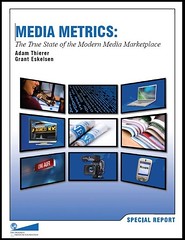 Faithful readers will recall that, several months ago, I penned a 7-part “Media Metrics” series that took a hard look at the health of the media marketplace. Today, the Progress & Freedom Foundation is releasing a greatly expanded version of these essays that I have put together with my PFF colleague Grant Eskelsen. In this 100-page special report, “Media Metrics: The True State of the Modern Media Marketplace,” we begin by noting that heated debates about the state of the media marketplace continue to rage in Washington, and opinions seem to range from grim to outright apocalyptic. As we note on pg. 1:
Many people—including a large number of legislators and regulators—argue that America’s media marketplace is in a miserable state. Some claim that citizens lack choice in media outlets and that options are just as scarce as ever. Others believe that media “localism” is dead or that many groups or niches go underserved because of a lack of true “diversity” in media. Others argue that the market is hopelessly over-concentrated in the hands of a few evil media barons who are hell-bent on force-feeding us corporate propaganda. And still others say that the quality of news and entertainment in our society has deteriorated because of a combination of all of the above. It all sounds quite troubling, but is any of it true?
After taking an objective look at the true state of America’s media marketplace, we conclude that such pessimism is unwarranted. Indeed, a careful review of the facts reveals that—contrary to what those media critics suggest—we have more media choice, more media competition, and more media diversity than ever before. Indeed, to the extent there was ever a “golden age” of media in America, we are living in it today. The media sky has never been brighter and it is getting brighter with each passing year.
Continue reading →

 The Technology Liberation Front is the tech policy blog dedicated to keeping politicians' hands off the 'net and everything else related to technology.