A group of regulatory advocates that includes Free Press, Media Access Project and the New America Foundation, have fired off a letter to the Federal Communications Commission (FCC) requesting action against the nation’s #5 mobile provider, MetroPCS. These regulatory groups claim that “new service plans being offered by mobile provider MetroPCS block and discriminate against Internet content, applications and websites.” Wired’s Ryan Singel summarizes what the fight is about:
At issue are new, tiered 4G data plans from the nation’s fifth largest mobile carrier, which specializes in pay-as-you-go mobile-phone service. The new plans offer “unlimited web usage” for all three tiers, which cost $40, $50 and $60 a month. But MetroPCS’s terms exclude video sites other than YouTube from “unlimited web usage,” and block the use of internet-telephony services such as Skype and Tango. The terms of service also make it very unclear whether users would be allowed to use online-radio services such as Pandora.
The parties petitioning the FCC for regulatory intervention claim that “MetroPCS appears to be in violation of the Commission’s recently adopted open Internet rules” even though they note that “these rules have not yet taken effect.”
There are four things I find interesting about this hullabaloo: Continue reading →
I’ve just released a new PFF white paper looking at the hysteria that has often accompanied major media mergers and then taking a look at the marketplace reality years after the fact. Here‘s the PDF, but I have also pasted the entire thing down below.
_____________________________
A Brief History of Media Merger Hysteria:
From AOL-Time Warner to Comcast-NBC
by Adam Thierer
Although the pending union of Comcast and NBC Universal has not yet made it to the altar, Chicken Little-esque wails about the marriage have already begun in earnest. For example, the pro-regulatory media organization Free Press has already set up a website to complain about the deal.[1] And Jeff Chester, executive director of the Center for Digital Democracy, has called it “an unholy marriage.”[2] The fever only promises to spread once the deal is formally announced, and a lengthy fight over the deal is expected at the Federal Communications Commission (FCC) and whichever antitrust agency reviews the deal.[3]
But reality tends to play out somewhat less dramatically than the script penned by the media worrywarts. It’s worth looking back at some of the more prominent examples of media merger hysteria in recent years to understand why such panic is unwarranted, and why a deal between Comcast and NBC Universal is unlikely to lead to the sort of problems that the pessimists suggest.[4] Continue reading →
Tim Lee has been taking some heat here from Richard Bennett and Steve Schultze about various aspects of his new Net neutrality paper. I haven’t had much time this week to jump into these debates, but I did want to mention one important portion of Tim’s paper that is being overlooked. Specifically, I like the way Tim took head-on some of the silly free speech arguments being put forth as a rationale for net neutrality regulation. As Tim notes in the introduction of the paper:
Concerns that network owners will undermine free speech online are particularly misguided. Network owners have neither the technology nor the manpower to effectively filter online content based on the viewpoints being expressed, nor do profit-making businesses have any real incentive to do so. Should a network owner be foolish enough to attempt large-scale censorship of its customers, it would not only fail to suppress the disfavored speech, but the network would actually increase the visibility of the content as the effort at censorship attracted additional coverage of the material being censored.
I think that’s exactly right and, later in his paper (between pgs 22-3), Tim nicely elaborates about the “Herculean task” associated with any attempt by a broadband provider to “manipulate human communication.” Not only is it true, as Tim argues, that “no widescale manipulation would go unnoticed for very long,” but he is also correct in noting that the public and press backlash would be enormous.
Again, I agree wholeheartedly with all these sentiments, but I think Tim missed another important angle here when discussing the unfounded fears about corporate censorship and the misguided attempts to use free speech as a justification for imposing net neutrality regulations.
Continue reading →
There’s much to discuss as Obama shapes his administration (more on this at OpenMarket.org) but arguably one of the most important unanswered questions is who Obama will pick to staff the Federal Communications Commission.
CNET reports that Henry Rivera, a lawyer and former FCC Commissioner, has been selected to head the transition team tasked with reshaping the FCC. This selection gives us a glimpse of what the FCC’s agenda will look like under Obama, and it’s quite troubling.
Rivera has embraced a media “reform” agenda aimed at promoting minority ownership of broadcast media outlets. A couple weeks ago, Rivera sent a letter to the FCC that backed rules originally conceived by the Media Access Project to create a new class of stations to which only “small and distressed businesses” (SDB) could belong. The S-Class stations would be authorized to sublease digital spectrum and formulate must-carry programming, with the caveat that only half of the content can be “commercial”. To avoid the Constitutional issues surrounding racial quotas, eligibility for SDB classification would be based on economic status, rather than the racial composition of would-be station owners.
The S-Class proposal, like other media reform proposals, falsely assumes that current owners of media outlets are failing to meet the demands of their audience for a diverse range of content. The proposal also ignores the fact that consumers already enjoy an abundance of voices from all viewpoints, as we’ve discussed extensively here on TLF.
Continue reading →
Over at DrewClark.com, earlier today I reported today that television networks – which in recent years have had a strained relationship with local broadcasters on a variety of fronts – joined with the National Association of Broadcasters in calling for a time out on the politically simmering issue of “white spaces.” Here’s the start of the story, and you can read the full post at DrewClark.com
WASHINGTON, October 23 – The top executives of the four major broadcast networks on Thursday urged the head of the Federal Communications Commission to delay a vote on a politically simmering issue that pits broadcasters against Google and high-tech executives.
In the letter, the CEOs of CBS Corp., NBC Universal and Walt Disney, and the chief operating officer of News Corp., urge that the FCC exercise caution before taking irreparable action with regard to the vacant television channels known as “white spaces.”
Google and the other technology executives, including Microsoft, Motorola, Philips and others, want the FCC to authorize electronic devices that capable of transmitting internet signals over vacant television bands.
The network executives – CBS’s Leslie Moonves, Disney’s Robert Iger, NBC’s Jeffrey Zucker and Peter Chernin of News Corp. – want a time out.
They join their local broadcasting colleagues, as well as manufacturers and users of wireless microphones, like the National Football League and Boadway theater owners, who have been actively lobbying the issue.
[…]
Read the rest of the story at my blog, DrewClark.com – The Politics of Telecom, Media and Technology
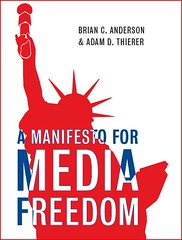 I’m pleased to announce the publication of A Manifesto for Media Freedom, which I co-authored with Brian C. Anderson of the Manhattan Institute. Brian serves as editor of Manhattan Institute’s excellent City Journal and he is the author of best-selling books like South Park Conservatives and Democratic Capitalism and Its Discontents.
In this little manifesto, we highlight one of the central ironies of the Information Age. Namely, that despite “the breathtaking abundance of new and old media outlets for obtaining news, information, and entertainment…”
many people hate this profusion, and never more than when it involves political speech. The current media market, they charge, doesn’t represent true diversity, or isn’t fair, or is subject to manipulation by a small and shrinking group of media barons. They want the government to regulate it into better shape, which just happens to be a shape that benefits them. Doing so… would be a disaster, a kind of soft or not-so-soft tyranny that would wipe out whole sectors of media, curtailing free speech and impoverishing our democracy.
In other words, instead of celebrating the unprecedented cornucopia of media choices at our collective disposal, many policymakers and media critics are calling for just as much media regulation as ever. We itemize these threats in our chapters and they include: efforts to revive the “Fairness Doctrine”, media ownership regulations, “localism” requirements, Net neutrality mandates, a la carte regulations, cable and satellite censorship, video game censorship, regulation of social networking sites, campaign finance-related speech restrictions, and so on.
In each case, we advance a pro-freedom paradigm to counter the advocates of media control. What do we mean by the “media freedom” that we advocate as the alternative to these new regulatory crusades? Here’s how we put it in the book:
Continue reading →
My ongoing media DE-consolidation series represents an effort to set the record straight regarding one of the leading myths about the media marketplace today: the notion that rampant consolidation is taking place and that operators are only growing larger and devouring more and more companies.
Nothing could be further from the truth. Over the past 3 to 5 years, traditional media operators and sectors have been coming apart at the seams in the face of unprecedented innovation and competition. The volume of divestiture activity has been quite intense, and most traditional media operators have been getting smaller, not bigger. “Traditional media’s numbers are shrinking,” argued FCC Commissioner Robert McDowell in a recent speech. “The ironic truth is,” McDowell continued, that “in many cases, media consolidation has actually become media divestiture. Companies… have been shedding properties to raise capital for new ventures.”
And so that trend continues today with the announcement from Cox Enterprises that it will be selling almost all its newspapers. According to the The Atlanta Journal-Constitution:
Continue reading →

 The Technology Liberation Front is the tech policy blog dedicated to keeping politicians' hands off the 'net and everything else related to technology.