WAR IS PEACE
FREEDOM IS SLAVERY
IGNORANCE IS STRENGTH
So declared the Party in George Orwell’s classic novel
1984. The corruption of language with a constant theme of Orwell’s work, most notably his 1946 essay “Politics and the English Language.” So Orwell would not have been surprised to see the term “Internet Freedom” captured by those who advocate an increased role for government (i.e., Big Brother) online. Nor would Orwell had been surprised to see these advocates claim Orwell for themselves, insisting that opponents of government regulation are the ones corrupting language. There is perhaps no better example of this than MSNBC’s Rachel Maddow’s comments in an interview with Boing Boing’s Xeni Jardin about the divisive issue of “Net Neutrality” regulations:
Rachel Maddow [dripping with sarcasm]: Sen. McCain’s bill, as you mentioned, is actually called the “Internet Freedom Act of 2009,” and he’s deriding the government effort to keep telecoms from walling off the Internet as “government intrusion” and “trying to regulate the Internet.” What that means is that he’s picked better branding, he’s picked better names. It doesn’t really relate the facts of what he’s doing. I’m wondering if it’s too late for a rebranding of the other side here. We need to get better about talking about this, because the language seems sort of corrupt at this point.
What makes Maddow’s comments so stunning is
not her view that corporate America, rather than government, is the real enemy of freedom. That view is simply part of the long-regnant political orthodoxy. No, what’s stunning is that she actually thinks that her side is losing the “war of words” just because Sen. McCain had the gall to use the term “Internet Freedom” as a rallying-cry for the outdated, bourgeois notion that “freedom” means the absence of coercion by the one entity that can enforce its commands at the point of a gun and call it “justice”: that coldest of all cold monsters, the State. That’s precisely what “liberalism” used to be about until people like Rachel appropriated that word and words like “liberty” and “freedom” as slogans for control. Xeni Jardin picks up where Rachel left off by appropriating the concept of rights, too:
Xeni Jardin: the Internet really is a basic right, it’s a necessity,such a fundamental way for communicating and accessing information now. Telecoms shouldn’t be able to throttle, to block, to slow down our access to something that might not be in their corporate interests.
This is pure, unadulterated cyber-socialism: Rights become not the sacred defense of the individual, but a positive assertion of entitlement to a vaguely defined principle of access: by guaranteeing this access through ever-expanding “neutrality regulation”, government gains unlimited control over the Internet itself.
As Adam Thierer and I have warned, that way lies madness: Inviting the government to regulate online content and services in the name of “neutrality” (or “privacy” or any of the many “glittering generalities” ending in “-y” Orwell would have denounced) would be the death of real
Internet Freedom, which requires a strict “Separation of Web and State.” Continue reading →
I remark briefly on the commentary “how smart is Palin,” noting her mispronunciation of “verbiage” and “pundit.” I’d suggest that observers be wary of assessing qualifications based on this kind of thing. Example: one very well-educated person I know, whose IQ is high enough to qualify enough for Mensa, mispronounces several words because he was socially isolated for his formative years and formed the habit of saying them before he had the chance to hear others pronounce them correctly. I don’t mean he was shut in a closet, which wouldn’t be relevant as Palin clearly hasn’t been, but just that he lived in a rural area where most of his peers were relatively uneducated.
In any case, it is curious that the anxious analysis of Palin, stemming from the fact that she is relatively unknown, seems to turn on characteristics of social class rather than on information about her decision-making as an executive. What significant choices about things like taxes, education policy, resources, and so on was she faced with as governor? What did she do in those situations? Why? What were the alternatives? Many voters probably do elect candidates based on how someone talks or looks, but mightn’t it be nice for a change for the talking classes to assess a candidate on policy? Would she make a better political candidate if some professor had had a couple months to drill her on vocabulary and delivery, like the hapless flower seller Eliza whats-her-name? Continue reading →
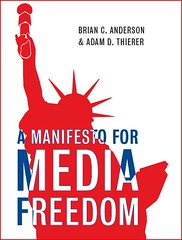 I’m pleased to announce the publication of A Manifesto for Media Freedom, which I co-authored with Brian C. Anderson of the Manhattan Institute. Brian serves as editor of Manhattan Institute’s excellent City Journal and he is the author of best-selling books like South Park Conservatives and Democratic Capitalism and Its Discontents.
In this little manifesto, we highlight one of the central ironies of the Information Age. Namely, that despite “the breathtaking abundance of new and old media outlets for obtaining news, information, and entertainment…”
many people hate this profusion, and never more than when it involves political speech. The current media market, they charge, doesn’t represent true diversity, or isn’t fair, or is subject to manipulation by a small and shrinking group of media barons. They want the government to regulate it into better shape, which just happens to be a shape that benefits them. Doing so… would be a disaster, a kind of soft or not-so-soft tyranny that would wipe out whole sectors of media, curtailing free speech and impoverishing our democracy.
In other words, instead of celebrating the unprecedented cornucopia of media choices at our collective disposal, many policymakers and media critics are calling for just as much media regulation as ever. We itemize these threats in our chapters and they include: efforts to revive the “Fairness Doctrine”, media ownership regulations, “localism” requirements, Net neutrality mandates, a la carte regulations, cable and satellite censorship, video game censorship, regulation of social networking sites, campaign finance-related speech restrictions, and so on.
In each case, we advance a pro-freedom paradigm to counter the advocates of media control. What do we mean by the “media freedom” that we advocate as the alternative to these new regulatory crusades? Here’s how we put it in the book:
Continue reading →
Writing at Slate, Tim Wu tries to make Obama out to be the real Big Government candidate on media policy, who will deliver “if not a chicken in every pot, a fiber-optic cable in every home.” By contrast, Wu implies that McCain is just another pro-big business lackey who doesn’t understand “that the media and information industries are special—that like the transportation, energy, or financial industries, they are deeply entwined with the public interest.” Wu goes on to say:
Ultimately, most of the difference in Obama’s and McCain’s media policies boils down to questions about whether the media is special and a dispute over how much to trust the private sector. Camp McCain would tend to leave the private sector alone, with faith that it will deliver to most Americans what they want and deserve. The Obama camp would probably administer a more frequent kick in the pants, in the belief that good behavior just isn’t always natural.
First, as a factual matter, Wu is just wrong about McCain being some sort of a radical hands-off, pro-market liberalizer on media policy issues. Oh, if only that were true! But for those of us who have been in DC covering telecom and media policy for many years, it is widely understood there is no nailing down John McCain on any tech, telecom or media policy issue. He’s been all over the board. While he has sponsored or supported
some deregulatory initiatives on the telecom front in the past, he’s also been a supporter of other regulatory causes. His battles with broadcasters and cable, for example, are well-known. Most recently, McCain has been leading the effort to impose a la carte mandates on cable and satellite operators.
Continue reading →
Braden has noted the release of John McCain’s tech policy–rightly decrying McCain’s socialistic community broadband concept. But far more outrageous, in my view is this bit of doublethink. First, the good part we should all applaud:
John McCain Has Fought to Keep the Internet Free From Government Regulation
The role of government in the Innovation Age should be focused on creating opportunities for all Americans and maintaining the vibrancy of the Internet economy. Given the enormous benefits we have seen from a lightly regulated Internet and software market, our government should refrain from imposing burdensome regulation. John McCain understands that unnecessary government intrusion can harm the innovative genius of the Internet. Government should have to prove regulation is needed, rather than have entrepreneurs prove it is not.
Amen! Even a hardened Ron Paul/Bob Taft/Grover Cleveland/Jack Randolph-survivalist/libertarian-crank like me can rally behind that banner. But then this self-styled champion of deregulation pulls a really fast one:
John McCain Will Preserve Consumer Freedoms. John McCain will focus on policies that leave consumers free to access the content they choose; free to use the applications and services they choose; free to attach devices they choose, if they do not harm the network; and free to chose among broadband service providers.
That sure
sounds nice, but it’s all Wu-vian code for re-regulation, not de-regulation. You might recognize that McCain is talking obliquely here about the FCC’s 1968 Carterfone doctrine, which has consumed much attention on the TLF (see this piece in particular).
McCain then insists that he will be a bold leader for “good” regulations: Continue reading →

 The Technology Liberation Front is the tech policy blog dedicated to keeping politicians' hands off the 'net and everything else related to technology.