 CBS and Time Warner Cable have been embroiled in a heated contractual battle over the past week that has resulted in viewers in some major markets losing access to CBS programming. When disputes like these go nuclear and signal blackouts occur, it is inevitable that some folks will call for policy interventions since nobody likes it when the content they love goes dark.
While some policy responses are warranted in this matter, policymakers should proceed with caution. Heated contractual negotiations are a normal part of any capitalist marketplace. We shouldn’t expect lawmakers to intervene to speed up negotiations or set content prices because that would disrupt the normal allocation of programming by placing a regulatory thumb too heavily on one side of the scale. This is why I am somewhat sympathetic to CBS in this fight. In an age when content creators struggle to protect their copyrighted content and get compensation for it, the last thing we need is government intervention that undermines the few distribution schemes that actually work well.
On the other hand, Time Warner Cable deserves sympathy here, too, since CBS currently enjoys some preexisting regulatory benefits. As I noted in this 2012
Forbes oped, “Toward a True Free Market in Television Programming,” many layers of red tape still encumber America’s video marketplace and prevent a truly free market in video programming from developing. The battle here revolves around the “retransmission consent” rules that were put in place as part of the Cable Act of 1992 and govern how video distributors carry signals from TV broadcasters, which includes CBS.
But those “retrans” rules are not the only part of the regulatory mess here. Continue reading →
Writing over at the conservative Big Government blog (part of the Breitbart.com network of blogs), someone who goes by the pseudonym “Capitol Connection” has posted an editorial about the debate over retransmission consent reform that is full of misinformation and misguided policy prescriptions, at least if you believe is truly limited government. The piece is entitled, “Big Cable Would Prefer if You Paid Their Bills,” and the problems are almost immediately evident from that headline alone. First, what is a supposedly small government-oriented blog doing using a silly label like “Big Cable” to describe a vigorously competitive sector of our capitalist economy? Using terms like “Big Cable” is a silly lefty tactic. Second, no one in the cable industry is proposing anyone “pay their bills” except for the customers who enjoy their services. Isn’t a fee for service part of capitalism?
Anyway, that’s just the problem with the title of the essay. Sadly, the rest of the piece is filled with even more erroneous information and arguments about the retransmission consent regulatory process as well as the bill that aims to reform that process, “The Next Generation Television Marketplace Act” (H.R. 3675 and S. 2008). That bill, which is sponsored by Senator Jim DeMint (R-SC) and Rep. Steve Scalise (R-LA), represents a comprehensive attempt to deregulate America’s heavily regulated video marketplace. In a recent Forbes oped, I argued that the DeMint-Scalise effort would take us “Toward a True Free Market in Television Programming” by eliminating a litany of archaic media regulations that should have never been on the books to begin with. The measure would:
- eliminate: “retransmission consent” regulations (rules governing contractual negotiations for content);
- end “must carry” mandates (the requirement that video distributors carry broadcast signals even if they don’t want to);
- repeal “network non-duplication” and “syndicated exclusivity” regulations (rules that prohibit distributors from striking deals with broadcasters outside their local communities);
- end various media ownership regulations; and
- end the compulsory licensing requirements of the Copyright Act of 1976, which essentially forced a “duty to deal” upon content owners to the benefit of video distributors.
This represents genuine and much-needed deregulation of a market that has been encumbered with far too much top-down control and micro-management by the FCC over the past several decades. To be clear,
none of these rules apply to any other segment of our modern information economy. Every day of the week, deals are cut between content creators and distributors in many other segments of the media industry without these rules encumbering the process. The DeMint-Scalise bill is an attempt to get big government out of the way and let these deals be cut in a truly free market without regulators putting their thumb on the scale in one direction or the other. Continue reading →
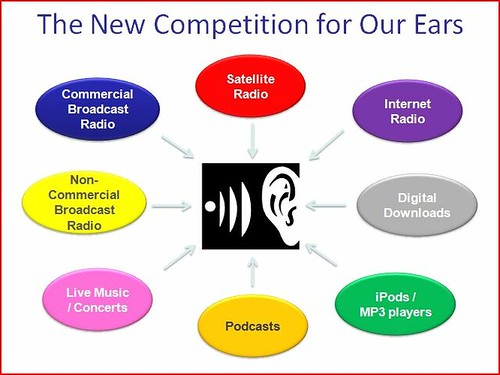
It really is amazing how much the audio marketplace has evolved over the past decade. I’ve written about the growing “competition for our ears” here before, but over at the Radio Survivor blog, there’s an outstanding collection of essays about “The Decade’s Most Important Radio Trends” by several long-time industry experts. Dennis Haarsager of National Public Radio has a nice listing of all the entries over on his blog, which I have reproduced down below.
It just blows my mind to think that just 10 years ago I didn’t have satellite radio (now have 3 subscriptions); I didn’t have Pandora (my 8 different personalized channels are playing in the background on my computer non-stop); I had never heard a podcast (and now subscribe to several and have hosted one here on occasion); I didn’t have an MP3 player and had never burned any of my music (now have 3 players and my entire 25-year collection of CDs on all 3 devices); and I had never spent any time listening to music online (and now am quite in love with Lala and LastFM). Meanwhile, I am still listening to the old fashion radio quite a bit, including on a new HD Radio player in my house. You gotta love choice like that!
Anyway, read these essays for a fuller investigation into the state of the audio marketplace. I don’t agree with everything said in each of the entries but still recommend you check out the entire series:
Continue reading →
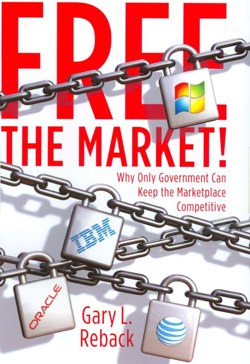 I recently finished reading Free the Market: Why Only Government Can Keep the Marketplace Competitive, a new book by noted antitrust agitator Gary L. Reback. Unsurprisingly, Reback, who led the antitrust jihad against Microsoft during the 1990s, has written a book that reads like an extended love letter to antitrust law. This man loves antitrust the way teenage girls love the Jonas Brothers — gushing, teary-eyed, ‘I-would-just-die-for-you’ sort of love. In Reback’s world, antitrust seemingly has no costs, no downsides, no trade-offs. It is our salvation and he serves as its high prophet. Everything good that happened in the world of high-tech over the past few decades? Oh, you can thank Almighty Antitrust for that. Anything bad that happened? Well, then, clearly there just wasn’t enough antitrust enforcement! That’s this book in a nutshell.
Think I’m kidding? How about this gem of quote from pg. 247: “Antitrust enforcement spawned Silicon Valley’s software industry as well.” Wow, who knew! Of course, that’s utter poppycock and should be somewhat insulting to the many entrepreneurial men and women in the high-tech world who risked everything in an attempt to build a better mousetrap. In Reback’s view of things, however, none of those mousetraps would have ever gotten built without antitrust there to supposedly shelter them from wicked “monopolists” (read: any large company) already operating in the marketplace. I’m sure many in Silicon Valley will also be surprised to hear Reback’s assertion that, “On closer examination, the Valley looks like one big public welfare project.” (p. 54) Ah yes, the old myth that government gave us the Net we know and love today. Please. Like many others, Reback spins a revisionist history of how early ARPANET involvement and seed money somehow made the Internet great when, in reality, the Net was stuck in the digital dark ages until it was finally allowed to be commercialized in 1992.
What irks me most about this book, however, is Reback’s perpetuation of the myth that antitrust is somehow not a form of economic regulation. I hear this tired old argument trotted out time and time again, even by many conservatives. Reback says, for example, that “Antitrust sets the rules of the road, so to speak, but doesn’t tell people where to drive.” By contrast, he argues, “Advocates of regulation want[] continuing government oversight and rule making to produce what would be the beneficial results of a free market… Neither approach works all the time, and decided between them remains difficult.” (p. 19) Again, this “choice” is largely a fiction since, for many industries, we end up getting both! Continue reading →
Much ink is spilled over the expanding array of video marketplace choices that are competing for the attention of our eyeballs, but much less is usually written about the competition for our ears. As this excellent new Business Week article by Olga Kharif makes clear, competition and innovation in the audio marketplace has never been more vibrant. It’s something I’ve pointed out here before and here’s a chart I created for my Media Metrics report to highlight all the new competition for our ears. We’ve come a long way since the days of my youth, when transistor radios and vinyl records were the extent of audio competition!
Speaking of socializing media, acting FCC Chairman Michael Copps is someone who has devoted much of his life to regulating the media marketplace into the ground. If he had his way, federal bureaucrats would be controlling virtually every aspect of the media universe. Nothing would get done with Big Nanny’s permission.
That’s what makes his recent comments about the impact of media regulation so delicious.. and hypocritical. According to an article Bloomberg ran on Thursday, Copps is now saying that, with newspapers struggling to remain afloat, the FCC should now reconsider regulations that prohibit combined ownership of broadcast stations and newspapers. The agency should “visit this whole problem” before long, Copps apparently told Bloomberg.
“Visit this problem before long”?? Please! Congress and the FCC have had opportunities to “visit” and revisit this problem for many years now, but it has been Michael Copps and his merry band of media reformistas who have stopped every reform effort dead in its tracks. (See my essays “Congress Fiddles, Newspapers Burn” and “Media Deregulation is Dead” for more evidence of how these radicals hijacked media policy in this country.) As I documented in my 2005 Media Myths book, these charlatans have used hyperbolic rhetoric, shameless fear-mongering, and unsubstantiated claims in opposition to each and every sensible effort to reform our nation’s outdated media ownership policies. Those laws and regulations have created artificial market structures and hindered the ability of media operators to find new business models that might throw them a lifeline in difficult times.
Consider the fact that it was just 14 months ago that then-Commissioner Copps issued this gem of a hysteria-ridden statement in response to the agency’s last effort to ever-so-slightly loosen the newspaper-broadcast cross ownership rule:
Continue reading →
 CBS and Time Warner Cable have been embroiled in a heated contractual battle over the past week that has resulted in viewers in some major markets losing access to CBS programming. When disputes like these go nuclear and signal blackouts occur, it is inevitable that some folks will call for policy interventions since nobody likes it when the content they love goes dark.
 The Technology Liberation Front is the tech policy blog dedicated to keeping politicians' hands off the 'net and everything else related to technology.