Today, the U.S. Senate Commerce Committee held a hearing on “The State of Online Consumer Privacy.”
The push for online privacy regulation has real momentum, as proposed privacy legislation from numerous lawmakers, a Department of Commerce report proposing a compulsory Do Not Track mechanism to regulate business marketing practices, and the Obama Administration’s proposed “Privacy Bill of Rights” all indicate.
However, Congress should be very wary of such proposals. A politically defined Do Not Track regime risks undermining targeted advertising, impeding business transactions that occur between strangers, and stifling mobile ecosystems that are barely out of the cradle. Rattling consumers needlessly by encouraging them to opt-out of largely beneficial information collection is an especially unwise idea in our uncertain economic climate – especially when major industry participants are developing such mechanisms on their own.
The opportunity to undermine online marketing – wrongly called “surveillance” – appeals to some, but such privacy purists have no right to call the shots for anyone but themselves and those who agree with them. The right to use information acquired through voluntary transactions is no less important than the right to decide whether to disclose information in the first place.
Continue reading →
Today the Mercatus Center has released a short new paper I have authored on “Unappreciated Benefits of Advertising and Commercial Speech.” I begin the piece by noting that:
Federal policy makers, state legislators, and state attorneys general have recently shown interest in regulating commercial advertising and marketing. Several new regulatory initiatives are being proposed, or are already underway, that could severely curtail or restrict advertising or marketing on a variety of platforms. The consequences of these stepped-up regulatory efforts will be profound and will hurt consumer welfare both directly and indirectly.
I go on to note that “advertising can be an easy target for politicians or regulatory activist groups who make a variety of (typically unsubstantiated) claims about its negative impact on society,” but then continue on to explain how “the role of commercial speech in a free-market economy is often misunderstood or taken for granted.” I outline how, despite regulators’ concerns, consumers actually derive three important types of benefits from advertising and marketing: (1) Informational / Educational Benefits; (2) Market Choice / Pro-Competitive Benefits; and (3) Media Promotion / Cross-Subsidization. After discussing each benefit, I conclude that:
For these reasons, a stepped-up regulatory crusade against advertising and marketing will hurt consumer welfare since it will raise prices, restrict choice, and diminish marketplace competition and innovation—both in ad-supported content and service markets, and throughout the economy at large. Simply stated, there is no free lunch.
Read the entire 1,800-word essay here. I have also embedded the document down below in a Scribd reader.
Continue reading →
Yesterday, the Federal Trade Commission (FTC) hosted an all-day workshop on “Protecting Kids’ Privacy Online,” which looked into the Children’s Online Privacy Protection Act of 1998 (COPPA) and challenges posed to its enforcement by new technological developments. The FTC staff did a nice job bringing together and moderating 5 panels worth of participants, all of whom had plenty of interesting things to say about the future of COPPA. But I was more struck by what was not said yesterday. Namely, there was:
- ZERO explanation of the supposed harms of advertising, marketing, and data collection. Advertising-bashing is an old sport here in Washington, so I guess I should not have been surprised to hear several panelists yesterday engaging in teeth-gnashing and hand-wringing about advertising, marketing, and the data collection methods that make it possible. But this grousing just went on and on without any explanation by the critics of the supposed harms that would result from it.
- ZERO appreciation of the benefits of advertising, marketing, and data collection. Not once yesterday — NOT ONCE — did anyone pause to ask what it is that makes all these wonderful online sites, services and content free (or dirt cheap) to consumers. Everyone at this show was guilty of the “manna fallacy” (that all this stuff just falls magically to Earth from the Net Gods above). Well, back here in the real world, something has to pay for all those goodies, and that something is advertising and marketing, which are facilitated by data collection! Or would you like to pay $19.95 a month for each of those currently free sites and services? Yeah, I didn’t think so.
Continue reading →
It’s intended as a cute line, but the opener of Stephanie Clifford’s New York Times story about custom coupons is packed with ideological assumptions: “For decades, shoppers have taken advantage of coupons. Now, the coupons are taking advantage of the shoppers.”
Meta-data in printed coupons can reveal much about the people using them.
Here’s a shocker, people: Free money might come with strings attached.
It would be wrong to dismiss the privacy problems that custom coupons might contain. They’re similar to the privacy problems that lots of other new technologies and business processes have. But the starting point if you worry about them is that you don’t have to use them.
I don’t—and it’s not even because of privacy worries. I just don’t.
But Clifford quotes two advocates of government regulation in her article—zero advocates of freedom, market experimentation, or innovation. Ed Mierzwinski, consumer program director for the United States Public Interest Research Group, says, “There really have been no rules set up for this ecosystem.”
Rules, rules. Anything new has to be draped in rules.
I would have opened the article saying, “For decades, shoppers have taken advantage of coupons. Now, the deal is going to be a little more fair.” Where does the story go from there?
By Adam Thierer & Berin Szoka
Progress & Freedom Foundation Progress Snapshot No. 6.5, Feb 2010 [.pdf]
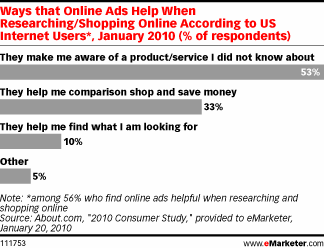 Advertising is increasingly under attack in Washington. In fact, we’re busy finishing up a paper with the working title: “The New Assault on Advertising: What it Means for the Future of Media & Culture.” Among other things, the paper inventories the many ways in which policymakers in Washington and elsewhere are stepping up regulation of commercial advertising and marketing efforts-and highlights the common themes that unite them. Unfortunately, the report is already over 50 pages long and we keep finding new threats to discuss!
This regulatory tsunami could not come at a worse time, of course, since an attack on advertising is tantamount to an attack on media itself, and media is at a critical point of technological change. As we have pointed out repeatedly, the vast majority of media and content in this country is supported by commercial advertising in one way or another-particularly in the era of “free” content and services.[1]
An Attack on Advertising Will Hurt Consumers
But there’s a more important reason to fear Washington’s new war on advertising:
It will hurt consumer welfare. That’s because advertising provides important information and signals to consumers about goods and services that are competing for their attention and business—and that scarcest of all things in the modern world, consumers’ attention. Continue reading →
Today I appeared on CNBC [video here and embedded down below] to discuss concerns about emerging “smart-sign” technology, which could give rise to a new generation of interactive retail advertising and marketing efforts. This is in the news because, as Don Clark and Nick Wingfield report today in The Wall Street Journal (“Intel, Microsoft Offer Smart-Sign Technology: Retailers, Product Marketers Could Discern Viewer, Make Choices on What to Display and Transfer Coupons Via Phone“), Intel and Microsoft have announced that:
they will collaborate to help companies create and use new forms of digital signs. By exploiting Intel chips and Microsoft software, the companies hope to bring more interactivity to such devices and help retailers customized marketing offers to consumers.
Signs equipped with cameras and specialized software could recognize the age, gender and height of people in front of them, and tell what products and images received the most attention, the companies said. By gathering information about which messages are more effective, they add, traditional retailers could develop marketing approaches that better counter Web-based competitors. “Every year retailers lose more ground to online [sellers], and they have to do something about that,” said Joe Jensen, general manager of Intel’s embedded computing division.
Down below, I have jotted down a couple of thoughts about the rise of “digital signage” and more targeted forms of retail marketing, only a few of which I was able to get across in this short TV spot. I think it’s an exciting new development for both retailers and consumers for the reasons I explain down below:
http://plus.cnbc.com/rssvideosearch/action/player/id/1383744249/code/cnbcplayershare
Continue reading →
 One of the themes you come across again and again in public policy debates about privacy, advertising, marketing, or even free speech battles, is the notion that the public at large is made up of mindless sheep being duped at every turn. And, as Berin Szoka and I noted in our paper “What Unites Advocates of Speech Controls & Privacy Regulation?” if you buy into the argument that consumers are basically that stupid then it logically follows that people cannot be trusted or left to their own devices. Thus, government must intervene and establish a baseline “community standard” on behalf of the entire citizenry to tell them what’s best for them.
But there are good reasons to question the premise that consumers are blind to efforts to persuade or influence them — regardless of what type of media content or communications efforts we are talking about. I was recently reading Communication Power by Manuel Castells and liked what he had to say about how so many media critics make this false assumption. Castells rightly notes:
Interestingly enough, critical theorists of communication often espouse [a] one-sided view of the communications process. By assuming the notion of a helpless audience manipulated by corporate media, they place the source of social alienation in the realm of consumerist mass communication. And yet, a well-established stream of research, particularly in the psychology of communications, shows the capacity of people to modify the signified of the messages they receive by interpreting them according to their own cultural frames, and by mixing the messages from one particular source with their variegated range of communicative practices. (p. 127)
That’s exactly right, and it is even more true in an age of ubiquitous, interactive communications technologies. “The people formerly known as the audience” have the unprecedented ability to talk back, to compare notes, to collectively criticize and hold accountable those who previously held all the cards in the mass media age of the past. Most consumers are perfectly capable of judging the merits of advertising, commercial messages, or other content on their own; they cast a skeptical eye toward most claims but process those claims alongside other counter-claims, independent judgments, informational inputs, and “cultural frames,” as Castells rightly argues. We need to give the public some credit.
Just read this AP article that reported on a Tuesday hearing of the Ohio Supreme Court about an Ohio “harmful to minors” law. According to the article, the statute makes it illegal to distribute harmful material to minors through “direct communications by people who know or have reason to believe the recipient is a minor.”
The case is in the 6th Circuit Court of Appeals, which has asked the Ohio Supreme Court to interpret “mass distribution” and “personally directed devices.” Per the law:
2) A person remotely transmitting information by means of a method of mass distribution does not directly sell, [etc.] … if either of the following applies:
(a) The person has inadequate information to know or have reason to believe that a particular recipient of the information or offer is a juvenile.
(b) The method of mass distribution does not provide the person the ability to prevent a particular recipient from receiving the information.
In the hearing (see the video) Justice Robert Cupp coins this beauty of a statement: “It’s not really the statute that’s confusing here, it’s the technologies.” Judge say what?
Isn’t the whole point of a statute to be applied to factual situations? Anything can make sense in the abstract (even law!). But applied to everyday life, the simplistic becomes complex — and can have unintended consequences. Continue reading →
Progress Snapshot 5.10
from
The Progress & Freedom Foundation
A recent telephone poll conducted by professors at Berkeley and the University of Pennsylvania concluded, “Contrary to what many marketers claim, most adult Americans (66%) do not want marketers to tailor advertisements to their interest.” The study’s authors claim that their poll is the “the first nationally representative telephone (wireline and cell phone) survey to explore Americans’ opinions about behavioral targeting by marketers.” They also assert that the poll indicates that “if Americans could vote on behavioral targeting today, they would shut it down.” Advocates of regulating online data collection have trumpeted this poll as evidence consumers demand legislation to protect their privacy. “This research gives the F.T.C. and Congress a political green light to go ahead and enact effective, but reasonable, rules and policies,” declared Jeff Chester, a leading critic of online advertising.
But what is most surprising about this poll is not that 66% of users said they do not want tailored online ads, but that 34% of users said they did! The key, initial question of “whether or not you want the websites you visit to show you ads that are tailored to your interests,” presents no trade-off. The fact that
anyusers said “yes” indicates that many users paused to do the rough mental math about the unarticulated trade-off between the benefits of receiving tailored ads and the costs of that tailoring.
The methodology of opinion polls necessarily affects respondents’ mental calculations, rendering polls not just easily manipulated, but inherently unreliable as indicators of real preferences. Every poll reflects the bias of its authors to some degree by the way questions are worded, the order in which they are asked, the sample surveyed,
etc. The easiest way to bias the results of a poll is to omit any mention of the trade-offs at issue. This poll simply buried the issue of trade-offs in a heavily loaded follow-up question: After telling respondents that marketers “often use technologies to follow the websites you visit and the content you look at in order to better customize ads,” the interviewer asked whether the respondent would allow advertisers to “follow [them] online in an anonymous way in exchange for free content.” Only 10% of users said they would allow this voluntary exchange.
What does this tell us about whether, and how, government should further regulate online advertising? Precious little: Not only does this poll overstate the costs of targeted advertising, understate its benefits, and ignore the tools available to users to address their privacy concerns but, like any opinion poll, this one tells us more about the psychology of decision-making under the artificial uncertainty of polls than about the choices users would actually make in the real world. Continue reading →
 Sometimes the most revealing conversations about policy issues happen with our loved ones at the breakfast table. Although loyal TLF readers may remember my partner Michael as my “Posterboy for Advertising’s Pro-Consumer Quid Pro Quo,” he doesn’t usually get into the policy issues I cover. But this morning, we fell into a conversation about the bitterly contentious issue of marketing to kids:
Michael: Growing up in South Korea, on a military base, we didn’t have any commercials on television. We had three channels and all they showed was public service announcements.
Sounds like paradise for anti-advertising zealots like Jeff Chester and the media reformistas who want to re-create the old media scarcity in the name of “media democracy“! Anyway:
We moved back to the U.S. when I was nine, and suddenly, during all my favorite cartoons, there were ads for toys. It was exciting—and more than a little bit overwhelming! It wasn’t just that I wanted these toys; it was that felt this incredible sense of urgency: I thought we had to go get the toys right now or they’d be gone!
What did Rousseau call his innocent man, the Noble Savage? That’s what we were: The noble savage, coming into this world of sophisticated toy advertisements.
But it didn’t take long for me to get over this initial bewilderment. My parents explained to me that we didn’t really have to go to the store
right away. (They also explained to me that I couldn’t haggle with the staff at Toys ‘R Us the same way I’d haggled with street vendors back in Korea—something that utterly mystified the staff.) After one trip to Toys Toys ‘R Us, I got the toys I wanted most and, over the next few months, realized that they weren’t anywhere near as exciting as I had imagined.
After that, I enjoyed the toy ads on TV, but I lost interest in many of the toys I already had, preferring to create my own toys or play outside.
I explained that advertising of toys to kids has long been the
cause celebre of anti-advertising crusaders:
Michael: But kids are acquisitive, too! How are they supposed to know about the latest toys if you can’t advertise to them? And what’s the big deal, anyway? I got used to toy ads and I think most kids would, too. The thing that’s different is incentive programs at stores.
Continue reading →

 The Technology Liberation Front is the tech policy blog dedicated to keeping politicians' hands off the 'net and everything else related to technology.