
Posts tagged as:

Almost every argument against technological innovation and progress that we hear today was identified and debunked by Samuel C. Florman a half century ago. Few others since him have mounted a more powerful case for the importance of innovation to human flourishing than Florman did throughout his lifetime.

Chances are you’ve never heard of him, however. As prolific as he was, Florman did not command as much attention as the endless parade of tech critics whose apocalyptic predictions grabbed all the headlines. An engineer by training, Florman became concerned about the growing criticism of his profession throughout the 1960s and 70s. He pushed back against that impulse in a series of books over the next two decades, including most notably: The Existential Pleasures of Engineering (1976), Blaming Technology: The Irrational Search for Scapegoats (1981), and The Civilized Engineer (1987). He was also a prolific essayist, penning hundreds of articles for a wide variety of journals, magazines, and newspapers beginning in 1959. He was also a regular columnist for MIT Technology Review for sixteen years.

Florman’s primary mission in his books and many of those essays was to defend the engineering profession against attacks emanating from various corners. More broadly, as he noted in a short autobiography on his personal website, Florman was interested in discussing, “the relationship of technology to the general culture.”

Florman could be considered a “rational optimist,” to borrow Matt Ridley’s notable term [1] for those of us who believe, as I have summarized elsewhere, that there is a symbiotic relationship between innovation, economic growth, pluralism, and human betterment.[2] Rational optimists are highly pragmatic and base their optimism on facts and historical analysis, not on dogmatism or blind faith in any particular viewpoint, ideology, or gut feeling. But they are unified in the belief that technological change is a crucial component of moving the needle on progress and prosperity.

Florman’s unique contribution to advancing rational optimism came in the way he itemized the various claims made by tech critics and then powerfully debunked each one of them. Continue reading →

[originally posted on Medium ]

Today is the anniversary of the day the machines took over.

Exactly twenty years ago today, on May 11, 1997, the great chess grandmaster Garry Kasparov became the first chess world champion to lose a match to a supercomputer. His battle with IBM’s “Deep Blue” was a highly-publicized media spectacle, and when he lost Game 6 of his match against the machine, it shocked the world.

At the time, Kasparov was bitter about the loss and even expressed suspicions about how Deep Blue’s team of human programmers and chess consultants might have tipped the match in favor of machine over man. Although he still wonders about how things went down behind the scenes during the match, Kasparov is no longer as sore as he once was about losing to Deep Blue. Instead, Kasparov has built on his experience that fateful week in 1997 and learned how he and others can benefit from it.

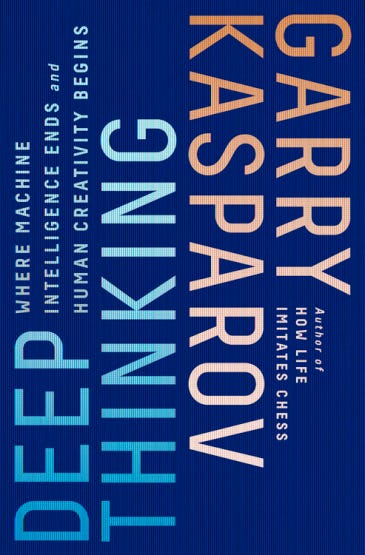
The result of this evolution in his thinking is Deep Thinking: Where Machine Intelligence Ends and Human Creativity Begins, a book which serves as a paean to human resiliency and our collective ability as a species to adapt in the face of technological disruption, no matter how turbulent.

Kasparov’s book serves as the perfect antidote to the prevailing gloom-and-doom narrative in modern writing about artificial intelligence (AI) and smart machines. His message is one of hope and rational optimism about future in which we won’t be racing against the machines but rather running alongside them and benefiting in the process.

Overcoming the Technopanic Mentality

There is certainly no shortage of books and articles being written today about AI, robotics, and intelligent machines. The tone of most of these tracts is extraordinarily pessimistic. Each page is usually dripping with dystopian dread and decrying a future in which humanity is essentially doomed.

As I noted in a recent essay about “The Growing AI Technopanic,” after reading through most of these books and articles, one is left to believe that in the future: “Either nefarious-minded robots enslave us or kill us, or AI systems treacherously trick us, or at a minimum turn our brains to mush.” These pessimistic perspectives are clearly on display within the realm of fiction, where every sci-fi book, movie, or TV show depicts humanity as certain losers in the proverbial “race” against machines. But such lugubrious lamentations are equally prevalent within the pages of many non-fiction books, academic papers, editorials, and journalistic articles.

Given the predominantly panicky narrative surrounding the age of smart machines, Kasparov’s Deep Thinking serves as a welcome breath of fresh air. The aim of his book is finding ways of “doing a smarter job of humans and machines working together” to improve well-being. Continue reading →

How is it that we humans have again and again figured out how to assimilate new technologies into our lives despite how much those technologies “unsettled” so many well-established personal, social, cultural, and legal norms?

In recent years, I’ve spent a fair amount of time thinking through that question in a variety of blog posts (“Are You An Internet Optimist or Pessimist? The Great Debate over Technology’s Impact on Society”), law review articles (“Technopanics, Threat Inflation, and the Danger of an Information Technology Precautionary Principle”), opeds (“Why Do We Always Sell the Next Generation Short?”), and books (See chapter 4 of my new book, “Permissionless Innovation: The Continuing Case for Comprehensive Technological Freedom”).

It’s fair to say that this issue — how individuals, institutions, and cultures adjust to technological change — has become a personal obsession of mine and it is increasingly the unifying theme of much of my ongoing research agenda. The economic ramifications of technological change are part of this inquiry, of course, but those economic concerns have already been the subject of countless books and essays both today and throughout history. I find that the social issues associated with technological change — including safety, security, and privacy considerations — typically get somewhat less attention, but are equally interesting. That’s why my recent work and my new book narrow the focus to those issues. Continue reading →

Here’s the first of two essays I’ve recently penned making “The Case for Internet Optimism.” This essay was included in the book, The Next Digital Decade: Essays on the Future of the Internet (2011), which was edited by Berin Szoka and Adam Marcus of TechFreedom.  In these essays, I identify two schools of Internet pessimism: (1) “Net Skeptics,” who are pessimistic about the Internet improving the lot of mankind; and (2) “Net Lovers,” who appreciate the benefits the Net brings society but who fear those benefits are disappearing, or that the Net or openness are dying.  (Regular readers of this blog will be familiar with these themes since I sketched them out in previous essays here such as, “Are You an Internet Optimist or Pessimist?” and “Two Schools of Internet Pessimism.”) The second essay is here.

This essay focuses on the first variant of Internet pessimism, which is rooted in general skepticism about the supposed benefits of cyberspace, digital technologies, and information abundance. The proponents of this pessimistic view often wax nostalgic about some supposed “good ‘ol days” when life was much better (although they can’t seem to agree when those were). At a minimum, they want us to slow down and think twice about life in the Information Age and how it’s personally affecting each of us.  Occasionally, however, this pessimism borders on neo-Ludditism, with some proponents recommending steps to curtail what they feel is the destructive impact of the Net or digital technologies on culture or the economy.  I identify the leading exponents of this view of Internet pessimism and their major works. I trace their technological pessimism back to Plato but argue that their pessimism is largely unwarranted. Humans are more resilient than pessimists care to admit and we learn how to adapt to technological change and assimilate new tools into our lives over time. Moreover, were we really better off in the scarcity era when we were collectively suffering from information poverty?  Generally speaking, despite the challenges it presents society, information abundance is a better dilemma to be facing than information poverty.  Nonetheless, I argue, we should not underestimate or belittle the disruptive impacts associated with the Information Revolution.  But we need to find ways to better cope with turbulent change in a dynamist fashion instead of attempting to roll back the clock on progress or recapture “the good ‘ol days,” which actually weren’t all that good.

Down below, I have embedded the entire chapter in a Scribd reader, but the essay can also be found on the TechFreedom website for the book as well as on SSRN.  I have also includes two updated tables that appeared in my old “optimists vs. pessimists” essay.  The first lists some of the leading Internet optimists and pessimists and their books. The second table outlines some of the major lines of disagreement between these two camps and I divided those disagreements into (1) Cultural / Social beliefs vs. (2) Economic / Business beliefs.

Continue reading →

[I’ve been working on an outline for a book I hope to write surveying technological skepticism throughout history. I first started thinking about this topic two years when I noticed that a great number of recent books about Internet policy could generally be grouped into one of two camps: Internet optimists vs. Internet pessimists. I subsequently penned an essay on the subject that generated a fair bit of attention. So, I figured I must be on to something, and the more Net policy books I read, the more I realized that the divisions between these two camps were growing wider and increasingly heated. Thus, I thought I would share this very rough draft (much of it still in outline form) of the opening chapter of that book I want to write about this great intellectual war over the impact of technology on society. I invite reader input. Update Jan. 2011: I finally published a full-length essay on this topic. You can find it here. ]

__________

The impact of technological change on culture, learning, and morality has long been the subject of intense debate, and every technological revolution brings out a fresh crop of both pessimists and pollyannas. Indeed, a familiar cycle has repeat itself throughout history whenever new modes of production (from mechanized agriculture to assembly-line production), means of transportation (water, rail, road, or air), energy production processes (steam, electric, nuclear), medical breakthroughs (vaccination, surgery, cloning), or communications techniques (telegraph, telephone, radio, television) have appeared on the scene.

The cycle goes something like this. A new technology appears. Those who fear the sweeping changes brought about by this technology see a sky that is about to fall. These “techno-pessimists” predict the death of the old order (which, ironically, is often a previous generation’s hotly-debated technology that others wanted slowed or stopped).  Embracing this new technology, they fear, will result in the overthrow of traditions, beliefs, values, institutions, business models, and much else they hold sacred.

The pollyannas, by contrast, look out at the unfolding landscape and see mostly rainbows in the air. Theirs is a rose-colored world in which the technological revolution du jour is seen as improving the general lot of mankind and bringing about a better order.  If something has to give, then the old ways be damned! For such “techno-optimists,” progress means some norms and institutions must adapt—perhaps even disappear—for society to continue its march forward.

Our current Information Revolution is no different. It too has its share of techno-pessimists and techno-optimists. Indeed, before most of us had even heard of the Internet, people were already fighting about it—or at least debating what the rise of the Information Age meant for our culture, society, and economy. Continue reading →