Posts tagged as:

A growing number of conservatives are calling for Big Government censorship of social media speech platforms. Censorship proposals are to conservatives what price controls are to radical leftists: completely outlandish, unworkable, and usually unconstitutional fantasies of controlling things that are ultimately much harder to control than they realize. And the costs of even trying to impose and enforce such extremist controls are always enormous.

Earlier this year, The Wall Street Journal ran a response I wrote to a proposal set forth by columnist Peggy Noonan in which she proposed banning everyone under 18 from all social-media sites (“We Can Protect Children and Keep the Internet Free,” Apr. 15). I expanded upon that letter in an essay here entitled, “Should All Kids Under 18 Be Banned from Social Media?” National Review also recently published an article penned by Christine Rosen in which she also proposes to “Ban Kids from Social Media.” And just this week, Zach Whiting of the Texas Public Policy Foundation published an essay on “Why Texas Should Ban Social Media for Minors.”

I’ll offer a few more thoughts here in addition to what I’ve already said elsewhere. First, here is my response to the Rosen essay. National Review gave me 250 words to respond to her proposal:

While admitting that “law is a blunt instrument for solving complicated social problems,” Christine Rosen (“Keep Them Offline,” June 27) nonetheless downplays the radicalness of her proposal to make all teenagers criminals for accessing the primary media platforms of their generation. She wants us to believe that allowing teens to use social media is the equivalent of letting them operate a vehicle, smoke tobacco, or drink alcohol. This is false equivalence. Being on a social-media site is not the same as operating two tons of steel and glass at speed or using mind-altering substances. Teens certainly face challenges and risks in any new media environment, but to believe that complex social pathologies did not exist before the Internet is folly. Echoing the same “lost generation” claims made by past critics who panicked over comic books and video games, Rosen asks, “Can we afford to lose another generation of children?” and suggests that only sweeping nanny-state controls can save the day. This cycle is apparently endless: Those “lost generations” grow up fine, only to claim it’s the  next generation that is doomed! Rosen casually dismisses free-speech concerns associated with mass-media criminalization, saying that her plan “would not require censorship.” Nothing could be further from the truth. Rosen’s prohibitionist proposal would deny teens the many routine and mostly beneficial interactions they have with their peers online every day. While she belittles media literacy and other educational and empowerment-based solutions to online problems, those approaches continue to be a better response than the repressive regulatory regime she would have Big Government impose on society.

I have a few more things to say beyond these brief comments. Continue reading →

If you haven’t yet had the chance to check out the new Progress Forum, I encourage you to do so. It’s a discussion group for progress studies and all things related to it. The Forum is sponsored by The Roots of Progress. Even though the Forum is still in pre-launch phase, there are already many interesting threads worth checking out. I was my honor to contribute one of the first on the topic, “Where is ‘Progress Studies’ Going?” It’s an effort to sort through some of the questions and challenges facing the Progress Studies movement in terms of focus and philosophical grounding. I thought I would just reproduce the essay here, but I encourage you to jump over to the Progress Forum to engage in discussion about it, or the many other excellent discussions happening there on other issues.

Continue reading →

Originally published on the AIER blog on 9/8/19 as “The Worst Regulation Ever Proposed.”


Imagine a competition to design the most onerous and destructive economic regulation ever conceived. A mandate that would make all other mandates blush with embarrassment for not being burdensome or costly enough. What would that Worst Regulation Ever look like?

Unfortunately, Bill de Blasio has just floated a few proposals that could take first and second place prize in that hypothetical contest. In a new Wired essay, the New York City mayor and 2020 Democratic presidential candidate explains, “Why American Workers Need to Be Protected From Automation,” and aims to accomplish that through a new agency with vast enforcement powers, and a new tax.

Taken together, these ideas represent one of the most radical regulatory plans any America politician has yet concocted.

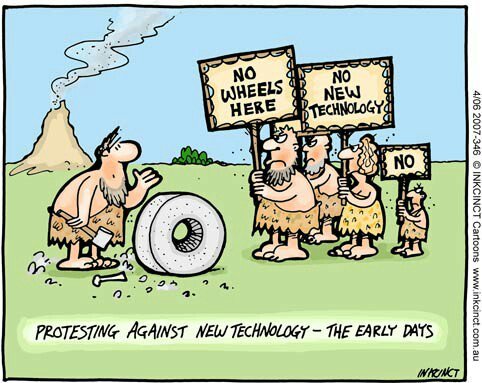
Politicians, academics, and many others have been panicking over automation at least since the days when the Luddites were smashing machines in protest over growing factory mechanization. With the growth of more sophisticated forms of robotics, artificial intelligence, and workplace automation today, there has been a resurgence of these fears and a renewed push for sweeping regulations to throw a wrench in the gears of progress. Mayor de Blasio is looking to outflank his fellow Democratic candidates for president with an anti-automation plan that may be the most extreme proposal of its kind. Continue reading →

Juma book cover

“The quickest way to find out who your enemies are is to try doing something new.” Thus begins Innovation and Its Enemies, an ambitious new book by Calestous Juma that will go down as one of the decade’s most important works on innovation policy.

Juma, who is affiliated with the Harvard Kennedy School’s Belfer Center for Science and International Affairs, has written a book that is rich in history and insights about the social and economic forces and factors that have, again and again, lead various groups and individuals to oppose technological change. Juma’s extensive research documents how “technological controversies often arise from tensions between the need to innovate and the pressure to maintain continuity, social order, and stability” (p. 5) and how this tension is “one of today’s biggest policy challenges.” (p. 8)

What Juma does better than any other technology policy scholar to date is that he identifies how these tensions develop out of deep-seated psychological biases that eventually come to affect attitudes about innovations among individuals, groups, corporations, and governments. “Public perceptions about the benefits and risks of new technologies cannot be fully understood without paying attention to intuitive aspects of human psychology,” he correctly observes. (p. 24) Continue reading →

Tech Policy Threat Matrix

by on September 24, 2015 · 2 comments

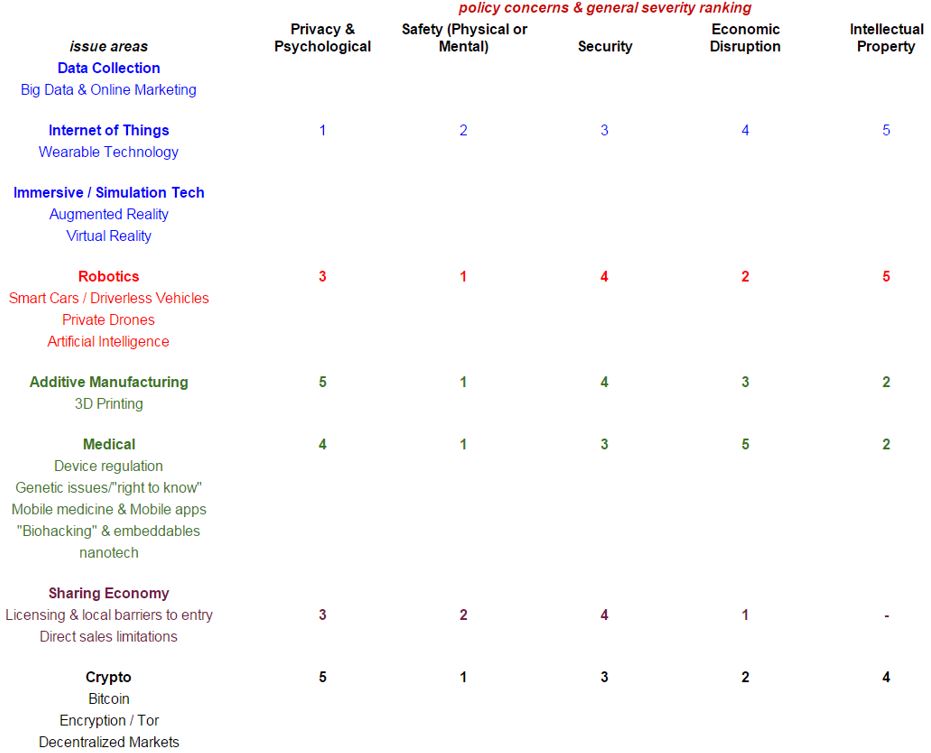
On the whiteboard that hangs in my office, I have a giant matrix of technology policy issues and the various policy “threat vectors” that might end up driving regulation of particular technologies or sectors. Along with my colleagues at the Mercatus Center’s Technology Policy Program, we constantly revise this list of policy priorities and simultaneously make an (obviously quite subjective) attempt to put some weights on the potential policy severity associated with each threat of intervention. The matrix looks like this: [Sorry about the small fonts. You can click on the image to make it easier to see.]


Tech Policy Issue Matrix 2015

I use 5 general policy concerns when considering the likelihood of regulatory intervention in any given area. Those policy concerns are:

  1. privacy (reputation issues, fear of “profiling” & “discrimination,” amorphous psychological / cognitive harms);
  2. safety (health & physical safety or, alternatively, child safety and speech / cultural concerns);
  3. security (hacking, cybersecurity, law enforcement issues);
  4. economic disruption (automation, job dislocation, sectoral disruptions); and,
  5. intellectual property (copyright and patent issues).

Continue reading →

Here’s the first of two essays I’ve recently penned making “The Case for Internet Optimism.” This essay was included in the book, The Next Digital Decade: Essays on the Future of the Internet (2011), which was edited by Berin Szoka and Adam Marcus of TechFreedom.  In these essays, I identify two schools of Internet pessimism: (1) “Net Skeptics,” who are pessimistic about the Internet improving the lot of mankind; and (2) “Net Lovers,” who appreciate the benefits the Net brings society but who fear those benefits are disappearing, or that the Net or openness are dying.  (Regular readers of this blog will be familiar with these themes since I sketched them out in previous essays here such as, “Are You an Internet Optimist or Pessimist?” and “Two Schools of Internet Pessimism.”) The second essay is here.

This essay focuses on the first variant of Internet pessimism, which is rooted in general skepticism about the supposed benefits of cyberspace, digital technologies, and information abundance. The proponents of this pessimistic view often wax nostalgic about some supposed “good ‘ol days” when life was much better (although they can’t seem to agree when those were). At a minimum, they want us to slow down and think twice about life in the Information Age and how it’s personally affecting each of us.  Occasionally, however, this pessimism borders on neo-Ludditism, with some proponents recommending steps to curtail what they feel is the destructive impact of the Net or digital technologies on culture or the economy.  I identify the leading exponents of this view of Internet pessimism and their major works. I trace their technological pessimism back to Plato but argue that their pessimism is largely unwarranted. Humans are more resilient than pessimists care to admit and we learn how to adapt to technological change and assimilate new tools into our lives over time. Moreover, were we really better off in the scarcity era when we were collectively suffering from information poverty?  Generally speaking, despite the challenges it presents society, information abundance is a better dilemma to be facing than information poverty.  Nonetheless, I argue, we should not underestimate or belittle the disruptive impacts associated with the Information Revolution.  But we need to find ways to better cope with turbulent change in a dynamist fashion instead of attempting to roll back the clock on progress or recapture “the good ‘ol days,” which actually weren’t all that good.

Down below, I have embedded the entire chapter in a Scribd reader, but the essay can also be found on the TechFreedom website for the book as well as on SSRN.  I have also includes two updated tables that appeared in my old “optimists vs. pessimists” essay.  The first lists some of the leading Internet optimists and pessimists and their books. The second table outlines some of the major lines of disagreement between these two camps and I divided those disagreements into (1) Cultural / Social beliefs vs. (2) Economic / Business beliefs.

Continue reading →

[I’ve been working on an outline for a book I hope to write surveying technological skepticism throughout history. I first started thinking about this topic two years when I noticed that a great number of recent books about Internet policy could generally be grouped into one of two camps: Internet optimists vs. Internet pessimists. I subsequently penned an essay on the subject that generated a fair bit of attention. So, I figured I must be on to something, and the more Net policy books I read, the more I realized that the divisions between these two camps were growing wider and increasingly heated. Thus, I thought I would share this very rough draft (much of it still in outline form) of the opening chapter of that book I want to write about this great intellectual war over the impact of technology on society. I invite reader input. Update Jan. 2011: I finally published a full-length essay on this topic. You can find it here. ]

__________

The impact of technological change on culture, learning, and morality has long been the subject of intense debate, and every technological revolution brings out a fresh crop of both pessimists and pollyannas. Indeed, a familiar cycle has repeat itself throughout history whenever new modes of production (from mechanized agriculture to assembly-line production), means of transportation (water, rail, road, or air), energy production processes (steam, electric, nuclear), medical breakthroughs (vaccination, surgery, cloning), or communications techniques (telegraph, telephone, radio, television) have appeared on the scene.

The cycle goes something like this. A new technology appears. Those who fear the sweeping changes brought about by this technology see a sky that is about to fall. These “techno-pessimists” predict the death of the old order (which, ironically, is often a previous generation’s hotly-debated technology that others wanted slowed or stopped).  Embracing this new technology, they fear, will result in the overthrow of traditions, beliefs, values, institutions, business models, and much else they hold sacred.

The pollyannas, by contrast, look out at the unfolding landscape and see mostly rainbows in the air. Theirs is a rose-colored world in which the technological revolution du jour is seen as improving the general lot of mankind and bringing about a better order.  If something has to give, then the old ways be damned! For such “techno-optimists,” progress means some norms and institutions must adapt—perhaps even disappear—for society to continue its march forward.

Our current Information Revolution is no different. It too has its share of techno-pessimists and techno-optimists. Indeed, before most of us had even heard of the Internet, people were already fighting about it—or at least debating what the rise of the Information Age meant for our culture, society, and economy. Continue reading →

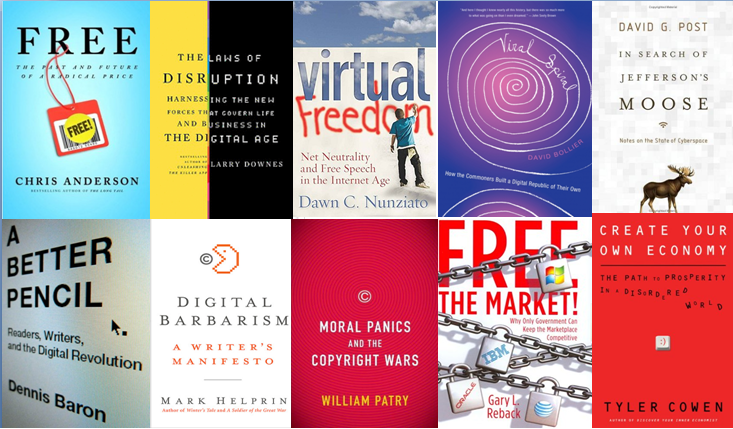
2009 was not as big of a year for Internet and information technology (“info-tech”) policy books as 2008 was, but there were still some notable titles released that offered interesting perspectives about the future of the Net and the impact the Digital Revolution is having on our lives, culture, and economy.  So, like last year, I figured I would throw together my list of the 10 most important info-tech policy books of the year.

book covers collage 2009First, let me repeat a few of the same caveats and disclaimers that I set forth last year.  What qualifies as an “important” info-tech policy book? Simply put, it’s a title that many people are currently discussing and that we will likely be referencing for many years to come.  However, I want to be clear that merely because a book appears on my list it does not necessarily mean I agree with everything said in it. In fact, as was the case in previous years, I found much with which to disagree in my picks for the most important books of 2009 and I find that the cyber-libertarianism I subscribe to has very few fans out there.

Another caveat: Narrowly-focused titles lose a few points on my list. For example, if a book deals mostly with privacy issues, copyright law, or antitrust policy, it does not exactly qualify as the same sort of “tech policy book” as other titles found on this list since it is a narrow exploration of just one set of issues with a bearing on technology policy.

With those caveats in mind, here are my choices for the Most Important Info-Tech Policy Books of 2009. Continue reading →

A Better Pencil book coverI very much enjoyed Dennis Baron’s new book, A Better Pencil: Readers, Writers, and the Digital Revolution, and highly recommend you pick it up. Baron does a wonderful job exploring the history of techno-pessimism and the endless battles about the impact of new technologies on life and learning, something I have written about here before in my essays on “Internet optimists vs. pessimists” (See: 1, 2, 3).

I have a complete review of Baron’s A Better Pencil now up on the City Journal‘s website here.  I’ve also pasted it down below.


Plato Wrote it Down by Adam Thierer

a review of A Better Pencil: Readers, Writers, and the Digital Revolution, by Dennis Baron (Oxford University Press, 280 pp., $24.95)

In the beginning, Dennis Baron reminds us in his new book, A Better Pencil, there was the word—the spoken word, that is. Oral tradition, the passing of knowledge through stories and lectures, was the primary method of instruction and learning throughout early human civilization. But then a few innovative souls decided to start writing everything down on stones and clay. Almost as soon as they did, a great debate began on the impact of new communications technology on culture and education. And it rages on today, with a new generation of optimists and skeptics battling over the impact that computing, the Internet, and digital technologies have on our lives and on how we learn about the world.

Continue reading →

Fred Vogelstein’s essay in Wired, “Great Wall of Facebook: The Social Network’s Plan to Dominate the Internet — and Keep Google Out” describes the intensifying clash between Google and Facebook—a clash that focuses on the ability to target advertising:

Like typical trash-talking youngsters, Facebook sources argue that their competition is old and out of touch. “Google is not representative of the future of technology in any way,” one Facebook veteran says. “Facebook is an advanced communications network enabling myriad communication forms. It almost doesn’t make sense to compare them.”

Apart from noting that Facebook directs users to Microsoft’s Bing as its default search engine for the Internet at large, the most interesting part of the article is Facebook’s “4-Step Plan for Online Domination”:

1. Build critical mass. In the eight months ending in April, Facebook has doubled in size to 200 million members, who contribute 4 billion pieces of info, 850 million photos, and 8 million videos every month. The result: a second Internet, one that includes users’ most personal data and resides entirely on Facebook’s servers. 2. Redefine search. Facebook thinks its members will turn to their friends—rather than Google’s algorithms—to navigate the Web. It already drives an eyebrow-raising amount of traffic to outside sites, and that will only increase once Facebook Search allows users to easily explore one another’s feeds. 3. Colonize the Web. Thanks to a pair of new initiatives—dubbed Facebook Connect and Open Stream—users don’t have to log in to Facebook to communicate with their friends. Now they can access their network from any of 10,000 partner sites or apps, contributing even more valuable data to Facebook’s servers every time they do it. 4. Sell targeted ads, everywhere. Facebook hopes to one day sell advertising across all of its partner sites and apps, not just on its own site. The company will be able to draw on the immense volume of personal data it owns to create extremely targeted messages. The challenge: not freaking out its users in the process.

Facebook can’t keep losing money forever.  Indeed, investors are willing to keep sinking money into Facebook during Phases 1-3 because they think it will pay off in Phase 4—when Facebook really threatens to be a fGoogle-killer.  But rather the fact that investors are willing to subsidize the creation of a wonderful platform now used by 200 million people (one fifth of all Internet users worldwide), or that Facebook might finally provide a counter-weight to the fearsome Google, the People for the Ethical Treatment of Data (PETD) are appalled.  One commenter on the Wired story put it best: Continue reading →