Randall Stross discusses his recent book: The Launch Pad: Inside Y Combinator, Silicon Valley’s Most Exclusive School for Startups. Stross’s behind-the-scenes look at Y Combinator details how the seed fund has been able to produce young entrepreneurs and successful startups such as Dropbox and Airbnb. Stross also discusses Y Combinator’s early history, the typical Y Combinator participant, the fund’s rate of return, the gender gap in the program, and the reason Silicon Valley has become the epicenter for startups.
Download
Related Links
The ACLU of Northern California says it’s time for a privacy check-in on location based-services. Their handy chart compares several of the most popular location-based services along a number of dimensions.
Little of what they examine has to do with civil liberties—cough, cough, ahem (this is a favorite critique of mine for my ACLU friends)—but the report does find that five out of six location-based providers are unclear about whether they require a warrant before handing information over to the government. Facebook is the winner here. Yelp, Foursquare, Gowalla, Loopt, and Twitter are unclear about whether they protect your location data from government prying.
 The latest edition (Version 4.0) of my PFF special report on “Parental Controls and Online Child Protection: A Survey of Tools & Methods” is now up. For those not familiar with the report, it explores the market for parental control tools, rating schemes, education and media literacy efforts, and various other tools, methods, and initiatives aimed at promoting online child safety. After evaluating that state of this market, I conclude: “There has never been a time in our nation’s history when parents have had more tools and methods at their disposal to help them decide what constitutes acceptable media content in their homes and in the lives of their children.” Moreover, I believe that the parental controls and content management tools cataloged in the report represent a better, less restrictive alternative to government regulation.
Version 4.0 of the report is now over 250 pages long (up from 200 pages in Version 3.0) and it contains almost 70 exhibits (up from 50), 725 references (up from roughly 500), and numerous updates in all five sections of the book. Major updates have been made to the Internet, social networking, and mobile media sections, reflecting the growing importance of those sectors and issues. Other new sections or appendices have also been added to the report, including:
- a new section examining how many households really need parental control tools;
- a new appendix on the downsides of mandatory parental controls and restrictive default settings;
- a new section on the dangers of “deputizing the online middleman” solution as an approach to solving child safety concerns;
- a new appendix reviewing the findings of 5 past online safety task forces;
- … and much more.
I issue major updates once a year and 1 or 2 minor tweaks during the course of the year to reflect the evolution of the parental control and online child safety marketplace and debate. The report is available free-of-charge on the PFF website, and the previous editions of the report are housed there too in case you want to see how it has evolved over the past couple of years. For those interested in taking a quick look at the report, I have embedded it down below the fold as a Scribd file. Finally, as is always the case, I encourage readers to send me updates and suggestions for how to improve the report and I will incorporate them into future versions.
Continue reading →
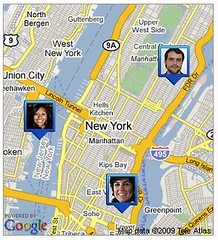 Google’s latest major launch is “Latitude,” a geo-location service that lets users find friends on a digital map and then network with them. These services are often referred to as “LBS,” which stands for “location-based services.” I wrote about LBS here before in my essay on “The Next Great Technopanic: Wireless Geo-Location / Social Mapping.” As I pointed out in that piece, LBS raise privacy concerns with some people because, by their nature, these technologies involve the tracking of users.
But I’ve argued that those concerns are generally over-blown, especially because you have to download and opt-in to these services. In other words, you know what you’re getting into. Moreover, companies who offer these services, like Loopt and now Google, go out of their way to offer privacy safeguards. Indeed, even some privacy activists agree.
For example, Michael Zimmer of the School of Information Studies at the University of Wisconsin-Milwaukee, is someone who pays close attention to privacy issues and is often critical of Google and other companies for supposedly not paying enough attention to privacy concerns. In the case of Latitude, however, he argues that “Google Actually Got it (Mostly) Right.” Here’s his snapshot of “what Google’s done to help give users control of their information flows in Latitude”:
Continue reading →
Just FYI, the latest update of my booklet on “Parental Controls and Online Child Protection: A Survey of Tools & Methods” is now live. The new version, Version 3.1, provides minor updates to all sections of the book and a new appendix of relevant research in the field. I issue major updates early each year and 1 or 2 tweaks during the course of the year to reflect the evolution of the parental control and online child safety market and debate.
For those not familiar with the report, it explores the market for parental control tools, rating schemes, education efforts, and initiatives aimed at promoting online child safety. I believe that the parental controls and content management tools cataloged in the report represent a better, less restrictive alternative to government regulation. As I conclude after evaluating that state of the market: “There has never been a time in our nation’s history when parents have had more tools and methods at their disposal to help them decide what constitutes acceptable media content in their homes and in the lives of their children.”
The report is available free-of-charge on the PFF website, and the previous editions of the report are housed there too in case you want to see how it has evolved over the past two years. For those interested in taking a quick look at the report, I have embedded it down below the fold as a Scribd file. Finally, as is always the case, I encourage readers to send me updates and suggestions for how to improve the report and I will incorporate them into future versions.
Continue reading →
A few days ago, I posted an essay about the recent history of “moral panics,” or “technopanics,” as Alice Marwick refers to them in her brilliant new article about the recent panic over MySpace and social networking sites in general.
I got thinking about technopanics again today after reading the
Washington Post’s front-page article, “When the Phone Goes With You, Everyone Else Can Tag Along.” In the piece, Post staff writer Ellen Nakashima discusses the rise of mobile geo-location technologies and services, which are becoming more prevalent as cell phones grow more sophisticated. These services are often referred to as “LBS,” which stands for “location-based services.”
Many of phones and service plans offered today include LBS technologies, which are very useful for parents like me who might want to monitor the movement of their children. Those same geo-location technologies can be used for other LBS purposes. Geo-location technologies are now being married to social networking utilities to create an entirely new service and industry: “social mapping.” Social mapping allows subscribers to find their friends on a digital map and then instantly network with them. Companies such as Loopt and Helio have already rolled out commercial social mapping services. Loopt has also partnered with major carriers to roll out its service nationwide, including the new iPhone 3G. It is likely that many other rivals will join these firms in coming months and years.
These new LBS services present exciting opportunities for users to network with friends and family, and it also open up a new world of commercial / advertising opportunities. Think of how stores could offer instantaneous coupons as you walk by their stores, for example. And very soon, you can imagine a world were many of our traditional social networking sites and services are linked into LBS tools in a seamless fashion. But as today’s
Washington Post article notes, mobile geo-location and social mapping is also raising some privacy concerns:
Continue reading →
PFF has just releasing an updated edition of my booklet on “Parental Controls and Online Child Protection: A Survey of Tools & Methods.” The new version, Version 3.0, includes two new appendixes and updates to each section to reflect new parental control tools and programs developed in the last nine months.
The updated report is timely as it comes on the heels of the recently-announced Internet Safety Technical Task Force, which is being chaired by the Berkman Center for Internet & Society at Harvard Law School. I am privileged to serve as a member of the Task Force, which is evaluating various online safety technologies and strategies and then reporting back to state attorneys general with our findings.
Those issues and much more are covered in the latest edition of my report. The report explores the market for parental control tools, rating schemes, education efforts, and initiatives aimed at promoting online child safety. I believe that the parental controls and content management tools cataloged in the report represent a better, less restrictive alternative to government regulation. As I conclude after evaluating that state of the market: “There has never been a time in our nation’s history when parents have had more tools and methods at their disposal to help them decide what constitutes acceptable media content in their homes and in the lives of their children.”
Version 3.0 of the special report, now over 200 pages, contains over fifty exhibits and numerous updates in all five sections of the book. Major updates have been made to the Internet, social networking, and mobile media sections, reflecting the growing importance of those sectors and issues. A greatly expanded section on video empowerment technologies has also been included. Finally, two appendices have also been added: a comprehensive legislative index cataloging over thirty bills introduced in Congress on these issues (complied with John Morris of Center for Democracy & Technology), and a glossary of 35 relevant terms and cases.
The report is available free-of-charge on the PFF website, as are the previous editions. And I am happy to provide hard copies to those who are interested.
http://documents.scribd.com/ScribdViewer.swf?document_id=2887320&access_key=key-um5xjvf98bfnuu8811v&page=&version=1&auto_size=true
PFF has just released my latest paper entitled “Parental Control Perfection? The Impact of the DVR and VOD Boom on the Debate over TV Content Regulation.” In the report, I focus on the extent to which new video technologies, such as digital video recorders (DVRs) and video on demand (VOD) services, are changing the way households consume media and are helping parents better tailor viewing experiences to their tastes and values. I provide evidence showing the rapid spread of these technologies and discuss how parents are using these tools in their homes. Finally, I argue that these developments will have profound implications for debates over the regulation of video programming. As parents are given the ability to more effectively manage their family’s viewing habits and experiences, it will lessen—if not completely undercut—the need for government intervention on their behalf.
This 16-page report can be found at: http://www.pff.org/issues-pubs/pops/pop14.20DVRboomcontentreg.pdf

 The Technology Liberation Front is the tech policy blog dedicated to keeping politicians' hands off the 'net and everything else related to technology.