Here’s the first of two essays I’ve recently penned making “The Case for Internet Optimism.” This essay was included in the book, The Next Digital Decade: Essays on the Future of the Internet (2011), which was edited by Berin Szoka and Adam Marcus of TechFreedom. In these essays, I identify two schools of Internet pessimism: (1) “Net Skeptics,” who are pessimistic about the Internet improving the lot of mankind; and (2) “Net Lovers,” who appreciate the benefits the Net brings society but who fear those benefits are disappearing, or that the Net or openness are dying. (Regular readers of this blog will be familiar with these themes since I sketched them out in previous essays here such as, “Are You an Internet Optimist or Pessimist?” and “Two Schools of Internet Pessimism.”) The second essay is here.
This essay focuses on the first variant of Internet pessimism, which is rooted in general skepticism about the supposed benefits of cyberspace, digital technologies, and information abundance. The proponents of this pessimistic view often wax nostalgic about some supposed “good ‘ol days” when life was much better (although they can’t seem to agree when those were). At a minimum, they want us to slow down and think twice about life in the Information Age and how it’s personally affecting each of us. Occasionally, however, this pessimism borders on neo-Ludditism, with some proponents recommending steps to curtail what they feel is the destructive impact of the Net or digital technologies on culture or the economy. I identify the leading exponents of this view of Internet pessimism and their major works. I trace their technological pessimism back to Plato but argue that their pessimism is largely unwarranted. Humans are more resilient than pessimists care to admit and we learn how to adapt to technological change and assimilate new tools into our lives over time. Moreover, were we really better off in the scarcity era when we were collectively suffering from information poverty? Generally speaking, despite the challenges it presents society, information abundance is a better dilemma to be facing than information poverty. Nonetheless, I argue, we should not underestimate or belittle the disruptive impacts associated with the Information Revolution. But we need to find ways to better cope with turbulent change in a dynamist fashion instead of attempting to roll back the clock on progress or recapture “the good ‘ol days,” which actually weren’t all that good.
Down below, I have embedded the entire chapter in a Scribd reader, but the essay can also be found on the TechFreedom website for the book as well as on SSRN. I have also includes two updated tables that appeared in my old “optimists vs. pessimists” essay. The first lists some of the leading Internet optimists and pessimists and their books. The second table outlines some of the major lines of disagreement between these two camps and I divided those disagreements into (1) Cultural / Social beliefs vs. (2) Economic / Business beliefs.
Continue reading →
 I recently finished Tyler Cowen’s latest book, Create Your Own Economy: The Path to Prosperity in a Disordered World. Like everything he writes, this book is worth reading and it will be of interest to those who follow technology policy debates since Cowen makes a passionate case for “Internet optimism” in the face of recent criticisms of the Internet and the Information Age in general.
Cowen is a Professor of Economics at George Mason University and the co-author, along with Alex Tabarrok, of the wonderful MarginalRevolution.com blog. And if you haven’t read Cowen’s
In Praise of Commercial Culture, stop what you’re doing and go get yourself a copy right now. Brilliant book. Compared to that book, Create Your Own Economy is a difficult book to summarize. Seriously, this book is all over the place… but in a good way. Even though it sometimes feels like “Tyler’s Miscellaneous Ramblings,” those ramblings will keep you engaged and entertained. Cord Blomquist did a pretty good job of summarizing the general themes of the book in this post two months ago when he noted that, “despite cultural reflexes that would have us do otherwise, we should embrace… new technologies as means to be more selective about what information we absorb and therefore welcome the increased volume of bytes into our lives. In his new book, [Cowen] explores technology as a vehicle to help you determine what you really value, not a series of a email-powered torture devices.” That’s a pretty good summation, but the book is about much more than that.
Instead of a full-blown review, I want to focus on some of passages from Cowen’s book about coping with information overload, which I think readers here might find of interest. In doing so, I will contrast Cowen’s views with those of John Freeman, who just penned “A Manifesto for Slow Communication” in The Wall Street Journal. As we will see, Cowen and Freeman’s differences exemplify the heated ongoing debate taking place among “Internet optimists & pessimists,” which I have discussed here many times before. Continue reading →
Mark Cuban penned a sharp piece over the weekend entitled “Who Cares What People Write?” in which he explains why people shouldn’t get too worked up about what they might read about themselves (or their organizations) online since, chances are, very few people are ever going to see it anyway. To explain why, Cuban identifies two kinds of “Outties” (which is shorthand for someone who publishes on the web): (1) “professional outties” (or “Those that attempt to publish in a limited number of locations to a maximum number of readers or listeners, with a reasonable expectation of building a following.”) and (2) “amateur outties” (“Those that attempt to publish in as many places as possible hoping they are “discovered.”) But those “amateur outties… really [have] no impact on 99.99pct of the population,” Cuban argues, “[and the] vast majority of what is written on the web goes unread and even that which is read, is quickly forgotten.” Moreover, “even when something is heavily commented on, it is usually just an onslaught by the ‘amateur outties.’”
Thus, Cuban concludes:
Fragmentation applies to 100pct of media. We have gotten to the point where it is so easy to publish to the web, that most of it is ignored. When it is not ignored and it garners attention, the attention is usually from those people, the amateur outties, whose only goal is to create volume on the web in hopes of being noticed.
That’s not to say there are no sites that people consume and pay attention to. There obviously are. That’s where the “professional outties” come in. They are branded. They have an identity that usually extends beyond the net. They are able to make a living publishing, even if its not much of one. They are the sites that people consume and may possibly remember.
The moral of the story is that on the internet, volume is not engagement. Traffic is not reach. When you see things written about a person, place or thing you care about, whether its positive or negative, take a very deep breath before thinking that the story means anything to anyone but you.
Continue reading →
Adam Thierer & I have just released a detailed examination (PDF) of brewing efforts to expand the Children’s Online Privacy Protection Act of 1998 to cover adolescents and potentially all social networking sites—an approach we call “COPPA 2.0.”
As Adam explained on Larry Magid’s CNET podcast, COPPA mandates certain online privacy protections for children under 13, most importantly that websites obtain the “verifiable consent” of a child’s parent before collecting personal information about that child or giving that child access to interactive functionality that might allow the child to share their personal information with others. The law was intended primarily to “enhance parental involvement in a child’s online activities” as a means of protecting the online privacy and safety of children.
Yet advocates of expanding COPPA—or “COPPA 2.0″—see COPPA’s verifiable parental consent framework as a means for imposing broad regulatory mandates in the name of online child safety and concerns about social networking, cyber-harassment,
etc. Two COPPA 2.0 bills are currently pending in New Jersey and Illinois. The accelerated review of COPPA to be conducted by the FTC next year (five years ahead of schedule) is likely to bring to Washington serious talk of expanding COPPA—even though Congress clearly rejected covering adolescents age 13-16 when COPPA was first proposed back in 1998.
We’ll discuss some of the key points of our paper in a series of blog posts, but here are the top nine reasons for rejecting COPPA 2.0, in that such an approach would:
- Burden the free speech rights of adults by imposing age verification mandates on many sites used by adults, thus restricting anonymous speech and essentially converging—in terms of practical consequences—with the unconstitutional Children’s Online Protection Act (COPA), another 1998 law sometimes confused with COPPA;
- Burden the free speech rights of adolescents to speak freely on—or gather information from—legal and socially beneficial websites;
- Hamper routine and socially beneficial communication between adolescents and adults;
- Reduce, rather than enhance, the privacy of adolescents, parents and other adults because of the massive volume of personal information that would have to be collected about users for authentication purposes (likely including credit card data);
Continue reading →
Google has announced that it will soon begin allowing U.S. advertisers to use trademarked keywords in limited circumstances in text ads, much as Yahoo! already does. Google currently allow advertisers to bid on trademarked terms as keywords that could cause an ad to appear, either next to Google search results or on a third-party publisher’s website. That policy will not change, and is discussed here by my PFF colleague Sid Rosenzweig. The new policy is focused on the text seen by users in ads themselves and applies only if the “landing page” (to which the ad links) is used by a reseller, aggregator or parts supplier to sell only products that are relevant to the mark in question, or if the page is used to provide impartial reviews or other information about the trademarked product. The new policy does not apply to sites/pages that (a) facilitate the sale of counterfeit goods, (b) allow the sale of a competitor’s goods, (c) criticize the trademarked good, or (d) do not provide substantial information or a purchase option. Despite these limitations and other safeguards, Google has been sharply criticized by some trademark holders and might even be sued (e.g., for contributory infringement).
I’ll defer to the real trademark lawyers to figure out whether Google is correct that its new policy falls within the bounds of trademark law (particularly the “nominative fair use” doctrine). But since Adam Thierer and I have been involved in an ongoing defense of online advertising against those who would squelch it through regulation in the name of privacy concerns (not at play here), I think it’s important to highlight the potential benefits to users from this seemingly arcane policy change-and to consider what this episode says about online advertising generally. I see three main benefits to consumers from the policy change that should be considered alongside the vitally important role that trademarks play in our economy in communicating reputational information.
First, Google’s new policy will allow consumers to
find products more easily because advertisers will be able to offer more descriptive and therefore informative ads, mentioning what they sell by name. Continue reading →
I’ve already laid out my own reactions to Google’s roll-out of an “interest based advertising” (IBA) program here. In a nutshell, I applauded Google setting a new “gold standard” in user empowerment by providing:
- Notice in their IBA-targeted ads of who’s paying for the ad and the fact that Google is serving it; and
- A link to a powerful “Ad Preference Manager” that allows users to:
- See and modify the “digital dossier” (to use the fearmonger’s term) of interests associated with the cookie on their computer; and
- Opt-out of tracking for IBA purposes.
But as I predicted, despite these pro-privacy features (and despite the fact that other major companies such as Yahoo! and Microsoft already have IBA programs), a number of privacy advocacy organizations are attacking Google for daring to enter the IBA (or “online behavioral advertising”) business at all. I’ll have much more to say about the criticism of Google’s new Ad Preference Manager soon, especially coming from Marc Rotenberg of EPIC (a “disaster“) and Jeff Chester of CDD—precisely the sort of the “paroxysms of privacy hysteria” I predicted.
But first, the criticism from Ari Schwartz of the Center for Democracy & Technology requires a response today. At its best, CDT plays a vital role in calling corporations to continually raise the bar on privacy. My own think tank, the Progress & Freedom Foundation, works closely with CDT on many issues, such as advocating user empowerment through technological means as a constitutionally “less restrictive” way of protecting children than government censorship.
Here’s what Ari had to say: Continue reading →

Statue at FTC Headquarters: “Man Controlling Trade” (We’re rooting for the horse!)
Adam Thierer and I have just released a new PFF paper entitled “Targeted Online Advertising: What’s the Harm & Where Are We Heading?” (PDF) about the FTC’s new “Self-Regulatory Principles for Online Behavioral Advertising.” Adam lampooned some of the attitudes at play in this debate in a great rant yesterday.
But we give the FTC credit for resisting calls to abandon self-regulation, and for its thoughtful consideration of the danger in stifling advertising-the economic engine that has supported a flowering of creative expression and innovation online content and services. That said, we continue to have our doubts about the FTC’s approach, however-well intentioned:
- Where is this approach heading? Will a good faith effort to suggest best practices eventually morph into outright government regulation of the online advertising marketplace?
- What, concretely, is the harm we’re trying to address? We have asked this question several times before and have yet to see a compelling answer.
- What will creeping “co-regulation” mean for the future of “free” Internet services? Is the mother’s milk of the Internet-advertising-about to be choked off by onerous privacy mandates?
We stand at an important crossroads in the debate over the online marketplace and the future of a “free and open” Internet. Many of those who celebrate that goal focus on concepts like “net neutrality” at the distribution layer, but what really keeps the Internet so “free and open” is the economic engine of online advertising at the applications and content layers. If misguided government regulation chokes off the Internet’s growth or evolution, we would be killing the goose that laid the golden eggs.
The dangers of regulation to the health of the Internet are real, but the ease with which government could disrupt the economic motor of the Internet (advertising) is not widely understood-and therein lies the true danger in this debate. The advocates of regulation pay lip service to the importance of advertising in funding online content and services but don’t seem to understand that this quid pro quo is a fragile one: Tipping the balance, even slightly, could have major consequences for continued online creativity and innovation.
Continue reading →
It’s been a big year for tech policy books. Several important titles were released in 2008 that offer interesting perspectives about the future of the Internet and the impact digital technologies are having on our lives, culture, and economy. Back in September, I compared some of the most popular technology policy books of the past five years and tried to group them into two camps: “Internet optimists” vs. “Internet pessimists.” That post generated a great deal of discussion and I plan on expanding it into a longer article soon. In this post, however, I will merely list what I regard as the most important technology policy books of the past year.
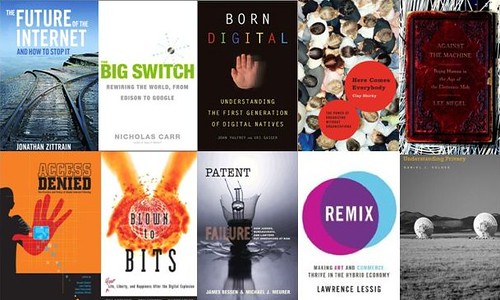
What qualifies as an “important” tech policy book? Basically, it’s a title that many people in this field are currently discussing and that we will likely be talking about for many years to come. I want to make it clear, however, that merely because a book appears on this list it does not necessarily mean I agree with everything said in it. In fact, I found much with which to disagree in my picks for the two most important books of 2008, as well as many of the other books on the list. [Moreover, after reading all these books, I am more convinced than ever that libertarians are badly losing the intellectual battle of ideas over Internet issues and digital technology policy. There’s just very few people defending a “Hands-Off-the-Net” approach anymore. But that’s a subject for another day!]
Another caveat: Narrowly focused titles lose a few points on my list. For example, as was the case in past years, a number of important IP-related books have come out this year. If a book deals exclusively with copyright or patent issues, it does not exactly qualify as the same sort of “tech policy book” as other titles found on this list since it is a narrow exploration of just one set of issues that have a bearing on digital technology policy. The same could be said of a book that deals exclusively with privacy policy, like Solove’s
Understanding Privacy. It’s an important book with implications for the future of tech policy, but I demoted it a bit because of its narrow focus.
With those caveats in mind, here are my Top 10 Most Important Tech Policy Books of 2008 (and please let me know about your picks for book of the year):
Continue reading →
A few months ago, I penned a mega book review about the growing divide between “Internet optimists and pessimists.” I noted that the Internet optimists — people like Chris Anderson, Clay Shirky, Yochai Benkler, Kevin Kelly, and others — believe that the Internet is generally improving our culture, economy, and society for the better. They believe the Net has empowered and liberated the masses, sparked unparalleled human creativity and communication, provided greater personalization and customization of media content, and created greater diversity of thought and a more deliberative democracy. By contrast, the Internet pessimists — including Nick Carr, Andrew Keen, Lee Siegel, and others — argue that the Internet is destroying popular culture and professional media, calling “truth” and “authority” into question by over-glamorizing amateurism and user-generated content, and that increased personalization is damaging deliberative democracy by leading to homogenization, close-mindedness, and an online echo-chamber. Needless to say, it’s a very heated debate!
I am currently working on a greatly expanded version of my “Net optimists vs. pessimists” essay for a magazine in which I will draw out more of these distinctions and weigh the arguments made by those in both camps. I plan on concluding that article by arguing that the optimists generally have the better of the argument, but that the pessimists make some fair points about the downsides of the Net’s radically disintermediating role on culture and economy.
So, this got me thinking that I needed to come up with some sort of a label for my middle-of-the-road position as well as a statement of my personal beliefs. As far as labels go, I guess I would call myself a “pragmatic optimist” since I generally side with the optimists in most of these debates, but not without some occasional reservations. Specifically, I don’t always subscribe to the Pollyanna-ish, rose-colored view of the world that some optimists seem to adopt. But the outright Chicken Little-like Ludditism of some Internet pessimists is even more over-the-top at times. Anyway, what follows is my “Pragmatic (Internet) Optimist’s Creed” which better explains my views. (Again, read my old essay first for some context about the relevant battle lines in this intellectual war).
Continue reading →
Somewhere between Nick Carr’s “Typology of Network Strategies” and Chris Anderson’s “Four Kinds of Free” is the secret to understanding our new economy:
Carr’s “Typology of Network Strategies”:
- Network effect
- Data mining
- Digital sharecropping, or “user-generated content”
- Complements
- Two-sided markets
- Economies of scale, economies of scope, and experience
Anderson’s “Four Kinds of Free”:
- Direct cross-subsidy (get one thing free, pay for another)
- Ad-supported (third-party subsidizes second party)
- “Freemium” (a few people subsidize everyone else)
- “Gift economy” (people give away things for non-monetary rewards)
Of course, both Carr and Anderson are building on theories and business models previously articulated by many others. A few that come to mind:

 The Technology Liberation Front is the tech policy blog dedicated to keeping politicians' hands off the 'net and everything else related to technology.