I’m pleased to report that the Mercatus Center at George Mason University has just released a new white paper on video marketplace regulation and the ongoing “retrans” wars by one of America’s leading media economists, Bruce M. Owen. Owen’s new paper, “Consumer Welfare and TV Program Regulation,” examines the lamentable history of misguided federal interventions into America’s video marketplace. Owen also explores to possibility of deregulating this marketplace via the important new Scalise-DeMint bill, “The Next Generation Television Marketplace Act.” If you’re following these issues, Owen’s paper is must-reading. Here’s the abstract:
Getting rid of obsolete regulation of the broadcast and distribution of video programming is essential to the efficient operation of a market that has the potential to greatly increase the benefits to consumers. Services that increase video program distribution capacity have been delayed and suppressed for many years, and consumer benefits were lost as the Federal Communications Commission (FCC) pursued ill-defined and ephemeral “public interest” and “localism” objectives.
It is past time to stop extending interventions originally intended for old technology to a range of new competitive media. No longer is there any rational public policy basis for a government agency to dictate how much or what content the viewing public can see, any more than there ever has been for printed media. There is no market failure to which the current regulatory framework is responding and no longer any reason for FCC bureaucrats to decide how much of the spectrum should be used for each of many existing and future commercial services. Spectrum reform, along with the repeal of other broadcast programming restrictions contained in the proposed Scalise-DeMint Next Generation Television Marketplace Act, provide a roadmap for the necessary reform. With an adequate supply of tradable rights in spectrum, we will find out how much additional competition is possible among traditional wired and wireless, analog and digital, and fixed and mobile delivery services.
Read the entire thing here [PDF], and you might also be interested in this Forbes column (“Toward a True Free Market in Television Programming“) and these two blog posts of mine (1, 2) on the retrans wars.
Last week, it was my great honor to speak at the 2011 State of the Net 2011 event, where I participated in a panel discussion about the future of the online video marketplace. In an earlier essay, I mentioned how some of the discussion that day revolved around the Comcast-NBCU merger, which had just been approved by the FCC, but with unprecedented strings being attached. The heart of the panel discussion, however, was a debate about the future of online video and regulation of the video marketplace more generally. Also joining me on the panel were Susan Crawford of Cardozo Law School, William Lehr of MIT, Marvin Ammori of Nebraska Law School, and Richard Bennett of ITIF.
http://www.youtube.com/v/Och8X_8AYMQ?fs=1&hl=en_US
During my response time on the panel, which begins around 28:45 of the video, I made a couple of key points: Continue reading →
At this week’s excellent State of the Net 2011 event, I participated in a panel discussion about the future of the online video marketplace. Unsurprisingly, a great deal of time was spent discussing the Federal Communications Commission’s (FCC) recent approval of the proposed merger of Comcast and NBC Universal (NBCU). On Tuesday, the agency voted 4-1 to approve the deal with myriad conditions and “voluntary” concessions being attached. The FCC voted on the matter and issued a short press release and late today issued its final 279-page order.
The Commission’s Comcast-NBCU order represents an unprecedented regulatory shakedown of a company that obviously would have done just about anything to gain approval of the deal. I believe the conditions the FCC has imposed on the deal, which are to run for seven years, are tantamount to a death by a thousand cuts for the deal and, ultimately, could lead to its failure. That’s because the requirements placed on the new entity make it practically impossible for Comcast to leverage the content it is acquiring from NBCU and profit from it such that they can recoup the significant costs associated with the deal.
In essence, Comcast-NBCU was forced to preemptively surrender much of its intellectual property rights by agreeing to share most of their content properties with others on terms someone else will determine. That’s a recipe for disaster. If Comcast-NBCU doesn’t have the right and ability to cut deals on terms that they find advantageous to the company and its shareholders, then why go through with this deal at all? Isn’t the whole point of such a deal with get some additional in-house content properties — something Comcast almost completely lacked previously — such that it would have some content gems to highlight and leverage in an attempt to attract new customers (or just keep old ones)? If someone else is constantly setting the terms of their deals, it will limit the inherent value of the IP owned by Comcast-NBCU and sap most of the value from the deal. Continue reading →
 When the history books are finally written documenting America’s failed experiment with broadcast industry content regulation, this past week may go down as a critical moment in the story. The obvious reason this week was so important was the Senate’s 87-11 vote on Thursday to prevent the Federal Communications Commission (FCC) from reinstating the Fairness Doctrine. But an equally important development this past week was the release of a new white paper by the radical Leftist activist group Free Press.
The Free Press, which was founded by the socialist media theorist Robert McChesney, doesn’t typically publish many things admitting to the failures of coercive government regulation. Nonetheless, in “The Fairness Doctrine Distraction,” a paper by Josh Silver and Marvin Ammori, the media reformistas at Free Press told their Big Government comrades in Congress and academia that it was finally OK to let go of at least this one old pet project of theirs. In their paper, Silver and Ammori note that, “The Fairness Doctrine put the federal government in the position of judging content and controlling speech” and “Reinstating the Doctrine will not result in greater viewpoint diversity in broadcasting.” They continue:
The Fairness Doctrine, while originally well-intentioned, is not wise public policy. [T]he Doctrine places the FCC in charge of determining what is fair in political speech — a difficult task in the best of circumstances. Placing the government in the role of monitoring and judging political speech will inevitably produce controversy that is impossible to resolve.
I applaud the Free Press for finally fessing up to the Fairness Doctrine’s many failings. This First Amendment-violating abomination should have never been allowed to be enforced by the FCC to begin with, but at least we can now all finally agree it should stay off the books for good.
Of course, the radicals at the (Un)Free Press weren’t about to let one of the Left’s old favorite regulations go so away without asking for something in return. One of the reasons that Silver and Ammori are suddenly willing to give their blessing to the Doctrine’s burial is because they want to get on with the more far-reaching agenda of micro-managing media markets using a variety of less visible regulations.
Continue reading →
Matt Lasar of Ars
tells us not to worry about the Fairness Doctrine being revived, only to go on and cite several lawmakers who have said they’d like to revive it. Meanwhile, over at the American Spectator, somebody called “The Prowler” seems to have all sorts of unnamed sources on the Hill telling him the Fairness Doctrine will be revived any day now.
Who knows what to believe. But let’s keep our eye on the real issue here. The danger is not that the Fairness Doctrine gets back on the books in the same form; it’s that versions of it sneak in through the back door via other regulatory initiatives. As Cord Blomquist pointed out here last April, “localism is the new Fairness Doctrine.” There are a lot of people are running around Washington today insisting that government must intervene in the marketplace to “save media localism” and “strengthen the public interest obligations” of local TV and radio broadcasters. There’s been an FCC proceeding open on this issue for some time, and everything about it reeks of the Fairness Doctrine in drag.
This effort is being spearheaded by the media reformistas whose short-term goal is to reinvigorate the amorphous “public interest standard” such that the FCC has open-ended powers to regulate everything under the sun going forward. That’s why a key part of the “localism” battle is their effort to breathe new life into “ascertainment rules,” which used to be more formal and required broadcasters to strictly report everything they aired and did in their communities. There’s lots of talk of ensuring more “accountability” from broadcasters regarding how they serve their local communities, and there’s even rumblings of “local community boards” who will sit as mini-free speech Star Chambers and pass judgment on whether local media outlets are doing their job. Again, it’s all just the Fairness Doctrine by another name. Continue reading →
Jesse Walker has a terrific feature story looking “Beyond the Fairness Doctrine” in this month’s issue of Reason magazine. I highly recommend it. It’s an in-depth exploration of what an Obama Administration means for the future of tech and media policy. Walker rightly opens the piece by noting that “The fairness doctrine is still dead, and it probably will stay dead even if Barack Obama becomes president.” The danger, however, is that an Obama FCC will still pursue a variety of onerous regulatory objectives that could do a great deal of damage to markets and free speech.
Walker touches upon the various issues that will likely be a priority for an Obama Administration and the Left-leaning media reformistas like Free Press, Media Access Project, Public Knowledge, and New America Foundation. Those policy issues include: net neutrality, “localism” mandates and increased “community oversight” regulations, media ownership rules, minority ownership requirements, increased merger meddling, spectrum policy, and other new “public interest” obligations.
Of course, as Walker also correctly points out, it is difficult to see how things could get much worse than they have been under Bush Administration’s FCC and the leadership of Chairman Kevin Martin. Walker was kind enough to quote my thoughts on this point: “Martin is the most regulatory Republican FCC Chairman in decades,” I told him. “He wants to control speech and will use whatever tools he has to get there.”
I stand by those words, but I am also aware that things could get worse — much worse — under a Democratic FCC influenced by radical Leftist activists like Free Press. Indeed, in our new book A Manifesto for Media Freedom, Brian Anderson and I inventory the many looming threats to media and technology freedom that exist today and show how most of them arise from the Left. As Walker notes in his article, however, it is unlikely that a re-empowered Democratic FCC would come right out of the gates with the same sort of command-and-control approaches they’ve employed in the past. And we’ll still have to worry about some right-of-center lawmakers and regulatory joining some of these misguided campaigns. “The real danger,” Walker concludes in his piece, “is more subtle and more mundane. It’s a bipartisan bureaucracy slowly, steadily increasing its power.” Make sure to read Jesse’s entire piece. Great stuff.
Back in the mid- and even late 1990s, I was engaged in a lot of dreadfully boring telecom policy debates in which the proponents of regulation flatly refused to accept the argument that the hegemony of wireline communications systems would ever be seriously challenged by wireless networks. Well, we all know how that story is playing out today. People are increasingly “cutting the cord” and opting to live a wireless-only existence. For example, this recent Nielsen Mobile study on wireless substitution reports that, although only 4.2% of homes were wireless-only at the end of 2003…
At the end of 2007, 16.4 percent of U.S. households had abandoned their landline phone for their wireless phone, but by the end of June 2008, just 6 months later, that number had increased to 17.1 percent. Overall, this percentage has grown by 3-4 percentage points per year, and the trend doesn’t seem to be slowing. In fact, a Q4 2007 study by Nielsen Mobile showed that an additional 5 percent of households indicated that they were “likely” to disconnect their landline service in the next 12 months, potentially increasing the overall percentage of wireless-only households to nearly 1 in 5 by year’s end.
And one wonders about how many homes are like mine — we just keep the landline for emergency purposes or to redirect phone spam to that number instead of giving out our mobile numbers. Beyond that, my wife and I are pretty much wireless-only people and I’m sure there’s a lot of others like us out there.
Anyway, I’ve been having a strange feeling of deva vu lately as I’ve been engaging in policy debates about the future of the video marketplace. Like those old telecom debates of the last decade, we are now witnessing a similar debate — and set of denials — playing out in the video arena. Many lawmakers and regulatory advocates (and even some industry folks) are acting as if the old ways of doing business are the only ways that still count. In reality, things are changing rapidly as video content continues to migrate online.
I was reminded of that again this weekend when I was reading Nick Wingfield’s brilliant piece in the
Wall Street Journal entitled “Turn On, Tune Out, Click Here.” It is must-reading for anyone following development in this field. As Wingfield notes:
Continue reading →
Over on the Poynter Online blog, Amy Gahran has a very smart piece on some of the confusion surrounding debates about “media localism.” In her essay asking “How Important is Local, Really?”, she challenges some of the assumptions underlying the Knight Foundation’s new Commission on the Information Needs of Communities in a Democracy.
I particularly like her line about how, “in many senses, ‘local’ is just one set of ripples on the lake of information — especially when it comes to ‘news.’ And for many people, it’s not even the biggest or most important set of ripples.” That is exactly right. Today, local choices are just a few more choices along the seemingly endless continuum of media choices. It’s foolish to assume that “media localism”
in a geographic sense is as important now as it was in the past for the reasons Gahran makes clear in her essay:
I’m glad that the Knight Foundation is asking basic questions about what kinds of information people need support community and democracy. However, I question the Commission’s strong focus on geographically defined local communities. It seems to me that with the way the media landscape has been evolving, geographically defined local communities are becoming steadily less crucial from an information perspective. I suspect that defining communities by other kinds of commonalities (age, economic status/class, interests, social circles, etc.) would be far more relevant to more people — although more complex to define.
Continue reading →
Terrific piece here from Ed Felten on how new technologies and cultural trends are undermining traditional conceptions of “media localism.” It’s a theme I have written on at length, most recently in this essay on “Our Continued Wishful Thinking about ‘Media Localism‘.” Anyway, as Felten correctly notes in the conclusion of his essay:
New technologies undermine the rationale for localist policies. It’s easier to get far-away content now — indeed the whole notion that content is bound to a place is fading away. With access to more content sources, there are more possible venues for local programming, making it less likely that local programming will be unavailable because of the whims or blind spots of a few station owners. It’s getting easier and cheaper to gather and distribute information, so more people have the means to produce local programming. In short, we’re looking at a future with more non-local programming and more local programming.
That’s exactly right. As Grant Eskelsen and I argue in Chapter 6 of our new Media Metrics book:
The decline of “localism” in media is a much-lamented but quite natural phenomenon as citizens gain access to news and entertainment sources of broader scale and scope. Although it is impossible to scientifically measure exactly how much “local” fare citizens demand—and defining the term is another challenge—we know that they still receive a wealth of information about developments in their communities. However, it is also evident that, left to their own devices, many citizens have voluntarily flocked to national (and even international) sources of news and entertainment. […]
[But] the demise of “localism” has been greatly exaggerated. The
relative decline in local media is simply a natural development resulting from the voluntary choices made by millions of American citizens, but the tools for producing, distributing, and acquiring local content are more robust than ever.
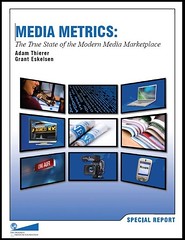 Faithful readers will recall that, several months ago, I penned a 7-part “Media Metrics” series that took a hard look at the health of the media marketplace. Today, the Progress & Freedom Foundation is releasing a greatly expanded version of these essays that I have put together with my PFF colleague Grant Eskelsen. In this 100-page special report, “Media Metrics: The True State of the Modern Media Marketplace,” we begin by noting that heated debates about the state of the media marketplace continue to rage in Washington, and opinions seem to range from grim to outright apocalyptic. As we note on pg. 1:
Many people—including a large number of legislators and regulators—argue that America’s media marketplace is in a miserable state. Some claim that citizens lack choice in media outlets and that options are just as scarce as ever. Others believe that media “localism” is dead or that many groups or niches go underserved because of a lack of true “diversity” in media. Others argue that the market is hopelessly over-concentrated in the hands of a few evil media barons who are hell-bent on force-feeding us corporate propaganda. And still others say that the quality of news and entertainment in our society has deteriorated because of a combination of all of the above. It all sounds quite troubling, but is any of it true?
After taking an objective look at the true state of America’s media marketplace, we conclude that such pessimism is unwarranted. Indeed, a careful review of the facts reveals that—contrary to what those media critics suggest—we have more media choice, more media competition, and more media diversity than ever before. Indeed, to the extent there was ever a “golden age” of media in America, we are living in it today. The media sky has never been brighter and it is getting brighter with each passing year.
Continue reading →

 The Technology Liberation Front is the tech policy blog dedicated to keeping politicians' hands off the 'net and everything else related to technology.