PFF has just published the transcript for an event we hosted last month asking “What Should the Next Communications Act Look Like?” The event featured (in order of appearance) Link Hoewing of Verizon, Walter McCormick of US Telecom, Peter Pitsch of Intel, Barbara Esbin, Ray Gifford of Wilkinson, Barker, Knauer, and Michael Calabrese of the New America Foundation. It was a terrific discussion and it couldn’t have been more timely in light of recent regulatory developments at the FCC. The folks at NextGenWeb were kind enough to make a video of the event and post it online along with a writeup, so I’ve included that video along with the event transcript down below the fold. Continue reading →
Last week I commented on a severely one-sided FCC net neutrality hearing that featured a endless parade of horribles being prophesied by virtually every speaker. The litany of spooky stories became tedious and absurd. Everyone foretold of the impending doom that awaits unless government intervenes to save us from various corporate conspiracies to “silence” our voices. Unsurprisingly, evidence was in short supply. It was pure Chicken Little poppycock.
This got me thinking again about what I have referred to as the “problem of proportionality.” I have discussed the problem of proportionality in the context of public policy debates about online safety and privacy, but it seems equally applicable to debates about net neutrality. Here’s how I explained the “problem of proportionality” in an earlier essay:
let’s think about how some of our lawmakers and media personalities talk about the Internet. If we were to judge the Internet based upon the daily headlines in various media outlets or from the titles of various Congressional or regulatory agency hearings, then we’d be led to believe that the Internet is a scary, dangerous place. That ’s especially the case when it comes to concerns about online privacy and child safety. Everywhere you turn there’s a bogeyman story about the supposed dangers of cyberspace. But let’s go back to the numbers. While I certainly understand the concerns many folks have about their personal privacy or their child’s safety online, the fact is the vast majority of online transactions that take place online each and every second of the day are of an entirely harmless, even socially beneficial nature. I refer to this disconnect as the “problem of proportionality” in debates about online safety and privacy. People are not just making mountains out of molehills, in many cases they are just making the molehills up or blowing them massively out of proportion.
Again, much the same is true of net neutrality. Indeed, it is even
more true since actual net neutrality “incidents” are so hard to come by. Continue reading →
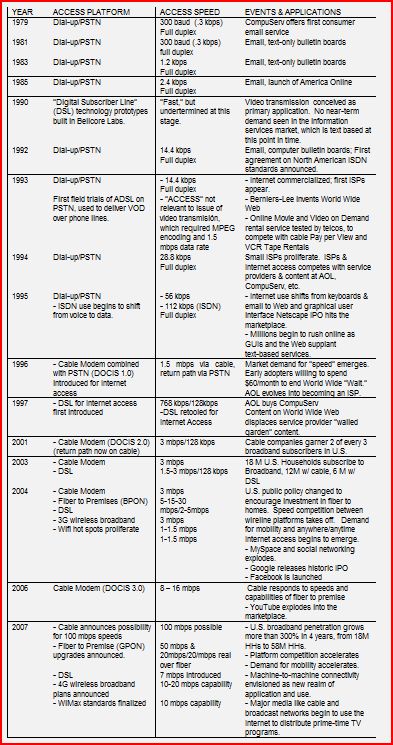
Very useful chart over on the Verizon policy blog put together by Link Hoewing and Larry Plumb. Link uses it illustrate the changes we have seen over the past three decades in terms of Internet access platforms and speeds. It’s too small to read here, so make sure to go there to see it more clearly and also see Link’s interesting discussion.

 The Technology Liberation Front is the tech policy blog dedicated to keeping politicians' hands off the 'net and everything else related to technology.