Posts tagged as:

I was my pleasure to appear on the latest episode of the Dissed podcast to discuss economic liberty and the right to earn a living. The show was hosted by Anastasia Boden and Elizabeth Slattery of the Pacific Legal Foundation and it included legal scholars Hadley Arkes, Timothy Sandefur, and Clark Neily. I appear in the second half of the program.

I’ve spent many years writing about the relationship between innovation, entrepreneurialism, economic liberty, and the right to earn a living. My latest book (Evasive Entrepreneurs) and previous one (Permissionless Innovation) devoted considerable attention to this. But I tried to bring it all down to just a few hundred words in my 2018 essay, “The Right to Pursue Happiness, Earn a Living, and Innovate.”

I’ve reprinted that down below, but please make sure to click over to the  Dissed page and listen to that excellent podcast.

Continue reading →

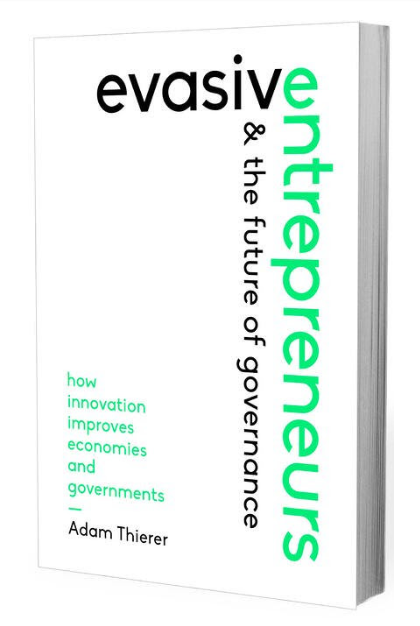
My latest book, Evasive Entrepreneurs and the Future of Governance How Innovation Improves Economies and Governments, is now live. Here’s the launch essay and online launch event. Also, here’s a summary of 10 major arguments advanced in the book. I will have more to say about the book in coming weeks, but here is a list of 13 key terms discussed in the text. This list appears at the end of the introduction to the book:

  1. Compliance paradox: The situation in which heightened legal or regulatory efforts fail to reverse unwanted behavior and instead lead to increased legal evasion and additional enforcement problems.
  2. Demosclerosis: Growing government dysfunction brought on by the inability of public institutions to adapt to change, especially technological change.
  3. Evasive entrepreneurs: Innovators who do not always conform to social or legal norms.
  4. Free innovation: Bottom-up, noncommercial forms of innovation that often take on an evasive character. Free innovation is sometimes called “grassroots” or “household” innovation or “social entrepreneurialism.” Even though it is typically noncommercial in character, free innovation often involves regulatory entrepreneurialism and technological civil disobedience.
  5. Innovation arbitrage: The movement of ideas, innovations, or operations to jurisdictions that provide legal and regulatory environments most hospitable to entrepreneurial activity. It can also be thought of as a form of jurisdictional shopping and can be facilitated by competitive federalism.
  6. Innovation culture: The various social and political attitudes and pronouncements toward innovation, technology, and entrepreneurial activities that, taken together, influence the innovative capacity of a culture or nation.
  7. Pacing problem: A term that generally refers to the inability of legal or regulatory regimes to keep up with the intensifying pace of technological change.
  8. Permissionless innovation: The general notion that “it’s easier to ask forgiveness than it is to get permission.” As a policy vision, it refers to the idea that experimentation with new technologies and innovations should generally be permitted by default.
  9. Precautionary principle: The practice of crafting public policies to control or limit innovations until their creators can prove that they will not cause any harm or disruptions.
  10. Regulatory entrepreneurs: Evasive entrepreneurs who set out to intentionally challenge and change the law through their innovative activities. In essence, policy change is part of their business model.
  11. Soft law: Informal, collaborative, and constantly evolving governance mechanisms that differ from hard law in that they lack the same degree of enforceability.
  12. Technological civil disobedience: The technologically enabled refusal of individuals, groups, or businesses to obey certain laws or regulations because they find them offensive, confusing, time-consuming, expensive, or perhaps just annoying and irrelevant.
  13. Technologies of freedom: Devices and platforms that let citizens openly defy (or perhaps just ignore) public policies that limit their liberty or freedom to innovate. Another term with the same meaning is “technologies of resistance.”

I’m pleased to announce that the Cato Institute has just published my latest book, Evasive Entrepreneurs and the Future of Governance How Innovation Improves Economies and Governments. Here’s my introductory launch essay about the book as well as the online launch event. And here’s a list of 13 key terms used throughout the book.

In coming days and weeks I will be occasionally blogging about different arguments made in the 368-page book, but here’s a quick summary of some of the key points I make in the book. These ten passages are pulled directly from the text:

  1. “the freedom to innovate is essential to human betterment for each of us individually and for civilization as a whole. That freedom deserves to be taken more seriously today.”
  2. “Entrepreneurialism and technological innovation are the fundamental drivers of economic growth and of the incredible advances in the everyday quality of life we have enjoyed over time. They are the key to expanding economic opportunities, choice, and mobility.”
  3. “Unfortunately, many barriers exist to expanding innovation opportunities and our entrepreneurial efforts to help ourselves, our loved ones, and others. Those barriers include occupational licensing rules, cronyism-based industrial protectionist schemes, inefficient tax schemes, and many other layers of regulatory red tape at the federal, state, and local levels. We should not be surprised, therefore, when citizens take advantage of new technological capabilities to evade some of those barriers in pursuit of their right to earn a living, to tinker with or try doing new things, or just to learn about the world and serve it better.”
  4. “Evasive entrepreneurs rely on a strategy of permissionless innovation in both the business world and the political arena. They push back against ‘the Permission Society,’ or the convoluted labyrinth of permits and red tape that often encumber entrepreneurial activities.” 
  5. “We should be willing to tolerate a certain amount of such outside-the-box thinking because entrepreneurialism expands opportunities for human betterment by constantly replenishing the well of important, life-enhancing ideas and applications.”
  6. “we should better appreciate how creative acts and the innovations they give rise to can help us improve government by keeping public policies fresh, sensible, and in line with common sense and the consent of the governed.”
  7. “Evasive entrepreneurialism is not so much about evading law altogether as it is about trying to get interesting things done, demonstrating a social or an economic need for new innovations in the process, and then creating positive leverage for better results when politics inevitably becomes part of the story. By acting as entrepreneurs in the political arena, innovators expand opportunities for themselves and for the public more generally, which would not have been likely if they had done things by the book.”
  8. “Dissenting through innovation can help make public officials more responsive to the people by reining in the excesses of the administrative state, making government more transparent and accountable, and ensuring that our civil rights and economic liberties are respected.”
  9. “In an age when many of the constitutional limitations on government power are being ignored or unenforced, innovation itself can act as a powerful check on the power of the state and can help serve as a protector of important human liberties.”
  10. “Lawmakers and regulators need to consider a balanced response to evasive entrepreneurialism that is rooted in the realization that technology creators and users are less likely to seek to evade laws and regulations when public policies are more in line with common sense.”

Continue reading →

Future and Its Enemies cover Technologies of FreedomI was honored to be asked by the editors at Reason magazine to be a part of their “Revolutionary Reading” roundup of “The 9 Most Transformative Books of the Last 45 Years.”  Reason is celebrating its 45th anniversary and running a wide variety of essays looking back at how liberty has fared over the past half-century. The magazine notes that “Statism has hardly gone away, but the movement to roll it back is stronger than ever.” For this particular feature, Reason’s editors “asked seven libertarians to recommend some of the books in different fields that made [the anti-statist] cultural and intellectual revolution possible.”

When Jesse Walker of Reason first contacted me about contributing my thoughts about which technology policy books made the biggest difference, I told him I knew exactly what my choices would be: Ithiel de Sola Pool’s Technologies of Freedom (1983) and Virginia Postrel’s The Future and Its Enemies (1998). Faithful readers of this blog know all too well how much I love these two books and how I am constantly reminding people of their intellectual importance all these years later. (See, for example, this and this.) All my thinking and writing about tech policy over the past two decades has been shaped by the bold vision and recommendations set forth by Pool and Postrel in these beautiful books.

As I note in my Reason write-up of the books: Continue reading →

Nate Anderson of Ars Technica has posted an interview with Sen. Al Franken (D-MN) about Defining Internet “Freedom”. Neither Sen. Franken nor Mr. Anderson ever get around to defining that term in their exchange, but the clear implication from the piece is that “freedom” means freedom for the government to plan more and for policymakers to more closely monitor and control the Internet economy.  The clearest indication of this comes when Sen. Franken repeats the old saw that net neutrality regulation is “the First Amendment issue of our time.”

As a lover of liberty, I find this corruption of language and continued debasement of the term “freedom” to be extremely troubling. The thinking we see at work here reflects the ongoing effort by many cyber-progressives (or “cyber-collectivists,” as I prefer to call them) to redefine Internet freedom as liberation from the supposed tyranny of the marketplace and the corresponding empowerment of techno-cratic philosopher kings to guide us toward a more enlightened and noble state of affairs. We are asked to ignore our history lessons, which teach us that centralized planning and bureaucracy all too often lead to massively inefficient outcomes, myriad unforeseen unintended consequences, bureaucratic waste, and regulatory capture.  Instead, we are asked to believe that high-tech entrepreneurs are the true threat to human progress and liberty. They are cast as nefarious villains and their innovations, we are told, represent threats to our “freedom.” We even hear silly comparisons likening innovators like Apple to something out of George Orwell’s 1984.  Continue reading →

Over at MediaFreedom.org, a new site devoted to fighting the fanaticism of radical anti-media freedom groups like Free Press and other “media reformistas,” I’ve started rolling out a 5-part series of essays about “The Battle for Media Freedom.” In Part 1 of the series, I defined what real media freedom is all about, and in Part 2 I discussed the rising “cyber-collectivist” threat to media freedom.  In my latest installment, I offer an analytical framework that better explains the major differences between the antagonists in the battle over media freedom.

Understanding the Origins of Political Struggles

In his many enlightening books, Thomas Sowell, a great economist and an even better political scientist, often warns of the triumph of good intentions over good economics. It’s a theme that F.A. Hayek and Milton Friedman both developed extensively before him. But Sowell has taken this analysis to an entirely differently level in books like A Conflict of Visions: Ideological Origins of Political Struggles, and The Vision of the Anointed: Self-Congratulation as a Basis for Social Policy . Sowell teaches us that no matter how noble one’s intentions might be, it does not mean that those ideas will translate into sound public policy. Nonetheless, since “the anointed” believe their own intentions are pure and their methods are sound, they see nothing wrong with substituting their will for the will of millions of individuals interacting spontaneously and voluntarily in the marketplace. The result is an expansion of the scope of public decision-making and a contraction of the scope of private, voluntary action. As a result, mandates replace markets, and freedom gives way central planning.

Sowell developed two useful paradigms to help us better understand “the origins of political struggles.” He refers to the “constrained” versus “unconstrained” vision and separates these two camps according to how they view the nature of man, society, economy, and politics:

“Constrained Vision” “Unconstrained Vision”
Man is inherently constrained; highly fallible and imperfect Man is inherently unconstrained; just a matter of trying hard enough; man & society are perfectible
Social and economic order develops in bottom-up, spontaneous fashion. Top down planning is hard because planners aren’t omnipotent. Order derives from smart planning, often from top-down. Elites can be trusted to make smart social & economic interventions.
Trade-offs & incentives matter most; wary of unintended consequences Solutions & intentions matter most; less concern about costs or consequences of action
Opportunities count more than end results; procedural fairness is key; Liberty trumps Outcomes matter most; distributive or “patterned” justice is key; Equality trumps liberty
Prudence and patience are virtues. There are limits to human reason. Passion for, and pursuit of, high ideals trumps all. Human reason has boundless potential.
Law evolves and is based on the experience of ages. Law is made by trusted elites.
Markets offer benefit of experience & experimentation and help develop knowledge over time. Markets cannot ensure desired results; must be superseded by planning & patterned justice
Exponents: Aristotle, Adam Smith, Edmund Burke, James Madison, Lord Acton, F.A. Hayek, Ludwig von Mises, Milton Friedman, James Buchanan, Robert Nozick Exponents: Plato, Rousseau, William Godwin, Voltaire, Robert Owen, John Kenneth Galbraith, John Dewey, Earl Warren, Bertrand Russell, John Rawls

Continue reading →

Forbes.com has just published an editorial that Berin Szoka and I penned about yesterday’s net neutrality announcement from the FCC.

The Day Internet Freedom Died

by Adam Thierer & Berin Szoka

There was a time, not so long ago, when the term “Internet Freedom” actually meant what it implied: a cyberspace free from over-zealous legislators and bureaucrats. For a few brief, beautiful moments in the Internet’s history (from the mid-90s to the early 2000s), a majority of Netizens and cyber-policy pundits alike all rallied around the flag of “Hands Off the Net!” From censorship efforts, encryption controls, online taxes, privacy mandates and infrastructure regulations, there was a general consensus as to how much authority government should have over cyber-life and our cyber-liberties. Simply put, there was a “presumption of liberty” in all cyber-matters.

Those days are now gone; the presumption of online liberty is giving way to a presumption of regulation. A massive assault on real Internet freedom has been gathering steam for years and has finally come to a head. Ironically, victory for those who carry the banner of “Internet Freedom” would mean nothing less than the death of that freedom.

We refer to the gradual but certain movement to have the federal government impose “neutrality” regulation for all Internet actors and activities—and in particular, to yesterday’s announcement by Federal Communications Commission (FCC) Chairman Julius Genachowski that new rules will be floated shortly. “But wait,” you say, “You’re mixing things up! All that’s being talked about right now is the application of ‘simple net neutrality,’ regulations for the infrastructure layer of the net.” You might even claim regulations are not really regulation but pro-freedom principles to keep the net “free and open.”

Such thinking is terribly short-sighted. Here is the reality: Because of the steps being taken in Washington right now, real Internet Freedom—for all Internet operators and consumers, and for economic and speech rights alike—is about to start dying a death by a thousand regulatory cuts. Policymakers and activists groups are ramping up the FCC’s regulatory machine for a massive assault on cyber-liberty. This assault rests on the supposed superiority of common carriage regulation and “public interest” mandates over not just free markets and property rights, but over general individual liberties and freedom of speech in particular. Stated differently, cyber-collectivism is back in vogue—and it’s coming very soon to a computer near you! Continue reading →

Mill On Liberty John Stuart Mill’s On Liberty turns 150 this year. Published in 1859, this slender manifesto for human liberty went on to become a classic of modern philosophy and political science.  It remains a beautiful articulation of the core principles of human liberty and a just society.

Anyone familiar with the book recognizes the importance of the opening chapter and Mill’s “one very simple principle” for “the dealings of society with the individual in the way of compulsion and control, whether the means used be physical force in the form of legal penalties, or the moral coercion of public opinion”:

That principle is, that the sole end for which mankind are warranted, individually or collectively, in interfering with the liberty of action of any of their number, is self-protection. That the only purpose for which power can be rightfully exercised over any member of a civilized community, against his will, is to prevent harm to others. His own good, either physical or moral, is not a sufficient warrant. He cannot rightfully be compelled to do or forbear because it will be better for him to do so, because it will make him happier, because, in the opinions of others, to do so would be wise, or even right. These are good reasons for remonstrating with him, or reasoning with him, or persuading him, or entreating him, but not for compelling him, or visiting him with any evil in case he do otherwise. To justify that, the conduct from which it is desired to deter him, must be calculated to produce evil to some one else. The only part of the conduct of any one, for which he is amenable to society, is that which concerns others. In the part which merely concerns himself, his independence is, of right, absolute. Over himself, over his own body and mind, the individual is sovereign.

Mill went on to outline “the appropriate region of human liberty,” and divided it into:

  1. liberty of conscience, in the most comprehensive sense; liberty of thought and feeling; absolute freedom of opinion and sentiment on all subjects, practical or speculative, scientific, moral, or theological. The liberty of expressing and publishing opinions may seem to fall under a different principle, since it belongs to that part of the conduct of an individual which concerns other people; but, being almost of as much importance as the liberty of thought itself, and resting in great part on the same reasons, is practically inseparable from it.”
  2. liberty of tastes and pursuits; of framing the plan of our life to suit our own character; of doing as we like, subject to such consequences as may follow: without impediment from our fellow-creatures, so long as what we do does not harm them, even though they should think our conduct foolish, perverse, or wrong”
  3. freedom to unite, for any purpose not involving harm to others”

Bringing it altogether, he argued:

The only freedom which deserves the name, is that of pursuing our own good in our own way, so long as we do not attempt to deprive others of theirs, or impede their efforts to obtain it. Each is the proper guardian of his own health, whether bodily, or mental and spiritual. Mankind are greater gainers by suffering each other to live as seems good to themselves, than by compelling each to live as seems good to the rest.

To this day, I do not believe there has been a more eloquent or concise summation of the central principles of libertarianism than those passages from Chapter 1 of the book. But what many fail to remember or appreciate is the equally powerful second chapter of Mill’s treatise, “On the Liberty of Thought and Discussion.” It was a bold defense of freedom of speech and expression that was many decades ahead of its time. And it still has lessons and warnings worth heeding in our modern Information Age.

Continue reading →

“Liberty upsets patterns.” That was one of the many lessons that the late Harvard philosopher Robert Nozick taught us in his 1974 masterpiece “Anarchy, State, and Utopia.” What Nozick meant was that there is a fundamental tension between liberty and egalitarianism such that when people are left to their own devices, some forms of inequality would be inevitable and persistent throughout society. (Correspondingly, any attempt to force patterns, or outcomes, upon society requires a surrender of liberty.)

No duh, right? Most people understand this today–even if some of them are all too happy to hand their rights over to the government in exchange for momentary security or some other promise.  In the world of media policy, however, many people still labor under the illusion that liberty and patterned equality are somehow reconcilable. That is, some media policy utopians and Internet pollyannas would like us to believe that if you give every man, woman, and child a platform on which to speak, everyone will be equally heard.  Moreover, in pursuit of that goal, some of them argue government should act to “upset patterns” and push to achieve more “balanced” media outcomes. That is the philosophy that has guided the “media access” movement for decades and it what fuels the “media reformista” movement that is led by groups like the (inappropriately named) Free Press, which was founded by neo-Marxist media theorist Robert McChesney.

Alas, perfect media equality remains an illusive pipe dream. As I have pointed out here before, there has never been anything close to “equal outcomes” when it comes to the distribution or relative success of books, magazines, music, movies, book sales, theater tickets, etc.  A small handful of titles have always dominated, usually according to a classic “power law” or “80-20” distribution, with roughly 20% of the titles getting 80% of the traffic / revenue.  And this trend is increasing, not decreasing, for newer and more “democratic” online media.

For example, recent research has revealed that “the top 10% of prolific Twitter users accounted for over 90% of tweets” and  “the top 15% of the most prolific [Wkipedia] editors account for 90% of Wikipedia’s edits.” As Clay Shirky taught us back in 2003 in this classic essay, the same has long held true for blogging, where outcomes are radically inegalitarian, with a tiny number of blogs getting the overwhelming volume of blogosphere attention.  The reason, Shirky pointed out, is that:

Continue reading →

Post Jeffersons MooseI used to have a (semi-crazy) uncle who typically began conversations with lame jokes or bad riddles. This sounds like one he might have used had he lived long enough: What do Thomas Jefferson, a moose, and cyberspace have in common?

The answer to that question can be found in a new book, In Search of Jefferson’s Moose: Notes on the State of Cyberspace, by David G. Post, a Professor of Law at Temple University. Post, who teaches IP and cyberspace law at Temple, is widely regarded as one of the intellectual fathers of the “Internet exceptionalist” school of thinking about cyberlaw.  Basically, Post sees this place we call “cyberspace” as something truly new, unique, and potentially worthy of some special consideration, or even somewhat different ground rules than we apply in meatspace. More on that in a bit.

[ Full disclosure: Post’s work was quite influential on my own thinking during the late 1990s, so much so that when I joined the Cato Institute in 2000, one of the first things I did was invite David to become an adjunct scholar with Cato. He graciously accepted and remains a Cato adjunct scholar today. Incidentally, Cato is hosting a book forum for him on February 4th that I encourage you to attend or watch online. Anyway, it’s always difficult to be perfectly objective when you know and admire someone, but I will try to do so here.]

Post’s book is essentially an extended love letter — to both cyberspace and Jefferson. Problem is, as Post even admits at the end, it’s tough to know which subject this book is suppose to teach us more about. The book loses focus at times — especially in the first 100 pages — as Post meanders between historical tidbits of Jefferson’s life and thinking and what it all means for cyberspace. But the early focus is on TJ.  Thus, those who pick up the book expecting to be immediately immersed in cyber-policy discussions may be a bit disappointed at first.  As a fellow Jefferson fanatic, however, I found all this history terrifically entertaining, whether it was the story of Jefferson’s Plow and his other agricultural inventions and insights, TJ’s unique interest in science (including cryptography), or that big moose of his.

OK, so what’s the deal with the moose? When TJ was serving as a minister to France in in the late 1780s, at considerable expense to himself, he had the complete skeleton, skin and horns of a massive American moose shipped to the lobby of his Paris hotel. Basically, Jefferson wanted to make a bold statement to his French hosts about this New World he came from and wake them up to the fact that some very exciting things were happening over there that they should be paying attention to. That’s one hell of way to make a statement!

Continue reading →