Posts tagged as:

Future and Its Enemies cover Technologies of FreedomI was honored to be asked by the editors at Reason magazine to be a part of their “Revolutionary Reading” roundup of “The 9 Most Transformative Books of the Last 45 Years.”  Reason is celebrating its 45th anniversary and running a wide variety of essays looking back at how liberty has fared over the past half-century. The magazine notes that “Statism has hardly gone away, but the movement to roll it back is stronger than ever.” For this particular feature, Reason’s editors “asked seven libertarians to recommend some of the books in different fields that made [the anti-statist] cultural and intellectual revolution possible.”

When Jesse Walker of Reason first contacted me about contributing my thoughts about which technology policy books made the biggest difference, I told him I knew exactly what my choices would be: Ithiel de Sola Pool’s Technologies of Freedom (1983) and Virginia Postrel’s The Future and Its Enemies (1998). Faithful readers of this blog know all too well how much I love these two books and how I am constantly reminding people of their intellectual importance all these years later. (See, for example, this and this.) All my thinking and writing about tech policy over the past two decades has been shaped by the bold vision and recommendations set forth by Pool and Postrel in these beautiful books.

As I note in my Reason write-up of the books: Continue reading →

Tom W. Bell, professor of law at Chapman University and author of the concluding essay in Copyright Unbalanced, a new book edited by Surprisingly Free’s own Jerry Brito, discusses the ways in which copyright has evolved over time and why reform is vital.

Bell differentiates copyright from other types of property, arguing that conflating the two terms causes great confusion amongst laypeople and, over time, corrodes the value placed in tangible property rights. According to Bell, copyright is a privilege created by statute that doesn’t exist in a state of nature and is not recognized by common law.

As a special type of economic good, copyright must be treated differently than tangible property rights, according to Bell, who outlines five proposals for copyright reform.

While Bell is not opposed to copyright, he argues that copyright enforcement has gone too far, and lawmakers should structure policies to lead us towards a world in which we conceivably do without it.

Download

Related Links

Earlier this year I read Scott Cleland’s new book, Search & Destroy: Why You Can’t Trust Google, Inc., after he was kind enough to send me an advance copy. I didn’t have time to review it at the time and just jotted down a few notes for use later. Because the year is winding down, I figured I should get my thoughts on it out now before I publish my end of year compendium of important tech policy books.

Cleland is President of Precursor LLC and a noted Beltway commentator on information policy issues, especially Net neutrality regulation, which he has vociferously railed against for many years. On a personal note, I’ve known Scott for many years and always enjoyed his analysis and wit, even when I disagree with the thrust of some of it.

And I’m sad to report that I disagree with most of it in Search & Destroy, a book that is nominally about Google but which is really a profoundly skeptical look at the modern information economy as we know it. Indeed, Cleland’s book might have been more appropriately titled, “Second Thoughts about Cyberspace.” In a sense, it represents an outline for an emerging “cyber-conservative” vision that aims to counter both “cyber-progressive” and “cyber-libertarian” schools of thinking.

After years of having Scott’s patented bullet-point mini-manifestos land in my mailbox, I think it’s only appropriate I write this review in the form of a bulleted list! So, here it goes.. Continue reading →

libertyby Adam Thierer & Berin Szoka — (Ver. 1.0 — Summer 2009)

We are attempting to articulate the core principles of cyber-libertarianism to provide the public and policymakers with a better understanding of this alternative vision for ordering the affairs of cyberspace. We invite comments and suggestions regarding how we should refine and build-out this outline. We hope this outline serves as the foundation of a book we eventually want to pen defending what we regard as “Real Internet Freedom.” [Note:  Here’s a printer-friendly version, which we also have embedded down below as a Scribd document.]

I. What is Cyber-Libertarianism?

Cyber-libertarianism refers to the belief that individuals—acting in whatever capacity they choose (as citizens, consumers, companies, or collectives)—should be at liberty to pursue their own tastes and interests online.

Generally speaking, the cyber-libertarian’s motto is “Live & Let Live” and “Hands Off the Internet!”  The cyber-libertarian aims to minimize the scope of state coercion in solving social and economic problems and looks instead to voluntary solutions and mutual consent-based arrangements.

Cyber-libertarians believe true “Internet freedom” is freedom from state action; not freedom for the State to reorder our affairs to supposedly make certain people or groups better off or to improve some amorphous “public interest”—an all-to convenient facade behind which unaccountable elites can impose their will on the rest of us.

Continue reading →

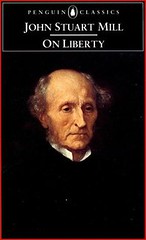
Mill On Liberty John Stuart Mill’s On Liberty turns 150 this year. Published in 1859, this slender manifesto for human liberty went on to become a classic of modern philosophy and political science.  It remains a beautiful articulation of the core principles of human liberty and a just society.

Anyone familiar with the book recognizes the importance of the opening chapter and Mill’s “one very simple principle” for “the dealings of society with the individual in the way of compulsion and control, whether the means used be physical force in the form of legal penalties, or the moral coercion of public opinion”:

That principle is, that the sole end for which mankind are warranted, individually or collectively, in interfering with the liberty of action of any of their number, is self-protection. That the only purpose for which power can be rightfully exercised over any member of a civilized community, against his will, is to prevent harm to others. His own good, either physical or moral, is not a sufficient warrant. He cannot rightfully be compelled to do or forbear because it will be better for him to do so, because it will make him happier, because, in the opinions of others, to do so would be wise, or even right. These are good reasons for remonstrating with him, or reasoning with him, or persuading him, or entreating him, but not for compelling him, or visiting him with any evil in case he do otherwise. To justify that, the conduct from which it is desired to deter him, must be calculated to produce evil to some one else. The only part of the conduct of any one, for which he is amenable to society, is that which concerns others. In the part which merely concerns himself, his independence is, of right, absolute. Over himself, over his own body and mind, the individual is sovereign.

Mill went on to outline “the appropriate region of human liberty,” and divided it into:

  1. liberty of conscience, in the most comprehensive sense; liberty of thought and feeling; absolute freedom of opinion and sentiment on all subjects, practical or speculative, scientific, moral, or theological. The liberty of expressing and publishing opinions may seem to fall under a different principle, since it belongs to that part of the conduct of an individual which concerns other people; but, being almost of as much importance as the liberty of thought itself, and resting in great part on the same reasons, is practically inseparable from it.”
  2. liberty of tastes and pursuits; of framing the plan of our life to suit our own character; of doing as we like, subject to such consequences as may follow: without impediment from our fellow-creatures, so long as what we do does not harm them, even though they should think our conduct foolish, perverse, or wrong”
  3. freedom to unite, for any purpose not involving harm to others”

Bringing it altogether, he argued:

The only freedom which deserves the name, is that of pursuing our own good in our own way, so long as we do not attempt to deprive others of theirs, or impede their efforts to obtain it. Each is the proper guardian of his own health, whether bodily, or mental and spiritual. Mankind are greater gainers by suffering each other to live as seems good to themselves, than by compelling each to live as seems good to the rest.

To this day, I do not believe there has been a more eloquent or concise summation of the central principles of libertarianism than those passages from Chapter 1 of the book. But what many fail to remember or appreciate is the equally powerful second chapter of Mill’s treatise, “On the Liberty of Thought and Discussion.” It was a bold defense of freedom of speech and expression that was many decades ahead of its time. And it still has lessons and warnings worth heeding in our modern Information Age.

Continue reading →

Just before the New Year, Mike Masnick reported:

It’s been well over five years since we first heard about a plan in Oregon to attach GPS devices to cars and tax drivers based on how much they drove and the idea hasn’t become any better in the intervening years… but apparently it’s still being pushed. Oregon’s governor is trying to move forward with the plan.  One of the reasons behind the bill has nothing to do with a more efficient way to tax drivers, but because the state is gaining less revenue from its gas tax since there are more fuel-efficient cars on the roads these days. Of course, rather than reward drivers for driving more fuel efficient cars, this sort of tax punishes them, and actually encourages the use of less fuel efficient vehicles. And, of course, that doesn’t even begin to get into the potential (and likely) privacy problems brought about by any system whereby the government has full access to a GPS system on your car.

This is a great example of the problems that often arise when trying to bring into the digital age areas of the economy monopolized or dominated by government.  There’s a clear (if imperfect) analogy here to Obama’s ambitious goal of digitizing health records:  both are great ideas that raise special privacy concerns because of the heavy involvement of government.  These privacy concerns are certainly not unwarranted:  I wouldn’t want the government to have access to my car’s location or my medical history at any given moment or a complete record of where I’ve driven or what doctors I’ve seen.  But just as relying on paper health records is clearly stupid (and dangerous), it would make a hell of a lot more sense for drivers to pay for road use depending on “where, when and how far they drove”—as in a small pilot project in the UK.

Today, state and Federal taxes on every gallon of gasoline are intended to serve two conflicting purposes—but do a poor job with both.   Continue reading →

Adam Thierer noted in mid-December that the FCC was considering allowing the experimental use of cellphone jammers in prison.  The FCC just issued (PDF) a Special Temporary Authorization to allow the DC Department of Corrections to test a cell phone jamming technology.

This technology sounds like an excellent solution to a serious problem:  The illicit use of cell phones inside correctional facilities by prisoners across the country.  In particular, the technology appears to be “directional,” meaning that unlike traditional jammers, which simply block signals within a certain radius around the jammer, this technology appears to be capable of blocking signals inside the confines of a particular room or building.  In fact, I’m sure millions of Americans would love to see such technologies implemented in cinemas, theatres, and other performing arts venues across the country.  I, for one, am tired of having the exquisite acoustic delicacies of Bach interrupted by annoying ring tones, such as  the (painfully) immortal “Who Let the Dogs Out?”

So Much for The Rule of Law

But there’s one important problem: The FCC isn’t waiving a rule here against cell phone jammer. unless I’m missing some subtle statutory quirk, they’re essentially “waiving” a statute—specifically 47 U.S.C. 333:

No person shall willfully or maliciously interfere with or cause interference to any radio communications of any station licensed or authorized by or under this chapter or operated by the United States Government.

You don’t need to be an administrative lawyer to know that agencies can’t just ignore acts of Congress—no matter how good the policy reason for the waiver is. That’s a big part of what the “rule of law” means.  Period.  Do not pass ‘Go’.  Do not collect $3,101.09 (today’s equivalent of $200 in 1935, when Monopoly debuted).

Fortunately, as noted in the WSJ article Adam cited, at least one legislator realizes this and thinks it’s worth fixing:  U.S. Rep. Kevin Brady (R., Texas) told the Journal that his office is “drafting the necessary legislation to remove this outdated FCC roadblock.”  The FCC, of course, sped right past that particular roadblock.  But then, what should we expect from an agency that has, under its outgoing (and none-too-soon!) chairman Kevin Martin, simply disregarded statutory limits on its authority when it found Comcast in violation of the agency’s non-binding net neutrality principles this summer?  (My PFF colleague Barbara Esbin has eloquently condemned this violation of the rule of law in, “The Law is Whatever the Nobles Do: Undue Process at the FCC” (PDF).)

Now, when Congress considers this question, let us hope that they draw the right lesson from this episode:   Whatever the wisdom of outright bans on particular technologies, writing such bans into statutes is a really bad idea.  At least if such decisions were left up to regulatory agencies, they would have the flexibility to decide when to depart from a general ban.  Thus, the best approach would be to repeal the ban altogether.   Continue reading →

Who Owns the Moon?

by on December 10, 2008 · 15 comments

My Romanian space lawyer (and improbably-named) friend Virgiliu Pop has made the front page of Space.com today in a great interview with leading space journalist Leonard David about his new book Who Owns the Moon?: Extraterrestrial Aspects of Land and Mineral Resources Ownership.  Virgil slams the “Common Heritage of Mankind” socialism behind the 1979 Moon Treaty, which was killed in the U.S. Senate by the free-market space movement, which later gave birth to the Space Frontier Foundation (which I chair).

Virgil once famously claimed ownership of the sun to demonstrate the absurdity of serious assertions made by a number of charlatans to ownership of lunar territory (Dennis Hope) or the entire Eros asteroid (Greg Nemitz).  Virgil’s point was “to show how ridiculous a property rights system in outer space would be if it were to be based solely on claim unsubstantiated by any actual possession.”

I’m looking forward to reading Virgil’s book–and to writing a proper review.  For now, I’ll just say that I think Virgil and I see eye-to-eye on three key premises (something of a rarity among space lawyers on the ultra-contentious issue of property rights):

  1. The Outer Space Treaty of 1967 prohibits nations from appropriating territory in space and also prohibits individuals from asserting any territorial claims (generally accepted) except to a narrowly-limited area under actual use (not accepted by all space lawyers).
  2. The Outer Space Treaty, properly understood, does not bar claims to ownership of movable objects such as extracted resources or even (if they can be moved in a meaningful way) entire asteroids or comets.
  3. Securing such property rights is essential to the economic development of space.

Here are a few choice excerpts from Virgil’s new book on the big picture of property rights in space: Continue reading →

As TLF readers may know, I took over in July as Chairman of the Board of the Space Frontier Foundation.  As I explained in my recent interview on The Space Show, SFF has been the leading citizens’ advocacy group for space commercialization since 1988.  Dedicated to promoting Princeton physicist Gerard O’Neill‘s vision of space settlement, as described in his 1976 masterpiece The High Frontier, the Foundation has always argued that “space is a place, not a program.”

We sent out the following press release on October 28, calling for a major transformation of the U.S. government’s space program by which the U.S. government would buy commercial transportation to the International Space Station.  We’ll have more to say about this in the coming weeks.


Space Frontier Foundation Finds Funding Source for COTS-D

The Space Frontier Foundation today called upon Presidential candidates Barack Obama and John McCain to invest the $2 billion in new funds they have promised to NASA for reducing the “Gap” in U.S. human spaceflight (after the Space Shuttle is retired in 2010) to spur innovation and competition in America.

Foundation Chairman Berin Szoka said “It’s time that our national leaders give American entrepreneurs a shot at closing this gap. Let’s take the two billion dollars in the candidates’ plans and fund up to five winners of COTS-D.”

The NASA Authorization Act of 2008, recently signed into law by the President, directs NASA to “issue a notice of intent [by mid-April 2009] … to enter into a funded, competitively awarded Space Act Agreement with two or more commercial entities’ for transporting humans to the ISS”-the “Capability D” of NASA’s Commercial Orbital Transportation Services program (or COTS-D for short). But that directive is not yet funded.

Szoka continued, “Let’s have an American competition in space – to create good jobs, fuel innovation, and close the gap more quickly. With private funds matching government’s investment, we can dramatically leverage the $2 billion to produce breakthroughs in a new American industry – commercial orbital human spaceflight.” Continue reading →

The Federal Circuit significantly limited the patentability of software and business methods today.  Mike Masnick at TechDirt summarizes the holding of the case as follows:

the court has said that there’s a two-pronged test to determine whether a software of business method process patent is valid: (1) it is tied to a particular machine or apparatus, or (2) it transforms a particular article into a different state or thing. In other words, pure software or business method patents that are neither tied to a specific machine nor change something into a different state are not patentable.

I’m sure several of my TLF colleagues will have a great deal to say about this.   Tim Lee has already written about this on Ars Technica:

The Bilski decision, then, is a clear signal that the pendulum has begun to swing back toward tighter limits on software and business patents. However, it remains to be seen how far the court will go in this direction. Bilski was a relatively easy case. The applicant made little effort to hide the fact that he was seeking to patent a mental process, something the Supreme Court has clearly said is not allowed. Therefore, the Federal Circuit’s rejection of this patent doesn’t tell us how it will rule when confronted with software or business method patents that are tied more directly to a physical machine or a transformation of matter. And indeed, the Federal Circuit reiterated that some software and business method patents are valid, so we are unlikely to return to the near-prohibition on such patents that prevailed until the early 1980s.

Thoughts?