Posts tagged as:

If you follow me on Twitter, you’ll see in among the last several weeks’ dreck some Tweets skeptical of various themes about the Tea Party movement—chiefly that they’re significantly racist/xenophobic, or that they’re handmaidens of figures like Glenn Beck or Sarah Palin.

I may have been bending over backwards to resist attempts to define the Tea Party movement. In secret, I’ve thought about parallels to punk rock, which seemed at times to have as many strains as people. Part of being punk was not fitting into anyone else’s categories, and the Tea Party seems to have this quality—rejecting Washington, D.C.’s party labels and ideological affiliations.

Well, I’ve finally come across a careful assessment of the Tea Party movement. National Journal‘s Jonathan Rauch spent a good deal of time studying the Tea Party movement and came up with the article (and video), “How Tea Party Organizes Without Leaders.”

The winner paragraph for me:

“Essentially what we’re doing is crowd-sourcing,” says Meckler, whose vocabulary betrays his background as a lawyer specializing in Internet law. “I use the term open-source politics. This is an open-source movement.” Every day, anyone and everyone is modifying the code. “The movement as a whole is smart.”

I do believe there is something special about the Tea Party movement. Somewhat like the Internet regards censorship as damage and routes around it, the Tea Party routes around centralizers’ attempts to capture its mojo.

There are plenty working to capture its mojo: Right-wing and Republican leaders are using it to aggrandize themselves, marching in front of the Tea Party for TV cameras and newspapers. Left-wing groups and progressives are searching for—and finding—the racism and xenophobia that unfortunately does exist in any large collection of average Americans. The decentralized character of the Tea Party movement makes it easy for charlatans to claim its mantle and fund-raise deceptively on the “Tea Party” brand.

There are some bad people in the Tea Party movement, just like there are some bad users of the Internet. But overall a self-organizing political/cultural network will produce better things—and faster—than a hierarchical organization.

I’d love to have the Tea Party movement push for exquisitely libertarian outcomes, and I regret hearing Tea Party participants veer into anything resembling racism, fear of Islam, or anti-immigration rhetoric, but I don’t get to own the Tea Party either.

If there is a theme that doesn’t unfairly push the Tea Party movement into a box, I think it’s “self-government.” It seems like Tea Partiers are tired of being told how to do their politics, tired of being told how their government is going to run them. On the whole, I’ll stand up for a network of people who think like that—but don’t try to push me into a box either.

Update: David Boaz has written an excellent post at Cato@Liberty about the Tea Party movement’s relationships to libertarianism and social conservatism.


I was over at the Federal Communications Commission (FCC) the other day chatting with someone about various regulatory issues and Rush Limbaugh’s WSJ editorial came up.  The person I was speaking with made a comment about how conservatives have really been energized and unified in opposition to the re-imposition to the Doctrine.  I reminded them, however, that it wasn’t always the case that conservatives stood together in the fight over the Fairness Doctrine.  In fact, when I first came to town almost 20 years ago, there were still plenty of conservatives who actually favored it.  I was reminded of that fact when reading a new piece in Engage about “Broadcast ‘Fairness’ in the Twenty-First Century” by my friend Robert Corn-Revere.  Bob is one America’s great First Amendment defenders and his new essay offers an excellent history of efforts to micro-manage speech on the broadcast airwaves over the years.  In it, he reminds us that:

Given the recent vocal opposition to the Fairness Doctrine in the interest of preserving conservative talk radio, it is easy to forget that many prominent conservatives championed the doctrine before its demise. Phyllis Schlafly was a vocal proponent of the Fairness Doctrine because of what she described as “the outrageous and blatant anti-Reagan bias of the TV network newscasts,” and she testified at the FCC in the 1980s in support of the policy “to serve as a small restraint on the monopoly power wielded by Big TV Media.” Senator Jesse Helms was another long-time advocate of the Fairness Doctrine, and conservative groups Accuracy in Media and the American Legal Foundation actively pursued fairness complaints at the FCC against network newscasts.

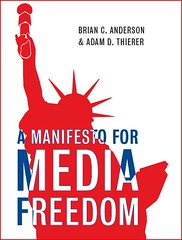
Likewise, in our book, A Manifesto for Media Freedom, Brian Anderson and I note that some other prominent right-leaning politicians, such as Sen. Trent Lott, favored the Fairness Doctrine.  Moreover, even though most of those conservative individuals and groups have now turned against the Fairness Doctrine, some Republicans still defend (or even seek to expand) the same underlying regulatory concepts that served as the foundation of the Fairness Doctrine.  As Corn-Revere notes: Continue reading →

Geese are flying overhead. Leaves are orange. The election is over. A historic moment. And I will be optimistic, and hope that although the economics of the moment seems to be a return to things past… to the 1930s, it will turn out to be otherwise, for a good bit is known now that was not known then, whatever one’s ideology. Continue reading →

Today was a big day — and not just because there was an election going on! As I mentioned yesterday, the other big news was that the U.S. Supreme Court was hearing oral arguments in the potentially historic free speech case of Federal Communications Commission v. Fox Television Stations, Inc. Again, all the background you need can be found in my post yesterday, so here I will just be summarizing my general thoughts about how the oral arguments played out this morning.

Unfortunately, because no electronic devices or even notepads are allowed in the courtroom, much of what I am relaying here is from memory or from the notes that I surreptitiously scribbled on a tiny piece of scrap paper when the guards weren’t looking. (And yes, I have been reprimanded before for taking notes in the Court!)  The transcript has just been released, however, so you can read it through and judge for yourself.  Anyway, here are some general thoughts:

Continue reading →

Supreme CourtTomorrow morning, the U.S. Supreme Court will hear oral arguments in the potentially historic free speech case of Federal Communications Commission v. Fox Television Stations, Inc. I plan on attending and will try to post some thoughts about how the arguments played out here later tomorrow afternoon or evening. [I won’t be able to live blog of Twitter it because no electronic devices are allowed in the courtroom, which I’ve always thought is outrageous.] In the meantime, here again is the background of the case.

The FCC v. Fox case is the indecency case involving the FCC’s new policy for “fleeting expletives.” I wrote about the Second Circuit Court of Appeals decision here and the full 2nd Circuit decision is here. [By contrast, the so-called “Janet Jackson case” — CBS v. FCC — took place in the Third Circuit Court of Appeals and that court recently handed down a decision that also went against the FCC. I wrote about the Third Circuit’s decision here.]

In a 2-1 decision, the Second Circuit ruled that “the FCC’s new policy sanctioning “fleeting expletives” is arbitrary and capricious under the Administrative Procedure Act for failing to articulate a reasoned basis for its change in policy.” The decision demonstrates how, over just the past few years, the FCC has arbitrarily thrown out 30+ years worth of precedent and greatly expand the scope of its regulatory authority over speech on broadcast TV and radio. As a result, the FCC’s order was vacated and remanded to the agency. The agency appealed the decision, however, and the Supreme Court accepted it for review.

Continue reading →

Manifesto for Media Freedom book coverI’m pleased to announce the publication of A Manifesto for Media Freedom, which I co-authored with Brian C. Anderson of the Manhattan Institute. Brian serves as editor of Manhattan Institute’s excellent City Journal and he is the author of best-selling books like South Park Conservatives and Democratic Capitalism and Its Discontents.

In this little manifesto, we highlight one of the central ironies of the Information Age.  Namely, that despite “the breathtaking abundance of new and old media outlets for obtaining news, information, and entertainment…”

many people hate this profusion, and never more than when it involves political speech. The current media market, they charge, doesn’t represent true diversity, or isn’t fair, or is subject to manipulation by a small and shrinking group of media barons. They want the government to regulate it into better shape, which just happens to be a shape that benefits them. Doing so… would be a disaster, a kind of soft or not-so-soft tyranny that would wipe out whole sectors of media, curtailing free speech and impoverishing our democracy.

In other words, instead of celebrating the unprecedented cornucopia of media choices at our collective disposal, many policymakers and media critics are calling for just as much media regulation as ever. We itemize these threats in our chapters and they include: efforts to revive the “Fairness Doctrine”, media ownership regulations, “localism” requirements, Net neutrality mandates, a la carte regulations, cable and satellite censorship, video game censorship, regulation of social networking sites, campaign finance-related speech restrictions, and so on.

In each case, we advance a pro-freedom paradigm to counter the advocates of media control. What do we mean by the “media freedom” that we advocate as the alternative to these new regulatory crusades? Here’s how we put it in the book:

Continue reading →