[UPDATE
4/30/13: This article was subsequently published in Volume 65, Issues 2 of the Federal Communications Law Journal in April 2013. The links below now point to the final FCLJ version.]
The Mercatus Center at George Mason University has just released a new paper by Brent Skorup and me entitled, “Uncreative Destruction: The War on Vertical Integration in the Information Economy.” Brent, who is the research director for the Information Economy Project at the George Mason University School of Law, and I have been working on this paper since the Spring and we are looking forward to getting it published in a law review shortly. The paper focuses on Tim Wu’s “separations principle” for the digital economy, something I’ve spent some time critiquing here in the past. Here’s the introduction from the 44-page paper that Brent and I just released:
Are information sectors sufficiently different from other sectors of the economy such that more stringent antitrust standards should be applied to them preemptively? Columbia Law School professor Tim Wu responds in the affirmative in his book The Master Switch: The Rise and Fall of Information Empires. Having successfully pushed net-neutrality regulation into the policy spotlight, Wu has turned his attention to what he regards as excessive market concentration and threats to free speech throughout the entire information economy.To support his call for increased antitrust intervention, Wu explains his view of competition in the information economy—a view that deviates substantially from current mainstream antitrust theory.
Continue reading →
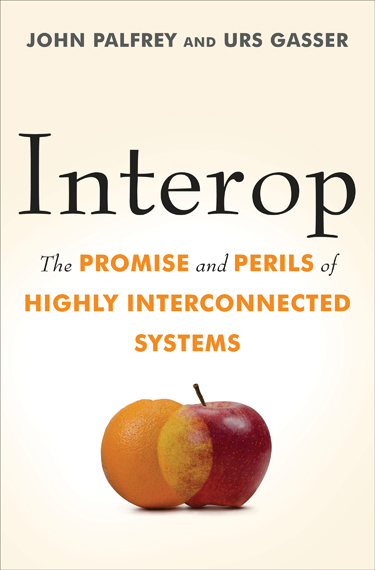 I’m pretty rough on all the Internet and info-tech policy books that I review. There are two reasons for that. First, the vast majority of tech policy books being written today should never have been books in the first place. Most of them would have worked just fine as long-form (magazine-length) essays. Too many authors stretch a promising thesis into a long-winded, highly repetitive narrative just to say they’ve written an entire book about a subject. Second, many info-tech policy books are poorly written or poorly argued. I’m not going to name names, but I am frequently unimpressed by the quality of many books being published today about digital technology and online policy issues.
The books of Harvard University cyberlaw scholars John Palfrey and Urs Gasser offer a welcome break from this mold. Their recent books, Born Digital: Understanding the First Generation of Digital Natives, and Interop: The Promise and Perils of Highly Interconnected Systems, are engaging and extremely well-written books that deserve to be books. There’s no wasted space or mindless filler. It’s all substantive and it’s all interesting. I encourage aspiring tech policy authors to examine their works for a model of how a book should be done.
In a 2008 review, I heaped praise on Born Digital and declared that this “fine early history of this generation serves as a starting point for any conversation about how to mentor the children of the Web.” I still recommend highly to others today. I’m going to be a bit more critical of their new book, Interop, but I assure you that it is a text you absolutely must have on your shelf if you follow digital policy debates. It’s a supremely balanced treatment of a complicated and sometimes quite contentious set of information policy issues.
In the end, however, I am concerned about the open-ended nature of the standard that Palfrey and Gasser develop to determine when government should intervene to manage or mandate interoperability between or among information systems. I’ll push back against their amorphous theory of “optimal interoperability” and offer an alternative framework that suggests patience, humility, and openness to ongoing marketplace experimentation as the primary public policy virtues that lawmakers should instead embrace. Continue reading →
The Mercatus Center at George Mason University has just released my new white paper, “The Perils of Classifying Social Media Platforms as Public Utilities.” [PDF] I first presented a draft of this paper last November at a Michigan State University conference on “The Governance of Social Media.” [Video of my panel here.]
In this paper, I note that to the extent public utility-style regulation has been debated within the Internet policy arena over the past decade, the focus has been almost entirely on the physical layer of the Internet. The question has been whether Internet service providers should be considered “essential facilities” or “natural monopolies” and regulated as public utilities. The debate over “net neutrality” regulation has been animated by such concerns.
While that debate still rages, the rhetoric of public utilities and essential facilities is increasingly creeping into policy discussions about other layers of the Internet, such as the search layer. More recently, there have been rumblings within academic and public policy circles regarding whether social media platforms, especially social networking sites, might also possess public utility characteristics. Presumably, such a classification would entail greater regulation of those sites’ structures and business practices.
Proponents of treating social media platforms as public utilities offer a variety of justifications for regulation. Amorphous “fairness” concerns animate many of these calls, but privacy and reputational concerns are also frequently mentioned as rationales for regulation. Proponents of regulation also sometimes invoke “social utility” or “social commons” arguments in defense of increased government oversight, even though these notions lack clear definition.
Social media platforms do not resemble traditional public utilities, however, and there are good reasons why policymakers should avoid a rush to regulate them as such. Continue reading →
 In my work critiquing the Lessig-Zittrain-Wu school of thinking–which fears the decline and fall of online “openness” and digital “generativity”–I have argued that, while there is no such thing as perfect “openness,” things are actually getting more open and generative all the time. All that really counts from my perspective is that we are witnessing healthy innovation across the generativity continuum.
Will some devices and platforms continue to be “closed”? Sure. Think Apple and cable set-top boxes. But (a) there’s a ton of innovation taking place on top of those supposedly “closed” platforms and (b) there are other options consumers can exercise if they don’t like those content /information delivery methods. [See this chapter from the Next Digital Decade book for my fuller critique.]
And, even if one adopts a rigid Zittrainian view of openness and generativity, each day seems to bring more good news. From that perspective it’s hard to find a better headline than this one: ”
Smartphone Makers Bow to Demands for More Openness.” That’s from ArsTechnica today and it refers to the fact that smartphone giant HTC just announced it would no longer attempt to lock the bootloader on its smartphones, meaning geeks like me can root and hack their devices to their heart’s content. As the Ars story notes:
Continue reading →
 Hanno F. Kaiser, a U.S. and EU antitrust lawyer and partner with Latham & Watkins LLP, has just released an important essay on a topic I have devoted much time to here over the years: the debate over the relative advantages of “open” vs. “closed” technological systems and the Lessig-Zittrain-Wu school of thinking about these issues.
Kaiser’s essay is entitled, ”
Are Closed Systems an Antitrust Problem?” and it appears in the latest edition of Competition Policy International. This essay is not to be missed. Kaiser’s terrific paper helps us better understand and debunk many of the myths and misperceptions that continue to riddle this debate. Here’s Kaiser’s key insight:
At bottom, the bad reputation of closed systems or walled gardens in the “open versus closed” debate is quite undeserved. Walled gardens generally benefit their environments—both in the real world and the digital realm. The primary purpose of a garden wall, after all, is to shelter plants from wind and frost, not to keep intruders out. In the protected space of the garden, flowers can grow that would not otherwise survive in the wild. Walled gardens thus deliberately create a microcosm that is different from the surrounding ecosystem. Therefore, as long as the garden does not take over the entire ecosystem, walled gardens increase, not reduce, overall diversity. From a competition policy perspective, enjoying the fruits of a walled garden is generally not a guilty pleasure.
Therefore, “as a policy matter, ‘open’ is not necessarily better than ‘closed’,” Kaiser argues, and elaborates as follows: Continue reading →
I’ve spent a great deal of time here defending “techno-optimism” or “Internet optimism” against various attacks through the years, so I was interested to see Cory Doctorow, a novelist and Net activist, take on the issue in a new essay at Locus Online. I summarized my own views on this issue in two recent book chapters. Both chapters appear in The Next Digital Decade and are labeled “The Case for Internet Optimism.” Part 1 is sub-titled “Saving the Net From Its Detractors” and Part 2 is called “Saving the Net From Its Supporters.” More on my own thoughts in a moment. But let’s begin with Doctorow’s conception of the term.
Doctorow defines “techno-optimism” as follows:
In order to be an activist, you have to be… pessimistic enough to believe that things will get worse if left unchecked, optimistic enough to believe that if you take action, the worst can be prevented. […]
Techno-optimism is an ideology that embodies the pessimism and the optimism above: the concern that technology could be used to make the world worse, the hope that it can be steered to make the world better.
What this definition suggests is that Doctorow has a very clear vision of what constitutes “good” vs. “bad” technology or technological developments. He turns to that dichotomy next as he seeks to essentially marry “techno-optimism” to a devotion to the free/open software movement and a rejection of “proprietary technology”: Continue reading →
Writing over at Forbes, Bret Swanson notes that the progression of information technology history isn’t going so well for those Net pessimists who, not so long ago, predicted that the sky was set to fall on consumers and that digital innovation was dying. Specifically, Swanson addresses the theories set forth by cyberlaw professors Lessig, Zittrain, and Wu (among others), whose theories about “perfect control,” the death of “generativity,” and the rise of the “master switch,” I have addressed here many time before. [See this compendium of TLF essays discussing “Problems with the Lessig-Zittrain-Wu Thesis.”] Swanson summarizes what went wrong with their gloomy Chicken Little theories and their predictions of the coming cyber end-times:
As the cloud wars roar, the cyber lawyers simmer. This wasn’t how it was supposed to be. The technology law triad of Harvard’s Lawrence Lessig and Jonathan Zittrain and Columbia’s Tim Wu had a vision. They saw an arts and crafts commune of cyber-togetherness. Homemade Web pages with flashing sirens and tacky text were more authentic. “Generativity” was Zittrain’s watchword, a vague aesthetic whose only definition came from its opposition to the ominous “perfect control” imposed by corporations dictating “code” and throwing the “master switch.”
In their straw world of “open” heros and “closed” monsters, AOL’s “walled garden” of the 1990s was the first sign of trouble. Microsoft was an obvious villain. The broadband service providers were
of course dangerous gatekeepers, the iPhone was too sleek and integrated, and now even Facebook threatens their ideal of uncurated chaos. These were just a few of the many companies that were supposed to kill the Internet. The triad’s perfect world would be mostly broke organic farmers and struggling artists. Instead, we got Apple’s beautifully beveled apps and Google’s intergalactic ubiquity. Worst of all, the Web started making money.
Swanson goes on to argue that, despite all the hang-wringing we’re heard from this triumvirate and their many, many disciples in the academic and regulatory activist world, things just keep getting more innovative, more generative, and yes, even more “open.” Continue reading →
The folks at Reason magazine were kind enough to invite me to submit a review of Tim Wu’s new book, The Master Switch: The Rise and Fall of Information Empires based on my 6-part series on the book that I posted here on the TLF late last year. (Parts 1, 2, 3, 4, 5, 6) My new essay, which is entitled “The Rise of Cybercollectivism,” has now been posted on the Reason website.
I realize that title will give some readers heartburn, even those who are inclined to agree with me much the time. After all, “collectivism” is a term that packs some rhetorical punch and leads to quick accusations of red-baiting. I addressed that concern in a Cato Unbound debate with Lawrence Lessig a couple of years ago after he strenuously objected to my use of that term to describe his worldview (and that of Tim Wu, Jonathan Zittrain, and their many colleagues and followers). As I noted then, however, the “collectivism” of which I speak is a more generic type, not the hard-edged Marxist brand of collectivism of modern times. For example, I do not believe that Professors Lessig, Zittrain, or Wu are out to socialize all the information means of production and send us all to digital gulags or anything silly like that. Rather, their “collectivism” is rooted in a more general desire to have–as Declan McCullagh eloquently stated in a critique of Lessig’s Code–rule by “technocratic philosopher kings.” Here’s a passage from my Reason review of Wu’s Master Switch in which I expand upon that notion:
Continue reading →
This is the second of two essays making “The Case for Internet Optimism.” This essay was included in the book, The Next Digital Decade: Essays on the Future of the Internet (2011), which was edited by Berin Szoka and Adam Marcus of TechFreedom. In my previous essay, which I discussed here yesterday, I examined the first variant of Internet pessimism: “Net Skeptics,” who are pessimistic about the Internet improving the lot of mankind. In this second essay, I take on a very different breed of Net pessimists: “Net Lovers” who, though they embrace the Net and digital technologies, argue that they are “dying” due to a lack of sufficient care or collective oversight. In particular, they fear that the “open” Internet and “generative” digital systems are giving way to closed, proprietary systems, typically run by villainous corporations out to erect walled gardens and quash our digital liberties. Thus, they are pessimistic about the long-term survival of the Internet that we currently know and love.
Leading exponents of this theory include noted cyberlaw scholars Lawrence Lessig, Jonathan Zittrain, and Tim Wu. I argue that these scholars tend to significantly overstate the severity of this problem (the supposed decline of openness or generativity, that is) and seem to have very little faith in the ability of such systems to win out in a free market. Moreover, there’s nothing wrong with a hybrid world in which some “closed” devices and platforms remain (or even thrive) alongside “open” ones. Importantly, “openness” is a highly subjective term, and a constantly evolving one. And many “open” systems or devices are as perfectly open as these advocates suggest.
Finally, I argue that it’s likely that the “openness” advocated by these advocates will devolve into expanded government control of cyberspace and digital systems than that unregulated systems will become subject to “perfect control” by the private sector, as they fear. Indeed, the implicit message in the work of all these hyper-pessimistic critics is that markets must be steered in a more sensible direction by those technocratic philosopher kings (although the details of their blueprint for digital salvation are often scarce). Thus, I conclude that the dour, depressing “the-Net-is-about-to-die” fear that seems to fuel this worldview is almost completely unfounded and should be rejected before serious damage is done to the evolutionary Internet through misguided government action.
I’ve embedded the entire essay down below in Scribd reader, but it can also be found on TechFreedom’s Next Digital Decade book website and SSRN.
Continue reading →
[Note: This post is updated regularly as I discover relevant old or new material.]
“Regulatory capture” occurs when special interests co-opt policymakers or political bodies — regulatory agencies, in particular — to further their own ends. Capture theory is closely related to the “rent-seeking” and “political failure” theories developed by the public choice school of economics. Another term for regulatory capture is “client politics,” which according to James Q. Wilson, “occurs when most or all of the benefits of a program go to some single, reasonably small interest (and industry, profession, or locality) but most or all of the costs will be borne by a large number of people (for example, all taxpayers).” (James Q. Wilson,
Bureaucracy, 1989, at 76).
While capture theory cannot explain all regulatory policies or developments, it does provide an explanation for the actions of political actors with dismaying regularity. Because regulatory capture theory conflicts mightily with romanticized notions of “independent” regulatory agencies or “scientific” bureaucracy, it often evokes a visceral reaction and a fair bit of denialism. (See, for example, the reaction of New Republic’s Jonathan Chait to Will Wilkinson’s recent Economist column about the prevalence of corporatism in our modern political system.) Yet, countless studies have shown that regulatory capture has been at work in various arenas: transportation and telecommunications; energy and environmental policy; farming and financial services; and many others.
I thought it might be useful to build a compendium of quotes from various economists and political scientists who have studied the regulatory process throughout history and identified regulatory capture or client politics as a major problem. I would greatly appreciate having others suggest additional quotes and studies to add to this list since I plan to update it frequently and eventually work all of this into a future paper or book. [
Note: I have updated this compendium over a dozen times since the original post, so please check back for updates.]
The following list is chronological and begins, surprisingly, with the thoughts of progressive hero Woodrow Wilson…
Continue reading →



 The Technology Liberation Front is the tech policy blog dedicated to keeping politicians' hands off the 'net and everything else related to technology.