Posts tagged as:

My thanks to both Maria H. Andersen and Michael Sacasas for their thoughtful responses to my recent Forbes essay on “10 Things Our Kids Will Never Worry About Thanks to the Information Revolution.” They both go point by point through my Top 10 list and offer an alternative way of looking at each of the trends I identify. What their responses share in common is a general unease with the hyper-optimism of my Forbes piece. That’s understandable. Typically in my work on technological “optimism” and “pessimism” — and yes, I admit those labels are overly simplistic — I always try to strike a sensible balance between pollyannism and hyper-pessimism as it pertains to the impact of technological change on our culture and economy. I have called this middle ground position “pragmatic optimism.” In my Forbes essay, however, I was in full-blown pollyanna mode. That doesn’t mean I don’t generally feel very positive about the changes I itemized in that essay, rather, I just didn’t have the space in a 1,000-word column to identify the tradeoffs inherent in each trend. Thus, Andersen and Sacasas are rightfully pushing back against my lack of balance.

But there is a problem with their slightly pessimistic pushback, too. To better explain my own position and respond to Andersen and Sacasas, let me return to the story we hear again and again in discussion about technological change: the well-known allegorical tale from Plato’s Phaedrus about the dangers of the written word. In the tale, the god Theuth comes to King Thamus and boasts of how Theuth’s invention of writing would improve the wisdom and memory of the masses relative to the oral tradition of learning.  King Thamus shot back, “the discoverer of an art is not the best judge of the good or harm which will accrue to those who practice it.”  King Thamus then passed judgment himself about the impact of writing on society, saying he feared that the people “will receive a quantity of information without proper instruction, and in consequence be thought very knowledgeable when they are for the most part quite ignorant.”

After recounting Plato’s allegory in my essay, “Are You An Internet Optimist or Pessimist? The Great Debate over Technology’s Impact on Society,” I noted how this same tension has played out in every subsequent debate about the impact of a new technology on culture, values, morals, language, learning, and so on. It is a never-ending cycle. Continue reading →

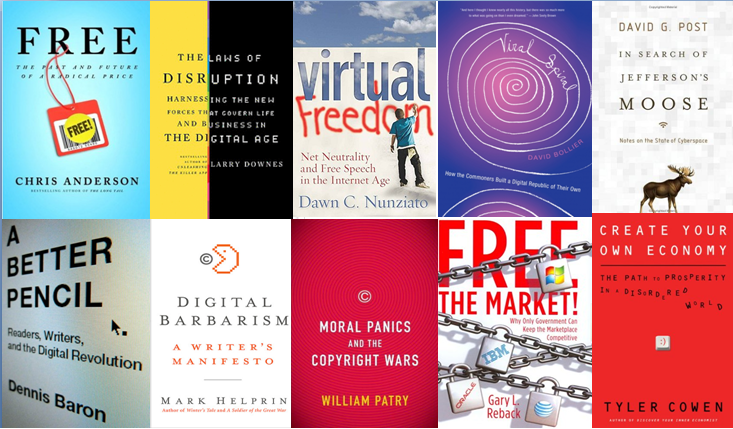
2009 was not as big of a year for Internet and information technology (“info-tech”) policy books as 2008 was, but there were still some notable titles released that offered interesting perspectives about the future of the Net and the impact the Digital Revolution is having on our lives, culture, and economy.  So, like last year, I figured I would throw together my list of the 10 most important info-tech policy books of the year.

book covers collage 2009First, let me repeat a few of the same caveats and disclaimers that I set forth last year.  What qualifies as an “important” info-tech policy book? Simply put, it’s a title that many people are currently discussing and that we will likely be referencing for many years to come.  However, I want to be clear that merely because a book appears on my list it does not necessarily mean I agree with everything said in it. In fact, as was the case in previous years, I found much with which to disagree in my picks for the most important books of 2009 and I find that the cyber-libertarianism I subscribe to has very few fans out there.

Another caveat: Narrowly-focused titles lose a few points on my list. For example, if a book deals mostly with privacy issues, copyright law, or antitrust policy, it does not exactly qualify as the same sort of “tech policy book” as other titles found on this list since it is a narrow exploration of just one set of issues with a bearing on technology policy.

With those caveats in mind, here are my choices for the Most Important Info-Tech Policy Books of 2009. Continue reading →

A Better Pencil book coverI very much enjoyed Dennis Baron’s new book, A Better Pencil: Readers, Writers, and the Digital Revolution, and highly recommend you pick it up. Baron does a wonderful job exploring the history of techno-pessimism and the endless battles about the impact of new technologies on life and learning, something I have written about here before in my essays on “Internet optimists vs. pessimists” (See: 1, 2, 3).

I have a complete review of Baron’s A Better Pencil now up on the City Journal‘s website here.  I’ve also pasted it down below.


Plato Wrote it Down by Adam Thierer

a review of A Better Pencil: Readers, Writers, and the Digital Revolution, by Dennis Baron (Oxford University Press, 280 pp., $24.95)

In the beginning, Dennis Baron reminds us in his new book, A Better Pencil, there was the word—the spoken word, that is. Oral tradition, the passing of knowledge through stories and lectures, was the primary method of instruction and learning throughout early human civilization. But then a few innovative souls decided to start writing everything down on stones and clay. Almost as soon as they did, a great debate began on the impact of new communications technology on culture and education. And it rages on today, with a new generation of optimists and skeptics battling over the impact that computing, the Internet, and digital technologies have on our lives and on how we learn about the world.

Continue reading →

Last month, Digital Barbarism book cover National Review magazine published a review that I penned of Mark Helprin’s new book, Digital Barbarism: A Writer’s Manifesto.  Helprin’s book is both a passionate defense of copyright law as well as a mini-autobiography.  Helprin is one of the great novelists and essayists of the past half-century, and his book A Soldier of a Great War is one of my all-time favorite novels.  I cannot in strong enough words encourage you to read that book; it is profoundly moving. (I almost named my son after the lead character in the book!)

Thus, I was quite excited when I learned that Helprin had penned a defense of copyright and I jumped at the chance to review it when the folks at National Review asked me to do so.  Alas, as you will see in my review, I was terribly disappointed.  I wish Helprin would have stuck with the very reasonable tone he adopted in this excellent podcast interview he did recently with John J. Miller of National Review Online. Unfortunately, he went a different direction in the book, as I make clear in my review:


National Review July 20, 2009

“Man, Machine, and Copyright” a review of Digital Barbarism: A Writer’s Manifesto, by Mark Helprin by Adam Thierer

It would be difficult to think of anyone more ideally suited to pen a passionate defense of copyright law than novelist Mark Helprin.  Helprin has written several of the finest works of modern literature, including his masterpiece, A Soldier of the Great War, a narrative of transcendent beauty. In Digital Barbarism, Helprin sets out to use his formidable gift for the written word to repel the “cyber mob” that has attacked copyright law and called for its curtailment, or even abolition.

Unfortunately, while Helprin occasionally rises to great heights in his defense of copyright, he too often sinks to lamentable lows — by resorting to the same unbecoming rhetorical tactics used by the mob he seeks to condemn. Indeed, his book is filled with gratuitous vitriol and neo-Luddite ramblings about the Internet and Information Age that severely detract from his defense of copyright. This is a shame, because, in places, Digital Barbarism makes a fine case against those critics who wrongly view copyright as an impediment to the creation and diffusion of content. “The availability of information is not and will not be restrained by the copyright system any more than it is or will be restrained by the delivery systems that make it possible,” Helprin argues. Why, he asks, “must ‘content’ be free” when everything else — access to the Internet, digital devices, etc. — costs good money? He notes that the movement that advocates “free,” universal access to all copyrighted material in the name of “openness” and “the public good” would, ironically, “destroy the dream it advocates”: Continue reading →

My problem with what Nick Carr is saying about Wikipedia here — as well as in his book The Big Switch — is that he always seems to assume that Wikipedia constitutes the totality of most searches for information online. I suppose it does for some people, but I have a hard time accepting the argument that everyone’s search for enlightenment ends there, even if Wikipedia does rank high in many search results today.

For me, Wikipedia is just a launch pad; a great starting point in the search for truth. I take much of what I read on Wikipedia with a large grain of salt, however, because I know not every entry is as trustworthy as others, and entries could change at any moment. But that’s true of much of what one finds online!  If one adopts a sort of caveat emptor attitude toward Wikipedia, and then uses it to seek out truth from alternative sources found in each entry, or from other searches, then were is the harm?  Only if one could show that the search for truth ends with Wikipedia would I be as concerned as Carr and other Internet pessimists and Wikipedia critics (like Lee Siegel and Andrew Keen). But I just don’t believe that is the case.

Moreover, it is impossible for me to believe that we have fewer authoritative sources of information at our disposal today than we did in the past.   Continue reading →

SunsteinPresident-elect Barack Obama will soon be naming Cass Sunstein, an old friend of his from their University of Chicago Law School days together, the new head the White House Office of Information and Regulatory Affairs (OIRA). OIRA oversees regulation throughout the U.S. government. Basically, Sunstein’s position is the equivalent of the federal regulatory czar.

Sunstein certainly possess excellent qualifications for the job. During his time at the University of Chicago and Harvard Law School, Sunstein has established himself as a leading liberal thinker in the field of law and economics. And, as I have joked in writing about him before, he is so insanely prolific that it seems every time I finish reading one of his new books a new title by him lands on my desk. I am quite convinced that both he and Richard Posner are actually cyborgs. I just don’t understand how two humans can compose words so rapidly!

Anyway, Professor Sunstein’s new position as head of OIRA gives him the ability influence federal regulatory decisions in both a procedural and substantive way. In terms of substance, it gives him an important platform to subtly “nudge” the regulatory philosophy and direction of the Obama Administration on many matters, including Internet policy. So, what has Professor Sunstein had to say about Internet policy in his recent work? Sunstein has developed his thinking about these issues primarily in his two recent books: Republic.com (2000) and Infotopia: How Many Minds Produce Knowledge (2006). But he’s also had a few relevant things to say about Internet issues in his recent book with Richard Thaler, Nudge: Improving Decisions About Health, Wealth, and Happiness (2008).

There are 3 Internet policy-related things from his work that I’d like to focus on here because I find them all quite troubling. Continue reading →

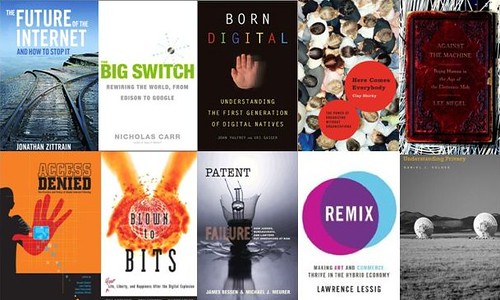
It’s been a big year for tech policy books. Several important titles were released in 2008 that offer interesting perspectives about the future of the Internet and the impact digital technologies are having on our lives, culture, and economy. Back in September, I compared some of the most popular technology policy books of the past five years and tried to group them into two camps: “Internet optimists” vs. “Internet pessimists.” That post generated a great deal of discussion and I plan on expanding it into a longer article soon. In this post, however, I will merely list what I regard as the most important technology policy books of the past year. Best Tech Books of 2008 (covers)

What qualifies as an “important” tech policy book? Basically, it’s a title that many people in this field are currently discussing and that we will likely be talking about for many years to come. I want to make it clear, however, that merely because a book appears on this list it does not necessarily mean I agree with everything said in it. In fact, I found much with which to disagree in my picks for the two most important books of 2008, as well as many of the other books on the list. [Moreover, after reading all these books, I am more convinced than ever that libertarians are badly losing the intellectual battle of ideas over Internet issues and digital technology policy. There’s just very few people defending a “Hands-Off-the-Net” approach anymore. But that’s a subject for another day!]

Another caveat: Narrowly focused titles lose a few points on my list. For example, as was the case in past years, a number of important IP-related books have come out this year. If a book deals exclusively with copyright or patent issues, it does not exactly qualify as the same sort of “tech policy book” as other titles found on this list since it is a narrow exploration of just one set of issues that have a bearing on digital technology policy. The same could be said of a book that deals exclusively with privacy policy, like Solove’s Understanding Privacy. It’s an important book with implications for the future of tech policy, but I demoted it a bit because of its narrow focus.

With those caveats in mind, here are my Top 10 Most Important Tech Policy Books of 2008 (and please let me know about your picks for book of the year):

Continue reading →

A few months ago, I penned a mega book review about the growing divide between “Internet optimists and pessimists.” I noted that the Internet optimists — people like Chris Anderson, Clay Shirky, Yochai Benkler, Kevin Kelly, and others — believe that the Internet is generally improving our culture, economy, and society for the better. They believe the Net has empowered and liberated the masses, sparked unparalleled human creativity and communication, provided greater personalization and customization of media content, and created greater diversity of thought and a more deliberative democracy. By contrast, the Internet pessimists — including Nick Carr, Andrew Keen, Lee Siegel, and others — argue that the Internet is destroying popular culture and professional media, calling “truth” and “authority” into question by over-glamorizing amateurism and user-generated content, and that increased personalization is damaging deliberative democracy by leading to homogenization, close-mindedness, and an online echo-chamber. Needless to say, it’s a very heated debate!

I am currently working on a greatly expanded version of my “Net optimists vs. pessimists” essay for a magazine in which I will draw out more of these distinctions and weigh the arguments made by those in both camps. I plan on concluding that article by arguing that the optimists generally have the better of the argument, but that the pessimists make some fair points about the downsides of the Net’s radically disintermediating role on culture and economy.

So, this got me thinking that I needed to come up with some sort of a label for my middle-of-the-road position as well as a statement of my personal beliefs. As far as labels go, I guess I would call myself a “pragmatic optimist” since I generally side with the optimists in most of these debates, but not without some occasional reservations. Specifically, I don’t always subscribe to the Pollyanna-ish, rose-colored view of the world that some optimists seem to adopt. But the outright Chicken Little-like Ludditism of some Internet pessimists is even more over-the-top at times. Anyway, what follows is my “Pragmatic (Internet) Optimist’s Creed” which better explains my views. (Again, read my old essay first for some context about the relevant battle lines in this intellectual war).

Continue reading →

Carr Big Switch book coverI just finished reading through The Economist’s new 14-page special report on cloud computing, “Let It Rise” in which Ludwig Siegele provides an outstanding overview of cloud computing and why it is so important:

The rise of the cloud is more than just another platform shift that gets geeks excited. It will undoubtedly transform the information technology (IT) industry, but it will also profoundly change the way people work and companies operate. It will allow digital technology to penetrate every nook and cranny of the economy and of society, creating some tricky political problems along the way.

Even if you are very familiar with cloud computing, I recommend you take a look at the article. Anyway, while I was reading it, I was unsurprised to come across some comments from Nicholas Carr, whose new book The Big Switch: Rewiring the World, from Edison to Google, is essentially an early history of cloud computing and an investigation into its effects on our economy, culture, and society. And that also reminded me that, even though I have mentioned Carr’s book here several times since it was released earlier this year, I have failed to give it a dedicated review. And it certain deserves one because “The Big Switch” is easily one of the most important technology policy books of 2008.

Continue reading →

Siegel Against the Machine book coverOf the titles I included in a mega-book review about Internet optimists and pessimists that I posted here a few months ago, I mentioned Lee Siegel’s new book, Against the Machine: Being Human in the Age of the Electronic Mob.  It is certainly the dourest of the recent books that have adopted a pessimistic view of the impact the Internet is having on our culture, society, and economy. Because Siegel’s book is one of the most important technology policy books of 2008, however, I decided to give it a closer look here.

Siegel’s book essentially picks up where Andrew Keen’s leaves off in Cult of the Amateur: How Today’s Internet is Killing our Culture (2007).  I posted a two-part review of Keen’s book here last year [Part 1, Part 2], but here’s a quick taste of Keen’s take on things.  He argues “the moral fabric of our society is being unraveled by Web 2.0” and that “our cultural standards and moral values are not all that are at stake.  Gravest of all,” Keen continues, “the very traditional institutions that have helped to foster and create our news, our music, our literature, our television shows, and our movies are under assault as well.”

As I noted in my earlier “Net optimists vs. pessimists” essay, after reading Cult of the Amateur, I didn’t think anyone else could ever be quite as over-the-top and Chicken Little-ish as Keen. But after working my way through Siegel’s Against the Machine, I realized I was wrong. It made Keen seem downright reasonable and cheery by comparison! Keen and Siegel seem to be in heated competition for the title “High Prophet of Internet Doom,” but Siegel is currently a nose ahead in that race.

Continue reading →