Posts tagged as:

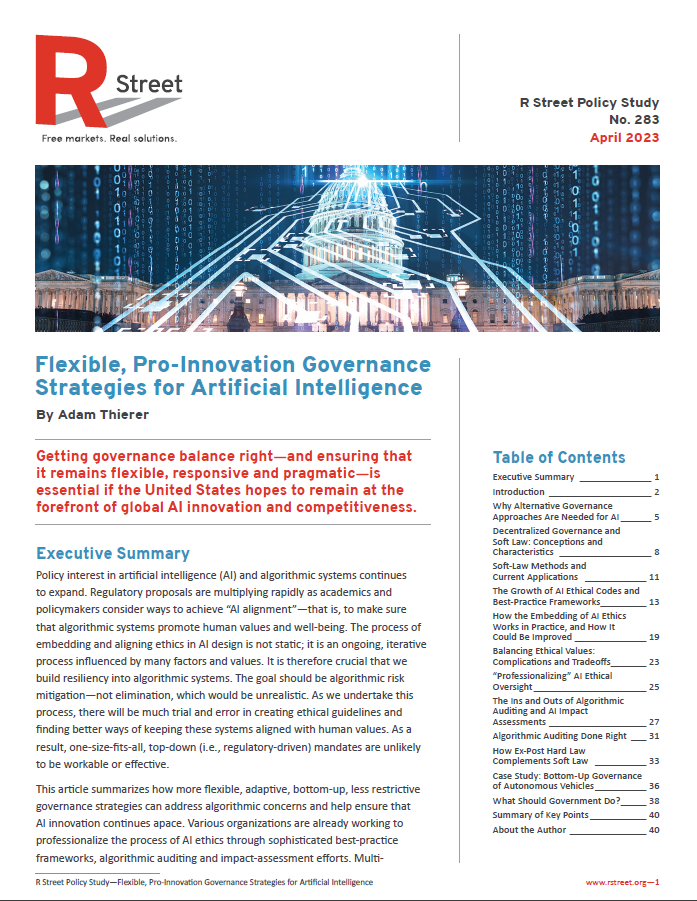
The R Street Institute has just released my latest study on AI governance and how to address “alignment” concerns in a bottom-up fashion. The 40-page report is entitled, “Flexible, Pro-Innovation Governance Strategies for Artificial Intelligence.”

My report asks, is it possible to address AI alignment without starting with the Precautionary Principle as the governance baseline default? I explain how that is indeed possible. While some critics claim that no one is seriously trying to deal with AI alignment today, my report explains how no technology in history has been more heavily scrutinized this early in its life-cycle as AI, machine learning and robotics. The number of ethical frameworks out there already is astonishing. We don’t have too few alignment frameworks; we probably have too many!

We need to get serious about bringing some consistency to these efforts and figure out more concrete ways to a culture of safety by embedding ethics-by-design. But there is an equally compelling interest in ensuring that algorithmic innovations are developed and made widely available to society.

Continue reading →

In my latest R Street Institute report, I discuss the importance of “Getting AI Innovation Culture Right.” This is the first of a trilogy of major reports on what sort of policy vision and set of governance principles should guide the development of  artificial intelligence (AI), algorithmic systems, machine learning (ML), robotics, and computational science and engineering more generally. More specifically, these reports seek to answer the question, Can we achieve AI safety without innovation-crushing top-down mandates and massive new regulatory bureaucracies? 

These questions are particular pertinent as we just made it through a week in which we’ve seen a major open letter issued that calls for a 6-month freeze on the deployment of AI technologies, while a prominent AI ethicist argued that governments should go further and consider airstrikes data processing centers even if the exchange of nuclear weapons needed to be considered! On top of that, Italy became the first major nation to ban ChatGPT, the popular AI-enabled chatbot created by U.S.-based OpenAI.

My report begins from a different presumption: AI, ML and algorithmic technologies present society with enormously benefits and, while real risks are there, we can find better ways of addressing them. Continue reading →

We are entering a new era for technology policy in which many pundits and policymakers will use “algorithmic fairness” as a universal Get Out of Jail Free card when they push for new regulations on digital speech and innovation. Proposals to regulate things like “online safety,” “hate speech,” “disinformation,” and “bias” among other things often raise thorny definitional questions because of their highly subjective nature. In the United States, efforts by government to control these things will often trigger judicial scrutiny, too, because restraints on speech violate the First Amendment. Proponents of prior restraint or even ex post punishments understand this reality and want to get around it. Thus, in an effort to avoid constitutional scrutiny and lengthy court battles, they are engaged in a rebranding effort and seeking to push their regulatory agendas through a techno-panicky prism of “algorithmic fairness” or “algorithmic justice.”

Hey, who could possibly be against FAIRNESS and JUSTICE? Of course, the devil is always in the details as Neil Chilson and I discuss in our new paper for the The Federalist Society and Regulatory Transparency Project on, “The Coming Onslaught of ‘Algorithmic Fairness’ Regulations.” We document how federal and state policymakers from both parties are currently considering a variety of new mandates for artificial intelligence (AI), machine learning, and automated systems that, if imposed, “would thunder through our economy with one of the most significant expansions of economic and social regulation – and the power of the administrative state – in recent history.” Continue reading →

[Cross-posted from Medium.]

[Cross-posted from Medium]

There are two general types of technological governance that can be used to address challenges associated with artificial intelligence (AI) and computational sciences more generally. We can think of these as “on the ground” (bottom-up, informal “soft law”) governance mechanisms versus “on the books” (top-down, formal “hard law”) governance mechanisms.

Unfortunately, heated debates about the latter type of governance often divert attention from the many ways in which the former can (or already does) help us address many of the challenges associated with emerging technologies like AI, machine learning, and robotics. It is important that we think harder about how to optimize these decentralized soft law governance mechanisms today, especially as traditional hard law methods are increasingly strained by the relentless pace of technological change and ongoing dysfunctionalism in the legislative and regulatory arenas.

Continue reading →

[last updated 4/3/2025 – Check my Medium page for latest posts]

This a running list of all the essays and reports I’ve already rolled out on the governance of artificial intelligence (AI), machine learning (ML), and robotics. Why have I decided to spend so much time on this issue? Because this will become the most important technological revolution of our lifetimes. Every segment of the economy will be touched in some fashion by AI, ML, robotics, and the power of computational science. It should be equally clear that public policy will be radically transformed along the way.

Eventually, all policy will involve AI policy and computational considerations. As AI “eats the world,” it eats the world of public policy along with it. The stakes here are profound for individuals, economies, and nations. As a result, AI policy will be the most important technology policy fight of the next decade, and perhaps next quarter century. Those who are passionate about the freedom to innovate need to prepare to meet the challenge as proposals to regulate AI proliferate.

There are many socio-technical concerns surrounding algorithmic systems that deserve serious consideration and appropriate governance steps to ensure that these systems are beneficial to society. However, there is an equally compelling public interest in ensuring that AI innovations are developed and made widely available to help improve human well-being across many dimensions. And that’s the case that I’ll be dedicating my life to making in coming years.

Here’s the list of what I’ve done so far. I will continue to update this as new material is released: Continue reading →

I’m finishing up my next book, which is tentatively titled, “A Flexible Governance Framework for Artificial Intelligence.” I thought I’d offer a brief preview here in the hope of connecting with others who care about innovation in this space and are also interested in helping to address these policy issues going forward.

The goal of my book is to highlight the ways in which artificial intelligence (AI) machine learning (ML), robotics, and the power of computational science are set to transform the world—and the world of public policy—in profound ways. As with all my previous books and research products, my goal in this book includes both empirical and normative components. The first objective is to highlight the tensions between emerging technologies and the public policies that govern them. The second is to offer a defense of a specific governance stance toward emerging technologies intended to ensure we can enjoy the fruits of algorithmic innovation.

AI is a transformational technology that is general-purpose and dual-use. AI and ML also build on top of other important technologies—computing, microprocessors, the internet, high-speed broadband networks, and data storage/processing systems—and they will become the building blocks for a great many other innovations going forward. This means that, eventually, all policy will involve AI policy and computational considerations at some level. It will become the most important technology policy issue here and abroad going forward.

The global race for AI supremacy has important implications for competitive advantage and other geopolitical issues. This is why nations are focusing increasing attention on what they need to do to ensure they are prepared for this next major technological revolution. Public policy attitudes and defaults toward innovative activities will have an important influence on these outcomes.

In my book, I argue that, if the United States hopes to maintain a global leadership position in AI, ML, and robotics, public policy should be guided by two objectives:

  1. Maximize the potential for innovation, entrepreneurialism, investment, and worker opportunities by seeking to ensure that firms and other organizations are prepared to compete at a global scale for talent and capital and that the domestic workforce is properly prepared to meet the same global challenges.
  2. Develop a flexible governance framework to address various ethical concerns about AI development or use to ensure these technologies benefit humanity, but work to accomplish this goal without undermining the goals set forth in the first objective.

The book primarily addresses the second of these priorities because getting the governance framework for AI right significantly improves the chances of successfully accomplishing the first goal of ensuring that the United States remains a leading global AI innovator. Continue reading →

On Thursday, June 9, it was my great pleasure to return to my first work office at the Adam Smith Institute in London and give a talk on the future of innovation policy and the governance of artificial intelligence. James Lawson, who is affiliated with the ASI and wrote a wonderful 2020 study on AI policy, introduced me and also offered some remarks. Among the issues discussed:

  • What sort of governance vision should govern the future of innovation generally and AI in particular: the “precautionary principle” or “permissionless innovation”?
  • Which AI sectors are witnessing the most exciting forms of innovation currently?
  • What are the fundamental policy fault lines in the AI policy debates today?
  • Will fears about disruption and automation lead to a new Luddite movement?
  • How can “soft law” and decentralized governance mechanism help us solve pressing policy concerns surrounding AI?
  • How did automation affect traditional jobs and sectors?
  • Will the European Union’s AI Act become a global model for regulation and will it have a “Brussels Effect” in terms of forcing innovators across the world to come into compliance with EU regulatory mandates?
  • How will global innovation arbitrage affect the efforts by governments in Europe and elsewhere to regulate AI innovation?
  • Can the common law help address AI risk? How is the UK common law system superior to the US legal system?
  • What do we mean by “existential risk” as it pertains to artificial intelligence?

I have a massive study in the works addressing all these issues. In the meantime, you can watch the video of my London talk here. And thanks again to my friends at the Adam Smith Institute for hosting!

Continue reading →

[This is a draft of a section of a forthcoming study on “A Flexible Governance Framework for Artificial Intelligence,” which I hope to complete shortly. I welcome feedback. I have also cross-posted this essay at Medium.]

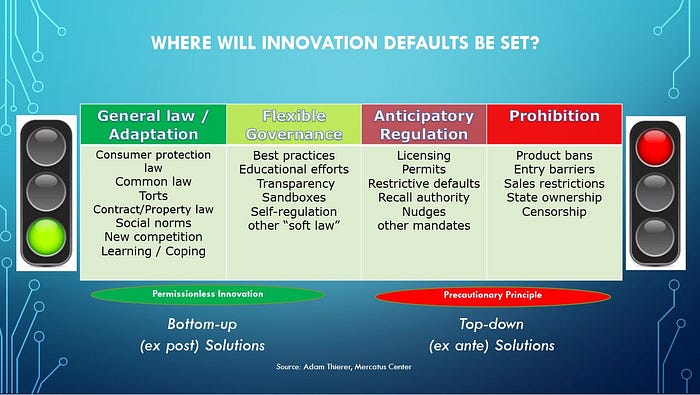
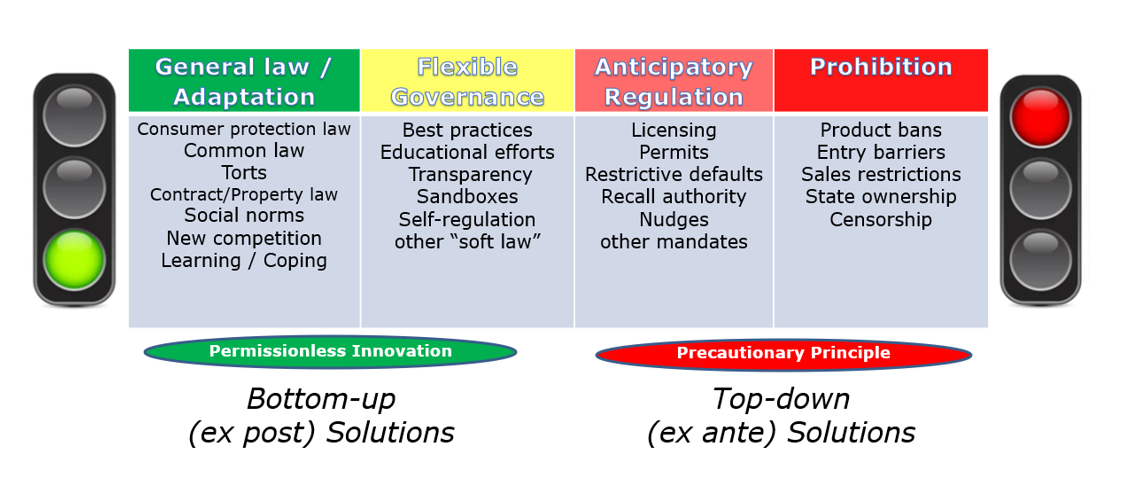
Debates about how to embed ethics and best practices into AI product design is where the question of public policy defaults becomes important. To the extent AI design becomes the subject of legal or regulatory decision-making, a choice must be made between two general approaches: the precautionary principle or the proactionary principle.[1] While there are many hybrid governance approaches in between these two poles, the crucial issue is whether the initial legal default for AI technologies will be set closer to the red light of the precautionary principle (i.e., permissioned innovation) or to the green light of the proactionary principle (i.e., (permissionless innovation). Each governance default will be discussed.

Continue reading →

I recently finished  Learning by Doing: The Real Connection between Innovation, Wages, and Wealth , by James Bessen of the Boston University Law School. It’s a good book to check out if you are worried about whether workers will be able to weather this latest wave of technological innovation.  One of the key insights of Bessen’s book is that, as with previous periods of turbulent technological change, today’s workers and businesses will obviously need find ways to adapt to rapidly-changing marketplace realities brought on by the Information Revolution, robotics, and automated systems.

That sort of adaptation takes time, but for technological revolutions to take hold and have meaningful impact on economic growth and worker conditions, it requires that large numbers of ordinary workers acquire new knowledge and skills, Bessen notes. But, “that is a slow and difficult process, and history suggests that it often requires social changes supported by accommodating institutions and culture.” (p 223) That is not a reason to resist disruptive forms of technological change, however. To the contrary, Bessen says, it is crucial to allow ongoing trial-and-error experimentation and innovation to continue precisely because it represents a learning process which helps people (and workers in particular) adapt to changing circumstances and acquire new skills to deal with them. That, in a nutshell, is “learning by doing.” As he elaborates elsewhere in the book:

Major new technologies become ‘revolutionary’ only after a long process of learning by doing and incremental improvement. Having the breakthrough idea is not enough. But learning through experience and experimentation is expensive and slow. Experimentation involves a search for productive techniques: testing and eliminating bad techniques in order to find good ones. This means that workers and equipment typically operate for extended periods at low levels of productivity using poor techniques and are able to eliminate those poor practices only when they find something better. (p. 50)

Luckily, however, history also suggests that, time and time again, that process has happened and the standard of living for workers and average citizens alike improved at the same time. Continue reading →